• Skip to primary navigation
  • Skip to main content
  • Skip to primary sidebar

Yellow Bricks

by Duncan Epping

  • Home
  • Unexplored Territory Podcast
  • HA Deepdive
  • ESXTOP
  • Stickers/Shirts
  • Privacy Policy
  • About
  • Show Search
Hide Search

networking

vCD – Networking part 2 – Network Pools

Duncan Epping · Sep 9, 2010 ·

In Part 1 of this series we described the different layers of networking. We already briefly spoke about Network Pools and that both a vApp Networks and Org Networks consume a segment out of a pool. In order to fully understand vCD (VMware vCloud Director) networking we will need to explain the foundation for all Cloud Internal traffic first which is the Network Pool.

Network Pools

As described in one of my earlier articles vCD mainly revolves around pooling of resources. This also goes for networking and more specifically for the Org Network and the vApp Network. Each vApp and Org Network will consume a network (segment) out of a defined pool. This network pool typically isolates network “segments” on layer 2 from the other networks in the pool. There are currently 3 types of network pools:

  1. VLAN Backed
  2. vCloud Network Isolation Backed (VCNI)
  3. Portgroup Backed

Each of these pools have specific requirements, recommendations and constraints and they will be listed below. However all of the three different types of pools are interchangeable; with that meaning a segment from a VLAN-Backed Pool and a Portgroup-Backed pool each offer the same functionality to your Org and vApp network and basically should be seen as a means of intra-Cloud transportation. Or to simplify it even further, it provides a wire. This wire enables VMs in a vApp to communicate to each other or vApps in an Org to communicate to each other. This also means, and that might sound very logical to some, the distributed vSwitch / Nexus / vSwitch needs physical uplinks in order to enable communication across multiple hosts in a cluster!

When is a segment of the network pool used? The answer is simple, whenever you create a vApp or Org Network which is not directly connected to the above layer a segment of your designated network pool will be used. Before you ask, the reason the network pool is not used in the case of a “directly” connected Org or vApp network is because the Org/vApp network is just a logical object in that case and the VM/vApp ends up directly in the portgroup the layer above. I will show you what that looks like in Part 3 of this series which will tie part 1 and 2 together including vShield Edge.

Now lets assume you created a VLAN-backed or a vCloud Network Isolation-backed pool. When an isolated or NAT routed vApp/Org network is created vCD will automatically instantiate a new network segment. This segment is essentially a portgroup on a distributed vSwitch. This portgroup will provide layer two isolation between the different segments. As a distributed vSwitch is used every host in your cluster will instantly have the same portgroups available. There is a very specific reason I only mentioned the VLAN Backed and the VCNI Backed pool, for the Portgroup Backed pool you will need to manually pre-create all portgroups and of course ensure all those portgroups are available on every host in the cluster.

To visualize it a bit more I took three screenshots. The first one shows the network pool. The pool is VLAN backed and holds VLAN 1000 through 1100 and these networks will be created on the distributed vSwitched labeled as “dvSwitch”:

Now that we have created a network pool we can create an isolated Org Network, in this case we create a fully isolated Org Network. This isolated org Network aka “Internal network” enables the vApps within your virtual datacenter to communicate to each other:
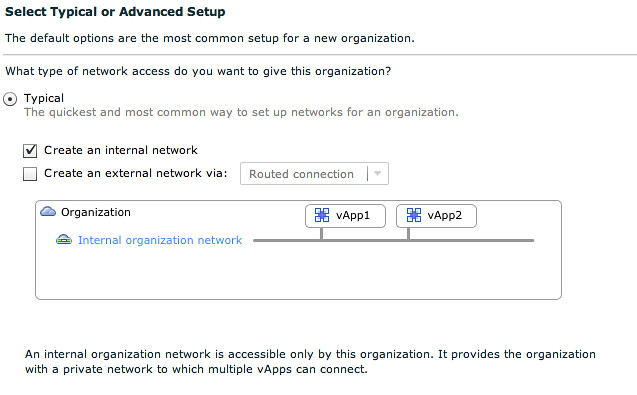
In order to be able to communicate we need a network segment. This network segment is provisioned from the Network Pool we created earlier, which was VLAN Backed.

After you fill out some of the other details and click “finish” a portgroup is automatically created within vSphere. Although difficult to read the portgroup name contains the Org Network and the VLAN ID. (VLAN 1008 and Org Network “YB-ISO-ORG”). You can even see the task at the bottom of the screenshot:

Hopefully that visualizes the process a bit more. I dropped some steps for the creation of the pool and the Org Network to keep it relatively simple. You can find a full detailed video here. Now as stated earlier each of the the three types of pools have very specific requirements and constraints I listed them below so you can make a decision based on the requirements or constraints you might have.

VLAN Backed

VLAN-backed network pools require availability of a set of unused VLANs. When an Org or vApp network is created which is based on a VLAN-backed network pool a portgroup is created on a dvSwitch and a VLAN is assigned to this portgroup. It should be noted that all VLANs specified for the pool will need to be trunked to the host and that in most environment the amount of available VLANs is limited.

  • Requirements: Distributed vSwitch, pool of available VLANs, Physical uplinks need to support VLAN Trunks.
  • Recommendations: n/a
  • Constraints: Nexus 1000v and regular vSwitches are not supported currently, amount of available VLANs in most environments.

vCloud Network Isolation Backed

vCloud Network Isolation-backed(VCNI) network pools are flexible, easy to configure and do not require VLANs. vCNI provides layer 2 isolation by utilizing a network overlay. This network overlay is provided by MAC in MAC encapsulation and requires a vDS. For each consumed network vCloud Director creates a portgroup and assigns this portgroup a network ID number. This network ID number is used for the encapsulation of the traffic. As explained vCD uses MAC in MAC for the encapsulation of traffic. However, because of that the use of VCNI requires an increase in the MTU of the underlying transport network(dvSwitch) to avoid frame fragmentation due to the minor overhead cause by the MAC in MAC encapsulation.

Now this is a very thin explanation, but I don’t want to go to deep into this as it would only complicate things.

  • Requirements: Distributed vSwitch
  • Recommendations: minimum of 1 VLAN, MTU Increase (24Bytes, 1500 –> 1524).
  • Constraints: Nexus 1000v and regular vSwitches are not supported currently.

Portgroup Backed

Portgroup-backed pools require pre-created portgroups within the vSphere environment. Portgroup-backed pools are in my opinion the least flexible of all three options. However, Portgroup-backed pools do not require vDS and can be based on vSS, vDS or Cisco Nexus 1000v which can be a specific customer or even platform requirement.

  • Requirements: All portgroups need to be pre-created and available on all hosts of your cluster
  • Recommendations: Use a scripted solution or host profiles to create the portgroups to ensure consistency
  • Constraints: n/a

Wrapping up

Hopefully this clarifies network pools a bit. As explained, when creating and Org of vApp network which is not directly connected to the layer above a network of your Network Pool will be used to provide intra-cloud communication. For those who haven’t used vCD at all, believe me it took me a while to grasp these concepts so don’t be shy and ask questions/comment if anything is unclear.
vCD – Networking part 1 – Intro

Duncan Epping · Sep 7, 2010 ·

After my introduction on vCD last week, I thought it was time to publish an article on Networking. Networking is most likely the most complex concept of vCD(VMware vCloud Director) and can at times be very confusing. I have created three articles which will explain the concepts of networking within vCD and of course will explain on a technical level how things work. (Including the vSphere layer)

If there are any questions don’t hesitate to leave a comment. Please note that I am deliberately trying to simplify things in this first article as I don’t want you to get lost in any of the layers of networking vCD offers.

Layered

Networking within vCD is built up out of 3 distinct layers.

  1. External Network
  2. Org Network
  3. vApp Network

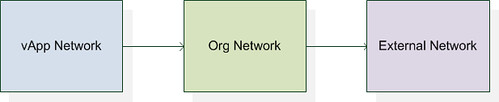
These three layers have been created to give the end-user the flexibility needed in a multi purpose virtual datacenter. I have depicted all three layers in the following diagram which shows the logical relationship between the layers:

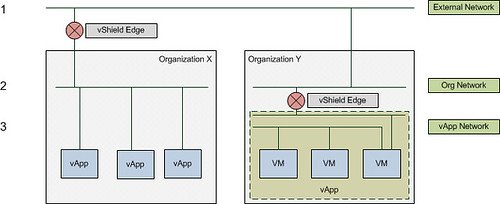
Some of you technical guys might say, that’s nice but I would like to see something less abstract. I created the following diagram which depicts the different layers in a different way. The diagram shows the three layers. I created a single External Network which links to two Org Networks. These Org Networks in its turn connect to multiple VMs(Org Y) and multiple vApps(Org X).

This is just an example however that illustrates possible network connections and as can clearly be seen it can be rather complex. As demonstrated there are multiple ways to connect vApps to each other or the outside world.

Now that we know some of the basics I will break down the three layers of networking. The  first before we will discuss any of the advanced options like vShield Edge or network pools

External Network

The External Network is used for inter-Cloud connections. Or as I like to call it “your connection to the outside world”. It is the first network “object” that you create within vCD. An External Network is always backed by a Portgroup, meaning that a portgroup needs to exist within vSphere before you can create this vCD network object. This portgroup can be on a regular vSwitch, a dvSwitch or you could use Nexus 1KV. It all works, and all of them are supported!

Of course it is heavily recommended to set this portgroup up with a VLAN for layer 2 isolation, again note that this is an outbound facing connection for your Org or for multiple Orgs.

Examples of External Networks are:

  • VPN to customer site
  • Internet connection

As said, an external network can be shared between organizations but is typically created per organization and is your connection from or to your virtual datacenter.

I would to stress that, the external network is your exit from your virtual datacenter or your entrance!

Org Network

The second object that is created is the Org Network. The Org Network is used for intra-Cloud connections. Or as I like to call it “Cloud internal traffic”.  An Org Network is linked to an organization and can be:

  • Directly connected to an External Network
  • NAT/Routed connected to an External Network
  • Completely Isolated

With that meaning that although an Org Network is primarily intended for internal traffic, it can be linked to an External Network to create an entry to or exit from your virtual datacenter. Note that it doesn’t necessarily need to be connected to an External Network, it could be completed isolated and used for “Cloud internal traffic” only! A use case for this would be for instance a test/dev environment where vApps will need to communicate with each other but not with the tenants back-end.

It should also be noted that the Org Network is mandatory! Every organization needs an Org Network, it is the only mandatory network object.

Just for completeness, an Org Network consumes a segment from a Network Pool when it is NAT/Routed or Isolated. A network pool is a collection of L2 networks which will be automatically consumed by vCD when needed, and what I call a segment is one of those L2 networks… basically a portgroup. I will explain Network Pools more in-depth in part 2.

When an Org Network is directly connected it is just a logical entity and physically doesn’t exist. Again in one of the following articles(part 3) I will explain what that looks like in vCenter.

vApp Network

The vApp Network kind of resembles the Org Network as it also consumes a segment from a Network Pool. The vApp Network enables you to have a vApp internal network, this could be useful for isolating specific VMs of a vApp. The vApp Network can be:

  • Directly connected to an Org Network
  • NAT/Routed to an Org Network
  • Completely Isolated

It should be noted that the “directly connected” option for both the Org Network and the vApp Network is just a logical connection. In the back-end it will be directly connected to the layer above.

As shown in an earlier diagram and explained above a vApp can contain multiple networks. This can be used to isolate specific VMs from the outside world. An example is shown in the following diagram where only the Web Server has a connection to the Org Network and the App and Database servers are isolated but do connect to the Web server.

Summary

vCD has three different layers of networking. Each of these layers has a specific purpose. The External Network is your connection to the outside world, the Org Network is linked to a specific Organization and the vApp network only resides within a vApp.

That is it for Part 1. Part 2 will focus on the Network Pools and Part 3 will focus on what these vApp, Org and External Networks look like on a vSphere layer and some general best practices.

My tip of the day, if you want to get to know vCD really well, check vCenter every time you make a change and see what happens!

UPDATE: for a full schematic overview check Hany’s awesome diagram.

Standby NICs in an “IP-Hash” configuration

Duncan Epping · Aug 6, 2010 ·

I was reviewing a document today and noticed something that I’ve seen a couple of times already. I already wrote about Active/Standby set ups for etherchannels a year ago but this is a slight different variant. Frank also wrote a more extensive article on it a while and I just want to re-stress this.

Scenario:

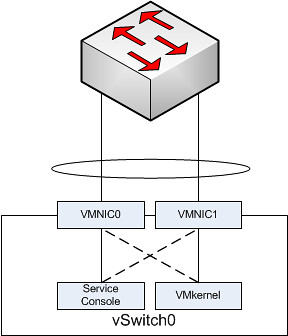
  • Two NICs
  • 1 Etherchannel of 2 links
  • Both Management and VMkernel traffic on the same switch

I created a simple diagram to depict this:

nics

In the above scenario each “portgroup” is configured in an active/standby scenario. So let’s take the Service Console. It has VMNIC0 as active and VMNIC1 as standby. The physical switch however is configured with both NICs active in a single channel.

Based on the algorithm that etherchannels use either of the two VMNICs will accept inbound traffic. The Service Console however will only send traffic outbound via VMNIC0. Even worse, the Service Console isn’t actively listening to VMNIC1 for incoming traffic as it was placed in Standby mode. Standby mode means that it will only be used when VMNIC0 fails. In other words your physical switch will think it can use VMNIC1 for you Service Console but your Service Console will not see the traffic coming in on VMNIC1 as it is configured in Standby mode on the vSwitch. Or to quote from Frank’s article…

it will sit in a corner, lonely and depressed, wondering why nobody calls it anymore.

High physical switch CPU load?

Duncan Epping · Aug 4, 2010 ·

One of my customers experienced high CPU load on their physical switch. After some investigation they noticed broadcasts packets being sent every two seconds. The first reaction was Beacon Probing is probably enabled.

Unfortunately this wasn’t the case. But VMware GSS came to the rescue and pointed us towards a KB article. Apparently a bug has been identified in 4.0 which causes this behaviour:

src: http://kb.vmware.com/kb/1024435

Problem:

  • ESX sends Beacon Packets when vDS/vSwitch are connected to more than one uplink.
  • ESX server sends periodic broadcast of Beacon Packets even if the vSwitch/vNetwork Distributed Switch (vDS) is not configured to use Beacon Probing for Network Failover Detection.
  • These packets have the virtual MAC of the vmnic in the Source MAC Address field.

Workaround:

#esxcfg-advcfg -s 0 /Net/MaxBeaconsAtOnce

The customer implemented this workaround and the problem is gone… From what I have been told this issue does not exist in ESX(i) 4.1 so if you are experiencing it, an upgrade might be a better solution. In this case due to the size of the environment that was not an option.

Changing your dvPortgroup settings? (need your input!)

Duncan Epping · Aug 2, 2010 ·

I am just wondering if I am the only one who doesn’t understand this. I had a discussion with our vDS team around changing the dvPortgroup settings. This can only been done after the dvPortgroup has been created. On top of that it gets created with standard values of which some don’t really follow my general best practices. (For instance Forged Transmits is set to Accept by default instead of Reject.)

With a regular vSwitch you could just set all your preferences on the vSwitch. The Portgroups that you would create would inherit the properties of the vSwitch. Of course when needed you could always override these properties on a per Portgroup level. However with a dvSwitch this isn’t possible as you cannot set these properties on the dvSwitch level. A dvPortgroup however is created with default settings which you can’t change during the creation.

Apparently this decision has been made after many customer complained about the complexity of the vSwitch / Portgroup inheritance concept. I have never found this a problem, or even complex to be honest and I was wondering what you think about this?

Do you prefer the current method or would you for instance like to have the option to change the defaults? I think having a “default dvPortgroup template” would be a nice enhancement. Please leave a comment and I will, if needed, contact our Product Manager to discuss this and will do my best to get it on the roadmap.

  • « Go to Previous Page
  • Page 1
  • Interim pages omitted …
  • Page 3
  • Page 4
  • Page 5
  • Page 6
  • Page 7
  • Interim pages omitted …
  • Page 9
  • Go to Next Page »

Primary Sidebar

About the Author

Duncan Epping is a Chief Technologist and Distinguished Engineering Architect at Broadcom. Besides writing on Yellow-Bricks, Duncan is the co-author of the vSAN Deep Dive and the vSphere Clustering Deep Dive book series. Duncan is also the host of the Unexplored Territory Podcast.

Follow Us

  • X
  • Spotify
  • RSS Feed
  • LinkedIn

Recommended Book(s)

Also visit!

For the Dutch-speaking audience, make sure to visit RunNerd.nl to follow my running adventure, read shoe/gear/race reviews, and more!

Do you like Hardcore-Punk music? Follow my Spotify Playlist!

Do you like 80s music? I got you covered!

Copyright Yellow-Bricks.com © 2026 · Log in