• Skip to primary navigation
  • Skip to main content
  • Skip to primary sidebar

Yellow Bricks

by Duncan Epping

  • Home
  • Unexplored Territory Podcast
  • HA Deepdive
  • ESXTOP
  • Stickers/Shirts
  • Privacy Policy
  • About
  • Show Search
Hide Search

BC-DR

VMware View Infrastructure Resiliency whitepaper published

Duncan Epping · Feb 24, 2013 ·

One of the white papers I worked on in 2012 when I was part of Technical Marketing was just published. This white paper is about VMware View infrastructure resiliency. It is a common question from customers, and now with this white paper you can explore the different options and understand the impact of these options. Below is a link to the paper and the description is has on the VMware website.

VMware View Infrastructure Resiliency: VMware View 5 and VMware vCenter Site Recovery Manager
“This case study provides insight and information on how to increase availability and recoverability of a VMware View infrastructure using VMware vCenter Site Recovery Manager (SRM), common disaster recovery (DR) tools and methodologies, and vSphere High Availability.”

I want to thank Simon Richardson, Kris Boyd, Matt Coppinger and John Dodge for working with me on this paper. Glad it is finally available!
vSphere HA 5.x restart attempt timing

Duncan Epping · Feb 18, 2013 ·

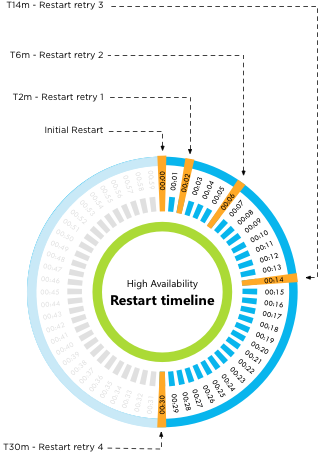
I wrote about how vSphere HA 5.x restart attempt timing works a long time ago but there appears still to be some confusion about this. I figured I would clarify this a bit more, I don’t think I can make it more simple than this:

  • Initial restart attempt
  • If the initial attempt failed, a restart will be retried after 2 minutes of the previous attempt
  • If the previous attempt failed, a restart will be retried after 4 minutes of the previous attempt
  • If the previous attempt failed, a restart will be retried after 8 minutes of the previous attempt
  • If the previous attempt failed, a restart will be retried after 16 minutes of the previous attempt

After the fifth failed attempt the cycle ends. Well that is, unless a new master host is selected (for whatever reason) between the first and the fifth attempt. In that case, we start counting again. Meaning that if a new master is selected after attempt 3, the new master will start with the “initial restart attempt.

Or as Frank Denneman would say:

vSphere HA 5.x restart attempt timing


** Disclaimer: This article contains references to the words master and/or slave. I recognize these as exclusionary words. The words are used in this article for consistency because it’s currently the words that appear in the software, in the UI, and in the log files. When the software is updated to remove the words, this article will be updated to be in alignment. **

SRM vs Stretched Cluster solution /cc @sakacc

Duncan Epping · Feb 11, 2013 ·

I was reading this article by Chad Sakac on vSphere DR / HA, or in other words SRM versus Stretched (vMSC) solutions. I have presented on vSphere Metro Storage Cluster solutions at VMworld together with Lee Dilworth and also wrote a white paper on this topic a while back and various blog posts since. I agree with Chad that there are too many people misinformed about the benefits of both solutions. I have been on calls with customers where indeed people were saying SRM is a legacy solution and the next big thing is “Active / Active”. Funny thing is that in a way I agree when they say SRM has been around for a long time and the world is slowly changing, I do not agree with the term “legacy” though.

I guess it depends on how you look at it, yes SRM has been around for a long time but it also is a proven solution that does what it says it does. It is an orchestration solution for Disaster Recovery solutions. Think about a disaster recovery scenario for a second and then read those two last sentences again. When you are planning for DR, isn’t it nice to use a solution that does what it says it does. Although I am a big believer in “active / active” solutions, there is a time and place for it; in many of the discussions I have been a stretched cluster solution was just not what people were looking for. On top of that Stretched Cluster solutions aren’t always easy to operate. That is I guess what Chad was also referring to in his post. Don’t get me wrong, a stretched cluster is a perfectly viable solution when your organization is mature enough and you are looking for a disaster avoidance and workload mobility solution.

If you are at the point of making a decision around SRM vs Stretched Cluster make sure to think about your requirements / goals first. Hopefully all of you have read this excellent white paper by Ken Werneburg. Ken describes the pros and cons of each of these solutions perfectly, read it carefully and then make your decision based on your business requirement.

So just in short to recap for those who are interested but don’t have time to read the full paper, make time though… really do!

Where does SRM shine:

  • Disaster Recovery
  • Orchestration
  • Testing
  • Reporting
  • Disaster Avoidance (will incur downtime when VMs failover to other site)

Where does a Stretched Cluster solution shine:

  • Workload mobility
  • Cross-site automated load balancing
  • Enhanced downtime avoidance
  • Disaster Avoidance (VMs can be vMotioned, no downtime incurred!)


Converged compute and storage solutions

Duncan Epping · Jan 28, 2013 ·

Lately I have been looking more and more in to converged compute and storage solutions, or “datacenter in a box” solutions as some like to call them. I am a big believer of this concept as some of you may have noticed. Those who have never heard of these solutions, an example of this would be Nutanix or Simplivity. I have written about both Nutanix and Simplivity in the past, and for a quick primer on those respective solutions I suggest to read those articles. In short, these solutions run a hypervisor with a software based storage solution that creates a shared storage platform from local disks. In others, no SAN/NAS required, or as stated… a full datacenter experience in just a couple of U’s.

One thing that stood out to me though in the last 6 months is that for instance Nutanix is often tied to VDI/View solutions, in a way I can understand why as it has been part of their core message / go-to-market strategy for a long time. In my opinion though there is no limit to where these solutions can grow and go. Managing storage, or better said your full virtualization infrastructure, should be as simple as creating or editing a virtual machine. One of the core principles mentioned during the vCloud Distributed Storage talk at VMworld, by the way vCloud Distributed Storage is a VMware software defined storage initiative.

Hopefully people are starting to realize that these so-called Software Defined Storage solutions will fit in most, if not all, scenarios out there today. I’ve been having several discussions with people about these solutions and wanted to give some examples of how it could fit in to your strategy.

Just a week ago I was having a discussion with a customer around disaster recovery. They wanted to add a secondary site and replicate their virtual machines to that site. The cost associated with a second storage array was holding them back. After an introduction to converged storage and compute solutions they realized they could step in to the world of disaster recovery slowly. They realized that these solutions allowed them to protect their Tier-1 applications and expand their DR protected estate when required. By using a converged storage and compute solutions they can avoid the high upfront cost and it allows them to scale out when needed (or when they are ready).

One of the service providers I talk to on a regular basis is planning on creating a new cloud service. Their current environment is reaching its limits and predicting how this new environment will grow in the upcoming 12 months is difficult due to the agile and dynamic nature of this service they are developing. The great thing though about a converged storage and compute solution is that they can scale out whenever needed, without a lot of hassle. Typically the only requirement is the availability of 10Gbps ports in your network. For the provider though the biggest benefit is probably that services are defined by software. They can up-level or expand their offerings when they please or when there is a demand.

These are just two simple examples of how a converged infrastructure solution could fit in to your software defined datacenter strategy. The mentioned vendors Nutanix and Simplivity are also just two examples out of various companies offering these. I know of multiple start-ups who are working on a similar products and of course there are the likes of Pivot3 who already offer turnkey converged solutions. As stated earlier, personally I am a big believer in these architectures and if you are looking to renew your datacenter or at the verge of a green-field deployment… I highly recommend researching these solutions.

Go Software Defined – Go Converged!

Stretched vCloud Director infrastructure

Duncan Epping · Jan 15, 2013 ·

A while back I wrote about design considerations when designing or building a stretched vCloud Director infrastructure. Since then I have been working on a document in collaboration with Lee Dilworth, and this document should be out soon hopefully. As various people have asked for the document I decided to throw it in to this blog post so that the details are already out there.

** Disclaimer: this article has not been reviewed by the technical marketing team yet, this is a preview of what will possibly be published. When the official document is published I will add a link to this article **

Introduction

VMware vCloud® Director™ 5.1 (vCloud Director) gives enterprise organizations the ability to build secure private clouds that dramatically increase datacenter efficiency and business agility. Coupled with VMware vSphere® (vSphere), vCloud Director delivers cloud computing for existing datacenters by pooling vSphere virtual resources and delivering them to users as catalog-based services. vCloud Director helps you build agile infrastructure-as-a-service (IaaS) cloud environments that greatly accelerate the time-to-market for applications and responsiveness of IT organizations.

Resiliency is a key aspect of any infrastructure but is even more important in “Infrastructure as a Service” (IaaS) solutions. This solution overview was developed to provide additional insight and information in how to architect and implement a vCloud Director based solution on a vSphere Metro Storage Cluster infrastructure.

Architecture Introduction

This architecture consists of two major components. The first component is the geographically separated vSphere infrastructure based on stretched storage solution, here after referred to as the vSphere Metro Storage Cluster (vMSC) infrastructure. The second component is vCloud Director.

Note –  Before we dive in to the details of the solution we would like to call out the fact that vCloud Director is not site aware. If incorrectly configured availability could be negatively impacted in certain failure scenarios.

[Read more…] about Stretched vCloud Director infrastructure

  • « Go to Previous Page
  • Page 1
  • Interim pages omitted …
  • Page 26
  • Page 27
  • Page 28
  • Page 29
  • Page 30
  • Interim pages omitted …
  • Page 63
  • Go to Next Page »

Primary Sidebar

About the Author

Duncan Epping is a Chief Technologist and Distinguished Engineering Architect at Broadcom. Besides writing on Yellow-Bricks, Duncan is the co-author of the vSAN Deep Dive and the vSphere Clustering Deep Dive book series. Duncan is also the host of the Unexplored Territory Podcast.

Follow Us

  • X
  • Spotify
  • RSS Feed
  • LinkedIn

Recommended Book(s)

Also visit!

For the Dutch-speaking audience, make sure to visit RunNerd.nl to follow my running adventure, read shoe/gear/race reviews, and more!

Do you like Hardcore-Punk music? Follow my Spotify Playlist!

Do you like 80s music? I got you covered!

Copyright Yellow-Bricks.com © 2026 · Log in