• Skip to primary navigation
  • Skip to main content
  • Skip to primary sidebar

Yellow Bricks

by Duncan Epping

  • Home
  • Unexplored Territory Podcast
  • HA Deepdive
  • ESXTOP
  • Stickers/Shirts
  • Privacy Policy
  • About
  • Show Search
Hide Search

Software Defined

HCI3041BU: Introducing Scalable File Storage on vSAN

Duncan Epping · Sep 6, 2018 ·

Another beta announcement last week for vSAN was around Native File Services. This was the topic of HCI3041BU, which was titled “Introducing Scalable File Storage on vSAN with Native File Services”. The full session can be found here, the summary is below for your convenience. The session was by Venkat Kolli (Product Manager) and engineers Rick Spillane and Wenguang Wang.

Venkat kicks of the session describing the different types of storage most of our customers have in their data center today, and also what kind of data lands on the different types of storage. Basically, it is divided into three main types: Block, File, and Object. Where I personally believe that “object” is at the point of becoming more common on-premises but for many is consumed as a cloud service. Looking at where the data growth is today, it is mainly in the “unstructured data” space.

Next Venkat discusses the management complexity of traditional file storage, not just management complexity but also scaling and forecasting. Which in most cases leads to increased cost. How can vSAN help with simplifying File Services and lowering cost by providing a framework which allows you to serve block, file and object. For now, we are discussing file-services however, but the vision is clear.
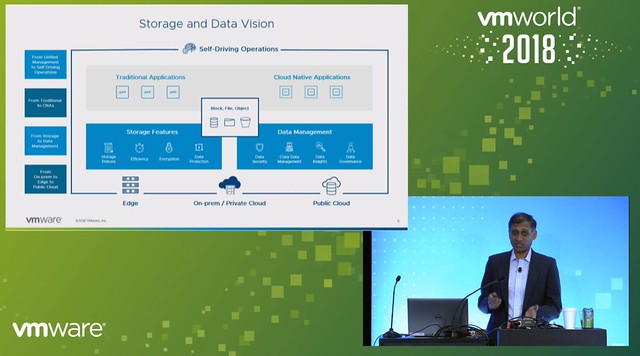
Rick is up next introducing File Services. vSAN File Services allows you to create file shares and provide file services to users/consumers through the same familiar interface you have available today in vSphere. On top of that, you get to leverage the power of policy-based management to provision file shares in a specific way. Which means that File Shares will work in stretched clusters, can be protected with vSAN Data Protection, can be striped/replicated etc. Most important piece of feedback during the design phase from customers was that they did not want a separate storage cluster to manage for file services, this needed to be an integral part of today’s offering.

The requirements and design principles for the vSAN Distributed File System were:

  • Elastic Scaling
    • Scale IOPs up/down
  • Single namespace across the cluster
  • Centrally managed, configured and monitored
  • Transparent failover
  • POSIX File Interface
  • Use vSAN services like data path, consensus mechanisms, and checksumming

Rick next explains a new platform that will (potentially) be included in vSAN, this is called the Storage Services Platform. What this provides is stateless containerized frontend servers which sit on top of the vSAN Distributed File System. This will be available for both VMware and partners, so even partners should be able to provide storage services through this platform. Data will sit in the VDFS volumes and then will be exposed through these services. These services, of course, are fully distributed and self-managing.
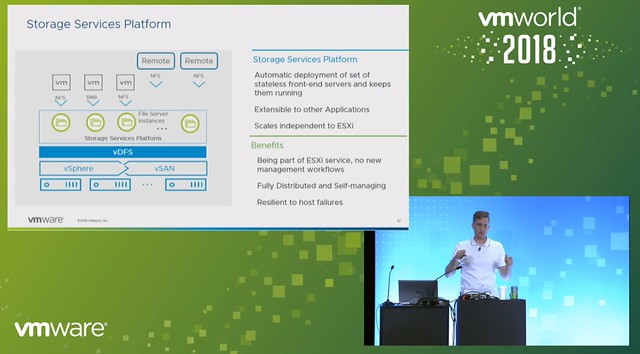
The Storage Services Platform is implemented in the form of a storage services control plane. This control plane will for instance monitor all front-end servers and node and help in the case of failures, but also will help to ensure availability during maintenance and upgrade. Also, when it comes to scalability the control plane monitors the instances and allows to scale up and down when needed.

Okay, that sounds great, but how do file shares get formed? File shares will be an aggregate of one or multiple vSAN Objects. The great thing about this is that it allows for elasticity in size and performance, plus policies can be associated with these objects. You can now simply create file shares through the UI, or leverage the API. The vSAN team made sure that you can access it and define them the way you prefer. On top of that, this platform will also be available to Kubernetes as part of our Cloud Native Storage Control Plane.

Next Rick briefly discussed data protection for file shares, he mentioned that the team has worked with various 3rd party vendors to allow for full backup and recovery, including file-level restore. What Rick also revealed, surprisingly enough, is that in the initial release we will have:

  • NFS v4.1 support
  • AD-based Authentication
  • Kerberos
  • Containerized application support

And in the release after that support for the following is planned:

  • SMB
  • vSAN DP Integration
  • OpenLDAP support

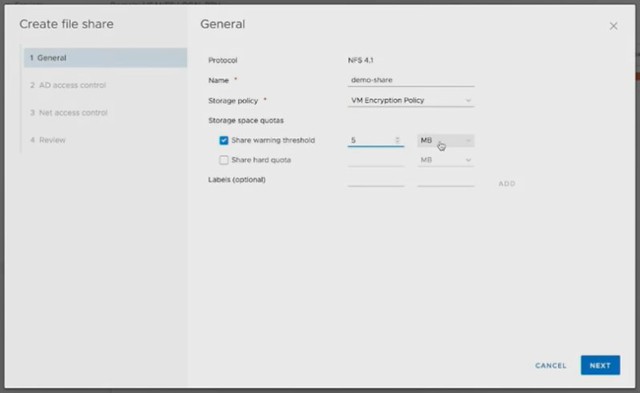
Next Wenguang came up on stage, and he demoed vSAN File Services. He showed how simple it is to enable File Services in the UI. Literally, a couple of steps, provide the networking details and also authentication mechanism. The next step will be to download an OVF, this contains the frontend service we spoke about earlier, for now, this is an NFS server, but this could be other services in the future. After the File Services have been enabled and the OVF is deployed you can start creating file shares. Again this is very straightforward, part of the familiar vSAN UI / HTML-5 interface, which is what I like most, if you know vSAN and/or vSphere you will be able to use vSAN File Services as well. I hope potential other services will be implemented in a similar easy manner.

The Q&A was interesting as well, as some questions around the potential SMB implementation were answered (SAMBA on Linux vs Microsoft vs Dell/EMC stack?) and for instance what block size is used for the file system (4K, like vSAN).

All in all a very exciting solution, and a great overview of what you can expect in the future for vSAN. Note that this is part of the beta, so if you are interested sign up!
HCI2476BU – Tech Preview RDMA and next-gen storage tech for vSAN

Duncan Epping · Sep 5, 2018 ·

This session I had high on my list to go and watch live. Unfortunately, I was double booked during the show, hence I had to watch “HCI2476BU – Tech Preview RDMA and next-gen storage tech for vSAN” online as well. This session was by my colleagues Biswa and Srinath (PM/Engineering) and discusses how we can potentially use RDMA and next-gen storage technology for vSAN.

I am not going to cover the intro, as all readers by now are well aware of what vSAN is and does. What I think was interesting was the quick overview of the different types of ready nodes we have available. Recently included is the Cisco E-Series which is intended for Edge Computing scenarios. Another interesting comment was around some of the trends in the market around CPU, it seems that “beefy” single-socket servers are gaining traction. Not entirely surprising considering it lowers the licensing considerably and you can go up to 64 cores per CPU with AMD EPYC. Next up is the storage aspect of things, what can we expect in the upcoming years?

Biswa mentions that there’s a clear move towards the adoption of NVMe, moving away from SAS/SATA. It is expected that the NVMe devices will be able to deliver 500k+ of IOPS in the next 2 years. Just think about that. 500k IOPS from a single device. Biswa also briefly touched on DDR4 based Persistent Memory, where we can expect million(s) of IOPS with nanoseconds of latency. Next various types of devices are discussed and the performance and endurance capabilities. Even if you consider what is available today, it is a huge contrast compared to 1-2 years ago. Of course, all of this will come at a cost. From a networking perspective 10G/25G/40G is mainstream now or becoming, and RDM enabled (RoCE) NIC is becoming standardized as well. 100G will become the new standard, but this will take 3-5 years at a minimum.

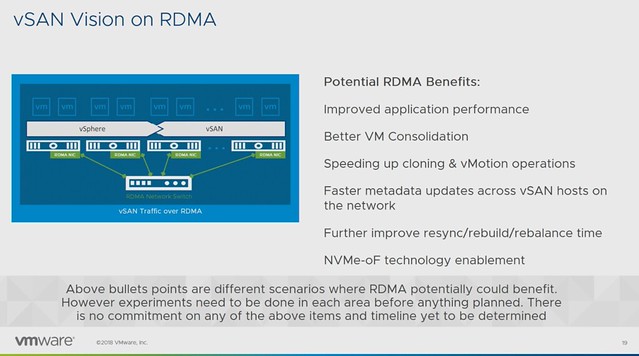
Before the RDMA section started a quick intro to RDMA was provided: “Remote direct memory access from one computer into that of another without involving either one’s operating system allows for high throughput and low latency, which is especially useful in massive parallel computer clusters”. The expected potential / benefits for vSAN is:

  • Improved application performance
  • Better VM Consolidation
  • Speeds up cloning & vMotion
  • Faster metadata updates
  • Faster resync/rebuild times
  • NVMe-oF technology enablement

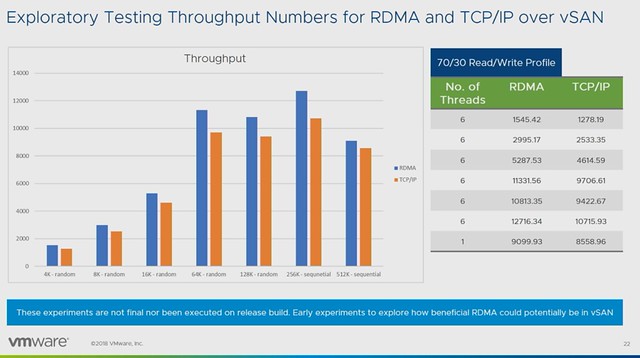
Early performance tests show a clear performance benefit for using RDMA. Throughput and IOPS are clearly higher, while latency is consistency lower when comparing RDMA to TCP/IP. Note that vSAN has not been optimized in these particular cases yet and this is just one example of a particular workload on a very specific configuration. (Tests were conducted with Mellanox.)

But what about that “next-gen storage”? How can we use this to increase IOPS/throughput while lowering not only latency but also HCI “overhead” like CPU and Memory consumption? Also, what does it mean for the vSAN architecture, what do we need to do to enable this? Faster networks, faster devices may mean that changes are required to various modules/processes. (Like DOM, LSOM, CLOM etc.)

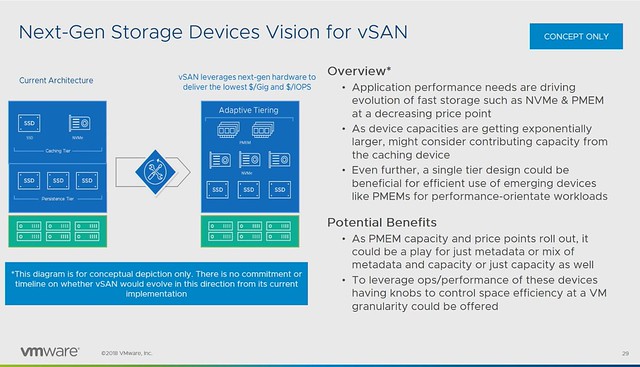
Persistent Memory is definitly one of those next-gen storage devices which will require us to rethink the architecture. Simply because of the ultra low latency, the lower the latency the higher the overhead of the storage stack appears to be. Especially when we are reaching access times which are close to memory speeds. Can we use these devices in an “adaptive tiering” architecture where we use PMEM, NVMe and SSDs? Where for instance PMEM is used for metadata, or even metadata and capacity for hot blocks?

Last but not least a concept demo was shown around NVMe-oF for vSAN. Meaning that NVMe over Fabric allows you to present (additional) capacity to ESXi/vSAN hosts. These devices would be “JBOF”, aka “just a bunch of flash” connected over RDMA / NVMe-oF. In other words, these hosts had no direct locally attached storage, but instead these NVMe devices are presented as “local devices” across the fabric. Which, potentially, allows you to present a lot of storage to hosts which have no local storage capabilities even(Blades anyone?). Also, I wonder if this would allow us in the future to have similar benefits of fabric connected devices as for instance VMware Cloud on AWS has. Meaning that devices can be connected to other hosts after a failure, so that a resync/rebuild can be avoided? Food for thought definitely.

Make sure to watch “HCI2476BU – Tech Preview RDMA and next-gen storage tech for vSAN” online if you want to know more, as it doesn’t appear to be scheduled for VMworld Europe!

HCI2164BU – HCI Management, current and futures

Duncan Epping · Sep 5, 2018 ·

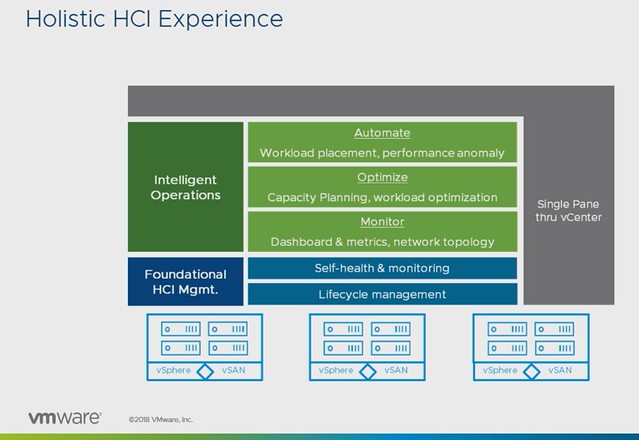
This session by Christian Dickmann and Junchi Zhang is usually one of my favorites in the HCI track, mainly because they show a lot of demos and in many cases show you what ends up being part of the product in 6-12 months. The session revolved all around management, or as they called it in the session “providing a holistic HCI experience”.

After a short intro Christian showed a demo around what we currently have around the installation of the vCenter Server Appliance and how we can deploy that to a vSAN Datastore, followed by the Quickstart functionality. I posted a demo of Quickstart earlier this week, let me post it here as well so you have an idea of what it is/does.

In the next demo, Christian showed how you can upgrade the firmware of a disk controller using Update Manager. Pretty cool, but afaik still limited to a single disk controller, hopefully, more will follow soon. But more importantly, after that demo ended he started talking about “Guided SDDC Update & Patching”, and this is where it got extremely interesting. We all know that it isn’t easy to upgrade a full stack, and what Christian was describing would be doing exactly that. Do you have Horizon? Sure, we will upgrade that as well when we do vCenter / ESXi / vSAN etc. Do you have NSX as part of your infra? Sure, that is also something we will take into account and upgrade it when required. This would also include firmware upgrades for NICs, disk controllers etc.

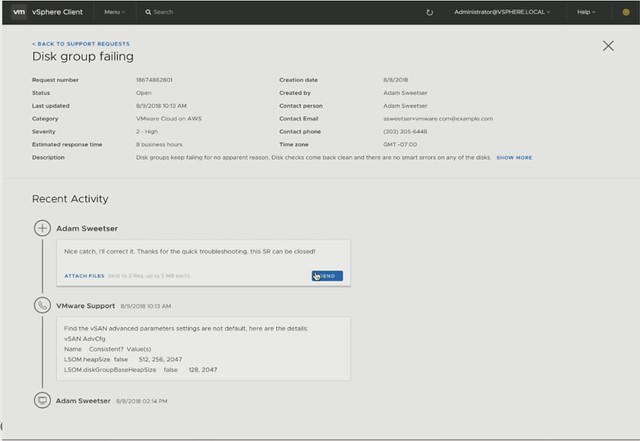
Next Christian showed the Support Insight feature, which is enabled through the Customer Experience Improvement Program. His demo then showed how to create a support request right from the H5 Client. The process shows that the solution understands the situation and files the ticket. Then it shows what the support team sees. It allows the support team to quickly analyze the environment, and more importantly inform the customer about the solution. No need to upload log bundles or anything like that, that all happens automatically. That’s not where it stop, you will be informed in the H5 client about the solution as well. Cool right?

Next Junchi was up and he discussed Capacity Management first. As he mentioned it appears to be difficult for people to understand the capacity graphs provided by vSAN. Junchi proposes a new model where it is clear instantly what the usable space is and by what current capacity is being consumed. Not just on a cluster level, but also at a VM level. This should also include what-if scenarios for usage projection. Junchi then quickly demoed the tools available that help with sizing and scaling.

Next Native File Services was briefly discussed, Data Protection and Cloud Native Storage. What does the management of these services look like? The file services demo that Junchi showed was really slick. Fill out IP details and Domain details and have File Services running in a minute or two natively on vSAN. Only thing you would need to do is create file shares and give folks access to the file shares. Also, monitoring will go through the familiar screens like the health check etc.

Last but not least Junchi discusses the integration with vRealize Automation on-premises and SaaS-based, a very cool demo showing how Cloud Assembly (but also vRA) will be able to leverage storage policies and new applications are provided using blueprints which have these policies associated with them.

That was it, if you like to know more, watch the session online, or attend it in EMEA!

HCI1603BU – Tech Preview of Native vSAN Data Protection

Duncan Epping · Sep 4, 2018 ·

The second session I watched was HCI1603BU Tech Preview of Native vSAN Data Protection by Michael Ng. I already discussed vSAN Data Protection last year, but considering the vSAN Beta is coming up soon that includes this functionality I felt it was worth covering again. Note that the beta will be a private beta, so if you are interested please sign up, you may be one of the customers getting selected for the beta.

Michael started out with an explanation about what an SSDC brings to customers, and how a digital foundation is crucial for any organization that wants to be competitive in the market. vSAN, of course, is a big part of the digital foundation, and for almost every customer data protection and data recovery is crucial. Michael went over the various vSAN use cases and also the availability and recoverability mechanisms before introducing Native vSAN Data Protection.
Now it is time for the vSAN Native Data Protection introduction. Michael first explains that we will potentially have a solution in the future where we can simply create snapshots locally through specifying the number of local snapshots you want in policy. On top of that, in the future, we will potentially provide the option to specify the snapshots (plus a full copy) will need to be offloaded to secondary storage. Secondary storage could be NFS, S3 Object Storage (both on-premises and in the cloud). Also, it should be possible to replicate VMs and snapshots to a DR location through policies.

What I think is very compelling is the fact that the native protection comes as part of vSAN/vSphere, there’s no need to install an appliance or additional software. vSAN Data Protection will be baked into the platform. Easy to enable and easy to consume through policy. The first focus is vSAN Local Data Protection.

vSAN Local Data Protection will provide Crash and Application-consistent snapshots at an RPO of 5 minutes and with a low RTO. On top of that, it will be possible to instant clone the snapshot. Meaning that you can restore the snapshot as an “instant clone”, this could be interesting when you want to test a certain patch or upgrade for instance. You can even specify during the recovery that the NIC doesn’t need to be connected. Application consistency is achieved by leveraging VSS providers on Windows and on Linux the VMware Tools pre- and post-scripts are being used.

What enables vSAN Data Protection is a new snapshotting technology. This new technology provides a lot better performance than traditional vSphere (or vSAN) snapshots. It also provides for better scale, meaning that you can go way above the 32 limit we currently have.

Next Michael demoed vSAN Data Protection, which is something I have done on various occasions if you are interested in what it looks like just watch the session. If I have time I may record a demo myself just so it is easier to share with you.

What I personally hadn’t seen yet were the additional performance views added. Very useful as it allows you to quickly check what the impact is of snapshots on general performance. Is there an impact? Do I need to change my policy?

Last but not least various questions were asked, most interesting parts was the following:

  • “file level restore” is on the roadmap but the first feature they will tackle is offloading to secondary storage.
  • “consistency groups” is something that is being planned for, especially useful when you have applications or services spanning VMs.
  • Integration with vRealize Automation, some of it is planned for the first release, everything is SPBM based which already have APIs. Being planned for is “self-service restore”
  • 100 snapshots per VM is tested for the first release

Good session, worth watching!

VMworld – VMware vSAN Announcements: vSAN 6.7 U1 and beta announced!

Duncan Epping · Aug 27, 2018 ·

VMworld is the time for announcements, and of course for vSAN that is no different. This year we have 3 major announcements and they are the following:

  • VMware vSAN 6.7 U1
  • VMware vSAN Beta
  • VMware Cloud on AWS new features

So let’s look at each of these, first of all, VMware vSAN 6.7 U1. We are adding a bunch of new features, which I am sure you will appreciate. The first one is various VUM Updates, of which I feel the inclusion of Firmware Updates through VUM is the most significant one. For now, this is for the Dell HBA330 only, but soon other controllers will follow. On top of that there now also is support for custom ISO’s. VUM will recognize the vendor type and validate compliance and update accordingly when/if needed.

The other big thing we are adding os the “Cluster Quickstart wizard“. I have shown this at various sessions already, so some of you may be familiar with it. It basically is a single wizard that allows you to select the required services, add the hosts and configure the cluster. This includes the configuration of HA, DRS, vSAN and the network components needed to leverage these services. I recorded a quick demo that actually shows you what this looks like

One of the major features in my opinion that is introduced is UNMAP. Yes, unmap for vSAN. So as of 6.7 U1 we are now capable of unmapping blocks when the Guest OS sends an unmap/trim command. This is great as it will greatly enhance/improve space efficiency. Especially in environments where for instance large files or many files are deleted. You need to enable it, for now, through “rvc”. And you can do this as follows:

/localhost/VSAN-DC/computers/6.7 u1> vsan.unmap_support -e .

When you run the above command you should see the below response.

Unmap support is already disabled
6.7 u1: success
VMs need to be power cycled to apply the unmap setting
/localhost/VSAN-DC/computers/6.7 u1>

Pretty simple right? Does it really require the VM to be power cycled? Yes, it does, as during the power-on the Guest OS actually queries for the unmap capability, there’s no way for VMware to force that query without power cycling the VM unfortunately. So power it off, and power it on if you want to take advantage of unmap immediately.

There are a couple smaller enhancements that I wanted to sum up for those who have been waiting for it:

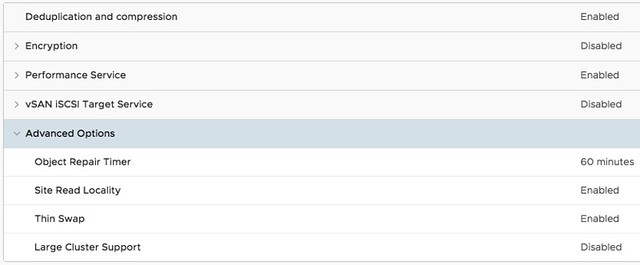
  • UI Option to change the “Object Repair Timer” value cluster-wide. This is the option which determines when vSAN starts repairing an object which has an absent component.
  • Mixed MTU support for vSAN Stretched Clusters (different MTU for Witness traffic then vSAN traffic)
  • Historical capacity reporting
  • VROps dashboards with vSAN stretched cluster awareness
  • Additional PowerCLI cmdlets
  • Enhanced support experience (Network diagnostic mode, specialized dashboards), you can find the below graphs under Monitor/vSAN/Support
  • Additional health checks (storage controllers firmware, unicast network performance test etc)

And last but not least, with vSAN Stretched we have the capability to protect data within a site. As of vSAN 6.7 U1 we also now have the ability to protect data within racks, it is however only available through an RPQ request. So if you need protection within a rack, contact GSS and file an RPQ.

Another announcement was around a vSAN Beta which is coming up. This vSAN Beta will have some great features, three though have been revealed:

  • Data Protection (Snapshot based)
  • File Services
  • Persistent Storage for Containers

I am not going to reveal anything about this, simply to avoid violating the NDA around this. Sign up for the Beta so you can find out more.

And then the last set of announcements was around functionality introduced for vSAN in VMware Cloud on AWS. Here there were two major announcements if you ask me. The first one is the ability to use Elastic Block Storage (EBS volumes) for vSAN. Meaning that in VMware Cloud on AWS you are no longer limited to the storage capacity physically available in the server, no you can now extend your cluster with capacity delivered through EBS. The second one is the availability of vSAN Encryption in VMware Cloud on AWS. This, from a security perspective, will be welcomed by many customers.

That was it, well… almost. This whole week many sessions will reveal various new potential features and futures. I aim to report on those when sitting in on those presentations, or potentially after VMworld.


  • « Go to Previous Page
  • Page 1
  • Interim pages omitted …
  • Page 13
  • Page 14
  • Page 15
  • Page 16
  • Page 17
  • Interim pages omitted …
  • Page 71
  • Go to Next Page »

Primary Sidebar

About the Author

Duncan Epping is a Chief Technologist and Distinguished Engineering Architect at Broadcom. Besides writing on Yellow-Bricks, Duncan is the co-author of the vSAN Deep Dive and the vSphere Clustering Deep Dive book series. Duncan is also the host of the Unexplored Territory Podcast.

Follow Us

  • X
  • Spotify
  • RSS Feed
  • LinkedIn

Recommended Book(s)

Also visit!

For the Dutch-speaking audience, make sure to visit RunNerd.nl to follow my running adventure, read shoe/gear/race reviews, and more!

Do you like Hardcore-Punk music? Follow my Spotify Playlist!

Do you like 80s music? I got you covered!

Copyright Yellow-Bricks.com © 2026 · Log in