• Skip to primary navigation
  • Skip to main content
  • Skip to primary sidebar

Yellow Bricks

by Duncan Epping

  • Home
  • Unexplored Territory Podcast
  • HA Deepdive
  • ESXTOP
  • Stickers/Shirts
  • Privacy Policy
  • About
  • Show Search
Hide Search

BC-DR

Hyper-Converged is here, but what is next?

Duncan Epping · Oct 11, 2016 ·

Last week I was talking to a customer and they posed some interesting questions. What excites me in IT (why I work for VMware) and what is next for hyper-converged? I thought they were interesting questions and very relevant. I am guessing many customers have that same question (what is next for hyper-converged that is). They see this shiny thing out there called hyper-converged, but if I take those steps where does the journey end? I truly believe that those who went the hyper-converged route simply took the first steps on an SDDC journey.

Hyper-converged I think is a term which was hyped and over-used, just like “cloud” a couple of years ago. Lets breakdown what it truly is: hardware + software. Nothing really groundbreaking. It is different in terms of how it is delivered. Sure, it is a different architectural approach as you utilize a software based / server side scale-out storage solution which sits within the hypervisor (or on top for that matter). Still, that hypervisor is something you were already using (most likely), and I am sure that “hardware” isn’t new either. Than the storage aspect must be the big differentiator right? Wrong, the fundamental difference, in my opinion, is how you manage the environment and the way it is delivered and supported. But does it really need to stop there or is there more?

There definitely is much more if you ask me. That is one thing that has always surprised me. Many see hyper-converged as a complete solution, reality is though that in many cases essential parts are missing. Networking, security, automation/orchestration engines, logging/analytic engines, BC/DR (and orchestration of it) etc. Many different aspects and components which seem to be overlooked. Just look at networking, even including a switch is not something you see to often, and what about the configuration of a switch, or overlay networks, firewalls / load-balancers. It all appears not to be a part of hyper-converged systems. Funny thing is though, if you are going on a software defined journey, if you want an enterprise grade private cloud that allows you to scale in a secure but agile manner these components are a requirement, you cannot go without them. You cannot extend your private cloud to the public cloud without any type of security in place, and one would assume that you would like to orchestrate every thing from that same platform and have the same networking / security capabilities to your disposal both private and public.

That is why I was so excited about the VMworld US keynote. Cross Cloud Services on top of hyper-converged leveraging all the tools VMware provides today (vSphere, VSAN, NSX) will exactly allow you to do what I describe above. Whether that is to IBM, vCloud Air or any other of the mega clouds listed in the slide below is even besides the point. Extending your datacenter services in to public clouds is what we have been talking about for a while, this hybrid approach which could bring (dare I say) elasticity. This is a fundamental aspect of SDDC, of which a hyper-converged architecture is simply a key pillar.
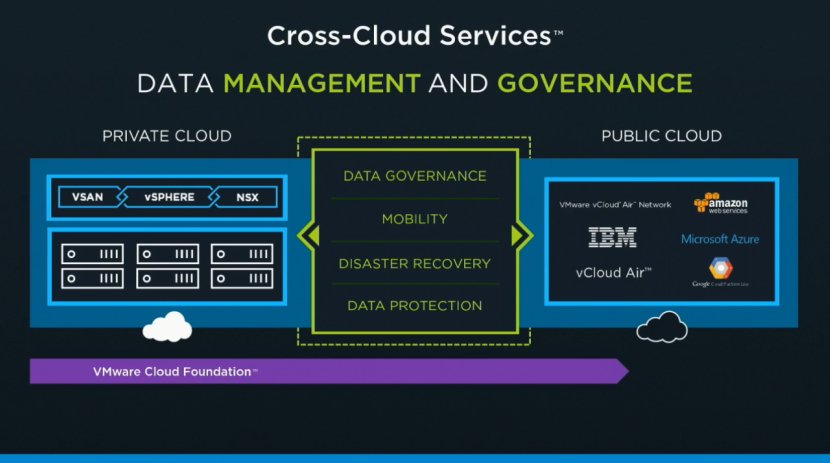
Hyper-converged by itself does not make a private cloud. Hyper-converged does not deliver a full SDDC stack, it is a great step in to the right direction however. But before you take that (necessary) hyper-converged step ask yourself what is next on the journey to SDDC. Networking? Security? Automation/Orchestration? Logging? Monitoring? Analytics? Hybridity? Who can help you reach full potential, who can help you take those next steps? That’s what excites me, that is why I work for VMware. I believe we have a great opportunity here as we are the only company who holds all the pieces to the SDDC puzzle. And with regards to what is next? Deliver all of that in an easy to consume manner, that is what is next!


Startup intro: Reduxio

Duncan Epping · Sep 23, 2016 ·

About a year ago my attention was drawn to a storage startup called Reduxio, not because of what they were selling (they weren’t sharing much at that point though even) but because two friends joined them, Fred Nix and Wade O’Harrow (EMC / vSpecialist fame). I tried to set up a meeting back then and it didn’t happen for whatever reason and it slipped my mind completely. Before VMworld Fred asked me if I was interested in meeting up and we ended up having an hour long conversation at VMworld with Reduxio’s CTO Nir Peleg and Jacob Cherian who is the VP of Product. This week we followed up that conversation with a demo, we had an hour scheduled but the demo was done in 20 minutes… not because it wasn’t interesting, but because it was that simple and intuitive. So who is Reduxio and what do they have to offer?

Reduxio is a storage company which was founded in 2012 and backed by Seagate Technology, Intel Capital, JVP and Carmel Ventures. I probably shouldn’t say storage company as they are more positioning themselves as a data management company, which makes sense if you know their roadmap. For those who care, Reduxio has a head office in San Francisco and an R&D site in Israel. Today Reduxio offers a hybrid storage system. The system is called HX550 and is a dual controller (active/standby) solution which comes in a 2U form factor with 8 SSDs and 16 HDDs, of course connected over 10GbE, dual power supply which also includes a cache protection unit for power failures. Everything you would expect from a storage system I guess.

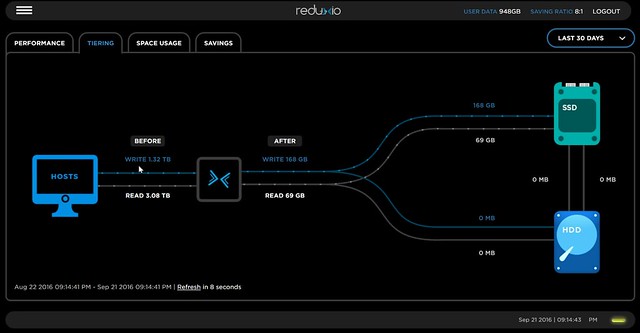
But the hardware specs are not what interested me. The features offered by the platform, or Reduxio’s TIME OS (as they call it) is what sets them apart from others. First of all, not surprisingly, the architecture revolves around flash. It is a tiering based architecture which provides in-memory deduplication and compression, this means that dedupe and compressions happens before data is stored on SSD or HDD. What I found interesting as well is that Reduxio expects IO to be random and all IO will go to SSD, however if it does detect sequential streams then the SSD is bypassed and the IO stream will go directly to HDD. This goes for both  reads and writes by the way. Also, they take proximity of the data in to account when IO moves between SSD and HDD, very smart as that ensures data moves efficiently. All of this by the way, is shown in the UI of course, including dedupe/compression results etc.

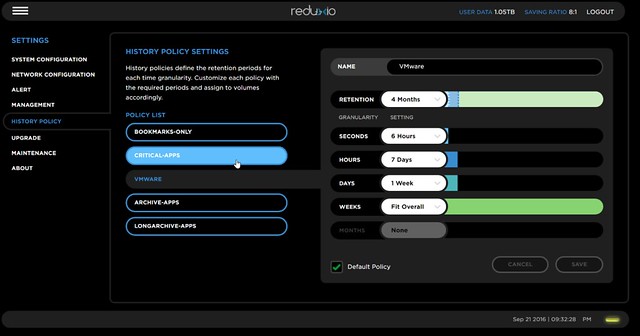
Now the interesting part is the “BackDating” feature Reduxio offers. Basically in their UI you can specify the retention time of data and automatically all volumes with the created policy will adhere to those retention times. You could compare it to snapshots, but Reduxio solved it differently. They asked themselves first what the outcome was a customer expected and then looked at how they could solve the problem, without taking existing implementations like snapshots in to account. In this case they added time as an attribute to a stored block. The screenshot below by the way shows how you can create BackDating policies and what you can set in terms of granularity. So “seconds” need to be saved for 6 hours in this example, hourly for 7 days and so on.

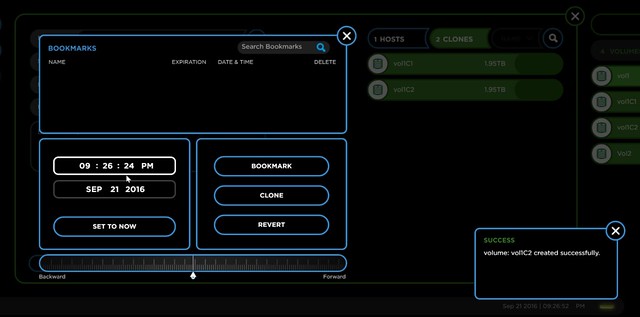
Big benefit is that as a result you can go to a volume and go back to a point in time and simply revert the volume to that point in time or create a clone from that volume for that point in time. This is also how the volume will be presented back to vSphere by the way, so you will have to re-signature it before you can access it. The screenshot below shows what the UI looks like, very straight forward, select a date / time or just use the slide if you need to go back seconds/minutes/hours.

What struck me when they demoed this by the way was how fast these volume clones were created. Jacob, who was driving the demo, explained that you need to look at their system as a database. They are not creating an actual volume, the cloned volume seen by the host is more the result of a query where the data set consists of volume, offset, reference and time. Just a virtual construct that points to data.

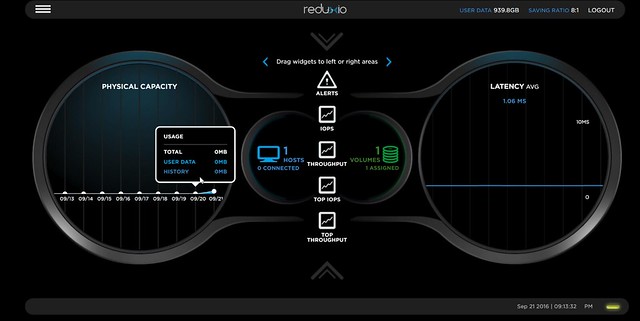
Oh and before I forget, just to keep things simple the UI also allows you to set a bookmark for a certain point in time so that it is easier to go back to that point using your own naming scheme. Talking about the UI, I think this is the thing that impressed me most, it is a simple concept, but allowing you to drag and drop widgets in to your front page dashboard is something I appreciate a lot. I may want to see different info on the frontpage than someone else, having the ability to change this is very welcome. The other thing about their UI, it doesn’t feel crammed. In most cases with enterprise systems we seem to have the habit of cramming as much as we can on a single page which then usually results in users not knowing where to start. Reduxio took a clean slate approach, what do we need and what don’t we need?

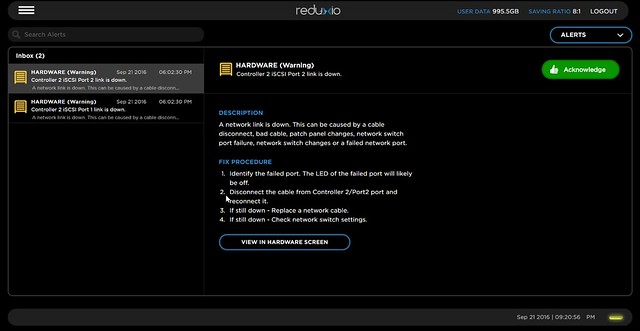
One other thing I liked was a feature they call StorSense. This is basically a SaaS based support infrastructure where analytics and an event database can help you prevent issues from occurring. When there is an error for instance the UI will inform you about the issue and also tells you how to mitigate it. Something which I felt was very useful as you don’t need to search an external KB system to figure out what is going on. Of course they also still offer traditional logging etc for those who prefer that.

That sounds cool right? So what’s the catch you may ask? Well there is one thing I feel is missing right now and that is replication. Or I should rather say the ability to sync data to different locations. Whether that is traditional sync replication or async replication or something in a different shape or form is to be seen. I am hoping they take a different approach again, as that is what Reduxio seems to be good at, coming up with interesting alternative ways for solving the same problem.

All in all they impressed me with what they have so far, and I didn’t even mention it, but they also have a vSphere plugin which allows for VM Level recovery. Hopefully we can expect support for VVols soon and some form of replication, just imagine how powerful that combination can be. Great work guys, and looking forward to hearing more in the future!

If you want to know more about them I encourage you to fill out their contact form so they can get back to you and give you a demo as I am sure you will appreciate it. (Or simply hit up someone like Fred Nix on twitter) Thanks Fred, Jacob and Nir for taking the time to have a chat!

An Industry Roadmap: From storage to data management #STO7903 by @xtosk

Duncan Epping · Sep 1, 2016 ·

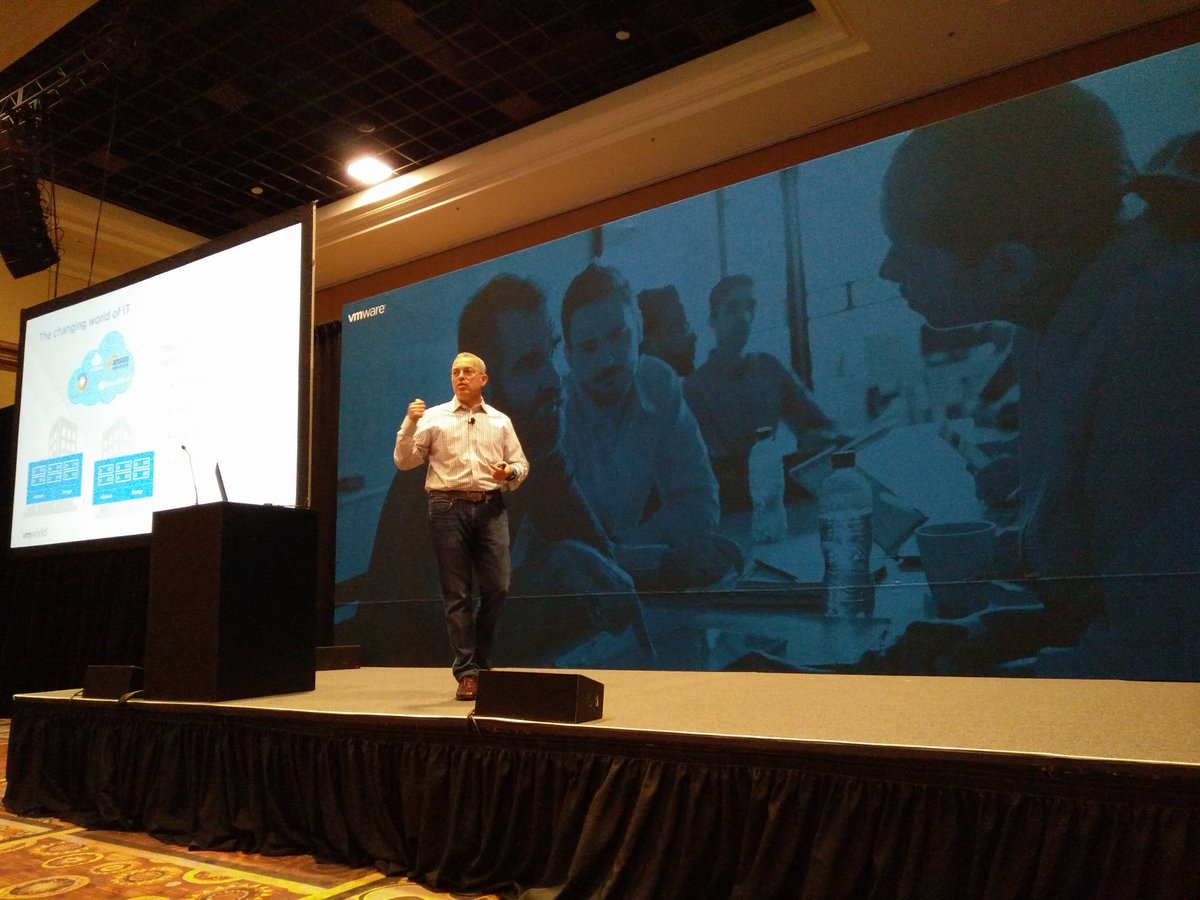
This is the session I have been waiting for, I had it very high on my “must see” list together with the session presented by Christian Dickmann earlier today. Not because it happened to be presented by our Storage an Availability CTO Christos Karamanolis (@XtosK on twitter), but because of the insights I expect to be provided in this session. The title I think says it all: An Industry Roadmap: From storage to data management.

** Keep that in mind when reading the rest of article. Also, this session literally just finished a second ago, I wanted to publish it asap so if there are any typos, my apologies. **

Christos starts with explaining the current problem. There is a huge information growth, 2x growth every 2 years. And that is on the conservative side. Where does the data go? According to analyst it is not expected that this will go to traditional storage, actually the growth of traditional storage is slowing down, actually there is a negative growth seen. Two new types of storage have emerged and are growing fast, Hyper-scale Server SAN Storage and Enterprise Server SAN Storage aka Hyper-converged systems.

With new types of applications changing the world of IT, data management is more important than ever before. Todays storage product do not meet the requirements of this rapidly changing IT world and does not provide the agility your business owners demand. Many of the infrastructure problems can be solved by Hyper-Converged Software, this is all enabled by the hardware evolution we’ve witness over the last years: flash, RDMA, NVMe, 10Gbe etc. These changes from a hardware point of view allowed us to simplify storage architectures and deliver it as software. But it is not just about storage, it is also about operational simplicity. How do we enable our customers to manage more applications and VMs with less. Storage Policy Based Management has enabled this for both Virtual SAN (hyper-converged) and Virtual Volumes in more traditional environments.

Data Lifecycle Management however is still challenging. Snapshots, Clones, Replication, Dedupe, Checksums, Encryption. How do I enable these on a per VM level? How do we decouple all of these data services from the underlying infrastructure? VMware has been doing that for years, best example is vSphere Replication where VMs and Virtual Disks can be replicated on a case by case basis between different types of storage systems. It is even possible to leverage an orchestration solution like Site Recovery Manager to manage your DR strategy end to end from a single interface from private cloud to private cloud, but also from private to public. And from private to public is enabled by vCloud Availability suite, and here you can pay as you g(r)o(w). All of this again driven by policy and through the interface you use on a daily basis, the vSphere Web Client.

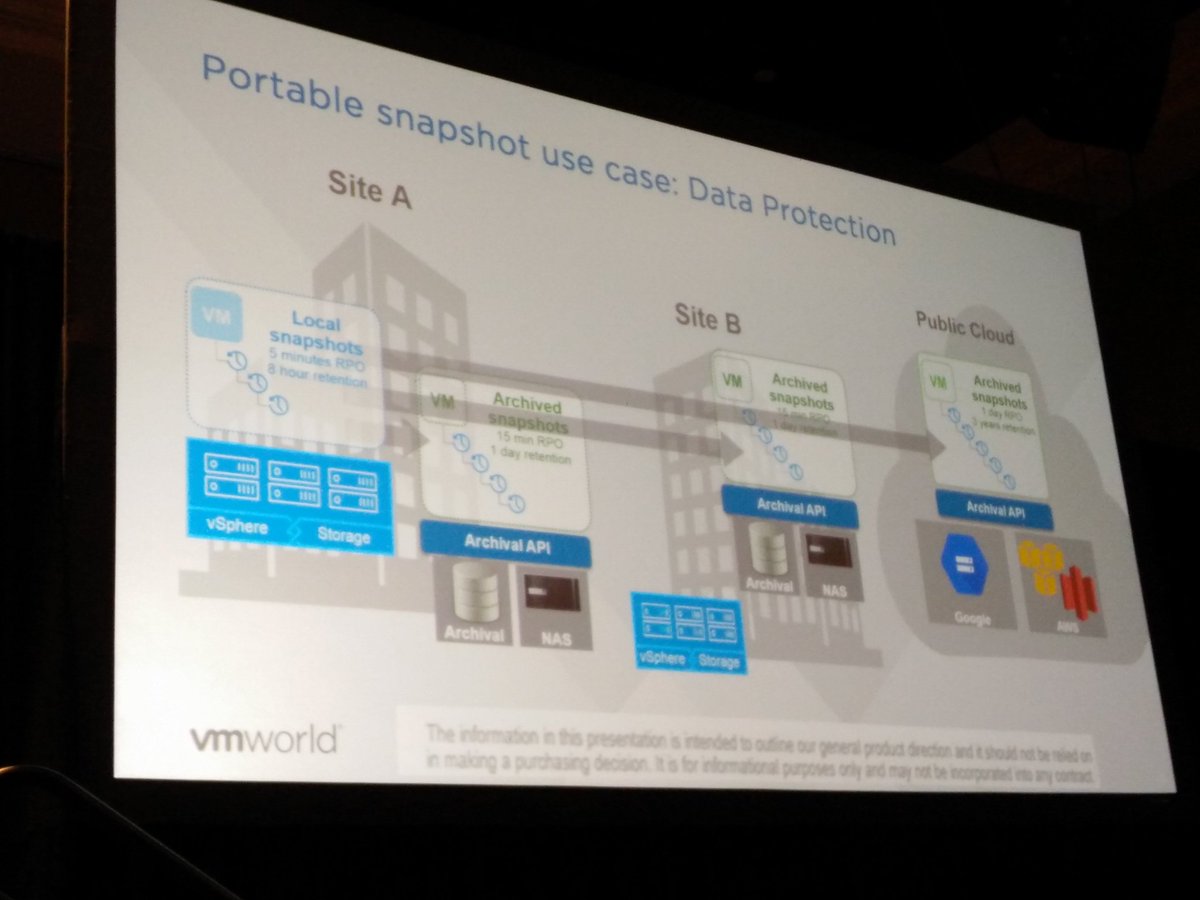
How can we improve the world of DR? Just imagine there was a portable snapshot. A snapshot that was decoupled from storage, can be moved between environments, can be stored in public or private clouds and maybe even both at the same time. This is something we as VMware are working on. A portable snapshot that can be used for Data Protection purposes. Local copies, archived copies in remote datacenters with a different SLA/retention.

How does this scale however when you have 10000s of VMs? Especially when there are 10s of snapshots per VM, or even hundreds. This should all be driven by policy. If I can move the data to different locations, can I use this data as well for other purposes? How about leveraging this for test&dev or analytics? Portable snapshots providing application mobility.

Christos next demoed what the above may look like in the future, the demo shows a VM being replicated from vSphere to AWS, but vSphere to vSphere or vSphere to Azure were also available as an option. The normal settings are configured (destination datastore and network) and literally within seconds the replication starts. The UI looks very crisp and seems to be similar to what was shown in the keynote on day 1 (Cross Cloud Services). But how does this work in the new world of IT, what if I have many new gen applications, containers / microservices?

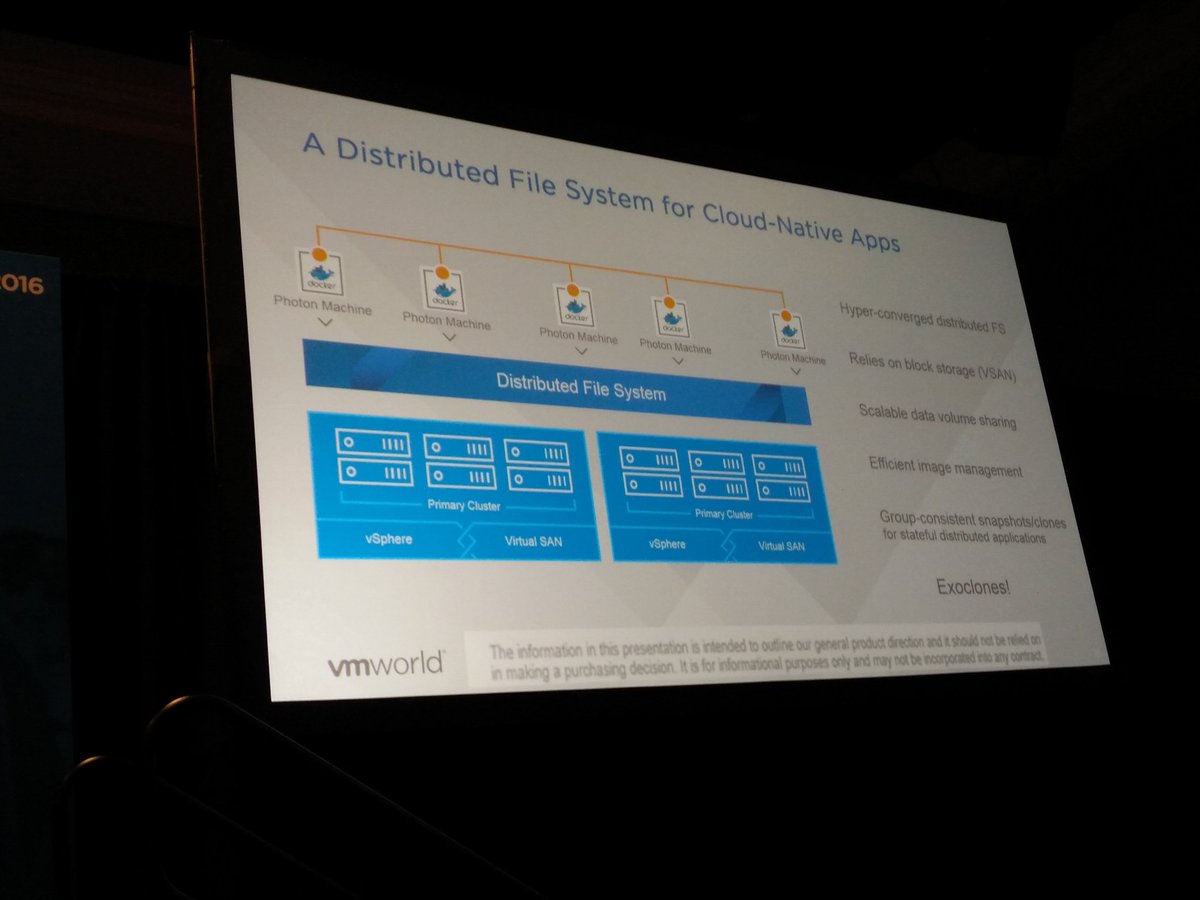
A Distributed File System for Cloud Native apps is now introduced. It appears to be a solution which sits on top of Virtual SAN and provides a file system that can scale to 1000s of hosts with functionality like highly scalable and performing snapshots and clones. These snapshots provided by this Distributed File System are also portable, this concept being developed is called exoclones. It is not something that is just living in the heads of the engineering team, Christos actually showed a demo of an exoclone being exported and imported to another environment.

If VMware does provide that level of data portability, how do you track and control all that data? Data governance is key in most environments, how do we enforce compliance, integrity and availability.  This will be the next big challenge for the industry. There are some products which can provide this today, but nothing that can do this cross-cloud and for both current and new application architectures and infrastructures.

Although for years we seem to have been under the impression that the infrastructure was the center of the universe. Reality is that it serves a clear purpose: host applications and provide users access to data. Your companies data is what is most important. We as VMware realize that and are working to ensure we can help you move forward on your next big journey. In short, it is our goal that you can focus on data management and no longer need to focus on the infrastructure.

Great talk,

Rubrik landed new funding round and announced version 3.0

Duncan Epping · Aug 24, 2016 ·

After having gone through all holiday email it is now time to go over some of the briefings. The Rubrik briefing caught my eye as it had some big news in there. First of all, they landed Series C, big congrats, especially considering the size, $ 61m is a pretty substantial I must say! Now I am not a financial analyst, so I am not going to spend time talking too much about it, as the introduction of a new version of their solution is more interesting to most of you. So what did Rubrik announce with version 3 aka Firefly.

First of all, the “Converged Data Management” term seems to be gone and “Cloud Data Management” was introduced, and to be honest I prefer “Cloud Data Management”. Mainly because data management is not just about data in your datacenter, but data in many different locations, which typically is the case for archival or backup data. So that is the marketing part, what was announced in terms of functionality?

Version 3.0 of Rubrik supports:

  • Physical Linux workloads
  • Physical SQL
  • Edge virtual appliance (for ROBO for instance)
  • Erasure Coding

When it comes to physical SQL and Linux support it is probably unnecessary, but you will be able to backup those systems using the same policy driven / SLA concepts Rubrik already provides in their UI. For those who didn’t read my other articles on Rubrik, policy based backup/data management (or SLA domains as they call it) is their big thing. No longer do you create a backup schedule. You create an SLA and assign that SLA to a workload or a group even. And now this concept applies to SQL and physical Linux as well, which is great if you still have physical workloads in your datacenter! Connecting to SQL is straight forward, there is a connector service which is a simple MSI that needs to be installed.

Now all that data can be store in AWS S3 and for instance Microsoft Azure in the public cloud or maybe in a privately deployed Scality solution. Great thing about the different tiers of storage is that you qualify the tiers in their solution and data flows between it as defined in your workload SLA. This also goes for the announced Edge virtual appliance. This basically is a virtualized version of the Rubrik appliance, which allows you to deploy a solution in ROBO offices. Through the SLA you bring data to your main data center, but you can also keep “locally cached” copies so that restores are fast.

Finally, Rubrik used mirroring in previous versions to safely store data. Very similar to VMware Virtual SAN they now introduce Erasure Coding. Which means that they will be able to store data more efficiently, and according to Chris Wahl at no performance cost.

Overall an interesting 3.0 release of their platform. If you are looking for a new backup/data management solution, definitely one to keep your eye on.

Can I select VSAN as my placeholder datastore with SRM?

Duncan Epping · Jun 13, 2016 ·

I received a question today about SRM, vSphere Replication and VSAN. The current documentation for SRM says the following:

Do not select as placeholder datastores any datastores that you use as the replication target datastore for vSphere Replication.

The question was, what about when using VSAN? As with VSAN as the source and destination datastore I usually only have 1 datastore. What do I select as my placeholder datastore then? Well with VSAN the situation is different. When using VSAN the placeholder datastore selected can be the VSAN datastore where the VMs are also replicated to. This is a gap in our current documentation, and we will make sure to get this updated asap.

  • « Go to Previous Page
  • Page 1
  • Interim pages omitted …
  • Page 13
  • Page 14
  • Page 15
  • Page 16
  • Page 17
  • Interim pages omitted …
  • Page 63
  • Go to Next Page »

Primary Sidebar

About the Author

Duncan Epping is a Chief Technologist and Distinguished Engineering Architect at Broadcom. Besides writing on Yellow-Bricks, Duncan is the co-author of the vSAN Deep Dive and the vSphere Clustering Deep Dive book series. Duncan is also the host of the Unexplored Territory Podcast.

Follow Us

  • X
  • Spotify
  • RSS Feed
  • LinkedIn

Recommended Book(s)

Advertisements


Copyright Yellow-Bricks.com © 2025 · Log in