• Skip to primary navigation
  • Skip to main content
  • Skip to primary sidebar

Yellow Bricks

by Duncan Epping

  • Home
  • Unexplored Territory Podcast
  • HA Deepdive
  • ESXTOP
  • Stickers/Shirts
  • Privacy Policy
  • About
  • Show Search
Hide Search

BC-DR

Where’s the HA enforce VM-Host and Affinity rules option in vSphere 6.5?

Duncan Epping · Apr 25, 2017 ·

Last week on (VMware internal) Socialcast someone asked where the UI option is in vSphere 6.5 that allows you to enable the ability for vSphere HA to respect VM-Host Affinity and VM-VM Anti Affinity rules. In vSphere 6.0 there is an option in the Rules part of the UI as shown in the screenshot below.

In vSphere 6.5 that option has disappeared completely. The reason for this is because vSphere HA now respects these rules by default, as it appeared this is the behavior customers wanted anyway. Note, that if for whatever reason vSphere HA cannot respect the rule it will restart the VMs (violating the rule) as these are non-mandatory rules it chooses availability over compliance in this situation.

If you would like to disable this behavior and don’t care about these rules during a fail-over you can set either or both advanced settings:

  • das.respectvmvmantiaffinityrules – set to “true” by default, set to “false” if you want to disable it
  • das.respectvmhostsoftaffinityrules – set to “true” by default, set to “false” if you want to disable it

I hope that helps those looking to make changes to this behavior.

VMware vSAN 6.6 demo

Duncan Epping · Apr 12, 2017 ·

I was playing around with a vSAN 6.6 environment yesterday and I figured I would record a quick demo of some of the new functionality introduced. Took me a bit longer than expected, but here it is. I hope you will find it useful, a 1080p version can be viewed on youtube.

VM showing that HA failure response is disabled in 6.5?

Duncan Epping · Apr 11, 2017 ·

I had a customer asking me today why on each VM it was showing that all HA responses are disabled. This customer is running vSphere 6.5 and below you can see what the UI showed. Note that it still says the VM is Protected, yet none of the protection mechanisms appeared to be enabled

I asked them to show me a screenshot of their HA configuration, and the HA configuration actually had several of these response mechanisms enabled. I checked my vSphere 6.5 lab and it seems I have the same problem and there’s a UI issue on the VM level details for vSphere HA in vSphere 6.5. I verified with engineering, and this is indeed a known issue which has been identified and is fixed in vCenter Server 6.5.0b! KB Article on the topic can be found here, and in the release notes for 6.5.0b it is mentioned that it is fixed.

HA disabled VMs not registered on other hosts after failure?

Duncan Epping · Apr 7, 2017 ·

A couple of weeks ago one of our SEs asked me about vSphere HA functionality that was introduced a while ago, which is the ability to have HA disabled VMs being registered on other healthy hosts in a cluster after a failure. Not only does this apply to “HA disabled VMs” but also to powered-off VMs. This functionality was introduced to make it easier to power-on a VM after a host failure which was powered off before the failure, or which was disabled for HA restarts. Without this functionality you would need to re-register the VM on a different host, which are various unneeded steps.

The customer testing this scenario had noticed that whenever a failure occurred HA disabled, and powered off, VMs did not get registered. Strange as the documentation states the following:

“If a host fails, vSphere HA attempts to register to an active host the affected virtual machines that were powered on and have a restart priority setting of Disabled, or that were powered off.”

After talking to the vSphere HA engineers it was discovered that there was a bug in vSphere 6.0 U1 and U2. This bug resulted in the fact that HA disabled (or powered-off) VMs were not registered on other hosts. Very annoying. Fortunately, this problem has been solved in vSphere 6.0 U3. If you rely on this functionality to work correctly, please upgrade to vSphere 6.0 U3 to fix your problem. Thanks!

Cohesity announces 4.0 and Round C funding

Duncan Epping · Apr 4, 2017 ·

Earlier this week I was on the phone with Rawlinson Rivera, my former VMware/vSAN colleague, and he told me all about the new stuff for Cohesity that was just announced. First of all, congrats with Round C funding. As we’ve all seen, lately it has been mayhem in the storage world. Landing a $90 million round is big. This round was co-led by investors GV (formerly Google Ventures) and Sequoia Capital. Both Cisco Investments and Hewlett Packard Enterprise (HPE) also participated in this round as strategic investors. I am not an analyst, and I am not going to pretend either, lets talk tech.
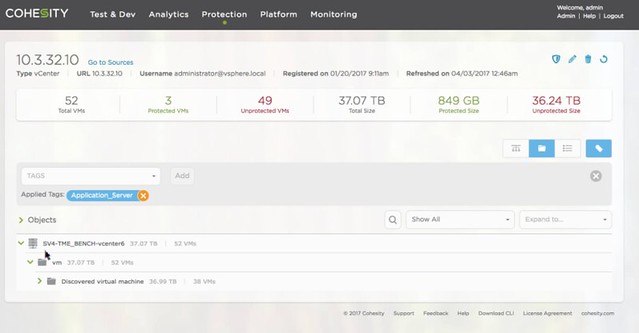
Besides the funding round, Cohesity also announced the 4.0 release of their hyper-converged secondary storage platform. Now, let it be clear, I am not a fan of the “hyper-converged” term used here. Why? Well I think this is a converged solution. They combined multiple secondary storage use cases and created a single appliance. Hyper-Converged stands for something in the industry, and usually it means the combination of a hypervisor, storage software and hardware. The hypervisor is missing here. (No I am not saying “hyper” in hyper-converged” stands for hypervisor.) Anyway, lets continue.

In 4.0 some really big functionality is introduced, lets list it out and then discuss each at a time:

  • S3 Compatible Object Storage
  • Quotas for File Services
  • NAS Data Protection
  • RBAC for Data Protection
  • Folder and Tag based protection
  • Erasure Coding

As of 4.0 you can now on the Cohesity platform create S3 Buckets, besides replicating to an S3 bucket you can now also present them! This is fully S3 compatible and can be created through their simple UI. Besides exposing their solution as S3 you can also apply all of their data protection logic to it, so you can have cloud archival / tiering /replication. But also enable encryption, data retention and create snapshots.

Cohesity already offered file services (NFS and SMB), and in this release they are expanding the functionality. The big request from customers was Quotas and that is introduced in 4.0. Along with what they call Write-Once-Read-Many (WORM) capabilities, which refers to data retention in this case (write once, keep forever).

For the Data Protection platform they now offer NAS Data Protection. Basically they can connect to a NAS device and protect everything which is stored on that device by snapping the data and storing it on their platform. So if you have a NetApp filer for instance you can now protect that by offloading the data to the Cohesity platform. For the Data Protection solution they also intro Role Based Access. I think this was one of the big ticket items missing, and with 4.0 they now provide that as well. Last but not last “vCenter Integration”, which means that they can now auto-protect groups of VMs based on the folder they are in or the tag they have provided. Just imagine you have 5000 VMs, you don’t want to associate a backup scheme with each of these, you probably much rather do that for an X number of VMs with a similar SLA at a time. Give them a tag, and associate the tag with the protection scheme (see screenshot). Same for folders, easy.

Last but not least: Erasure Coding. This is not a “front-end” feature, but it is very useful to have. Especially in larger configurations it can safe a lot of precious disk space. Today they have “RAID-1” mechanism more or less, where each block is replicated / mirrored to another host in the cluster. This results in a 100% overhead, in other words: for every 100GB stored you need 200GB capacity. By introducing Erasure Coding they reduce that immediately to 33%. Or in other words, with a 3+1 scheme you get 50% more usable capacity and with a 5+2 (double protection) you get 43% more. Big savings, a lot of extra usable capacity.

Oh and before I forget, besides getting Cisco and HPE as investors you can now also install Cohesity on Cisco kit (there’s a list of approved configurations). HPE took it one step further even, they can sell you a configuration with Cohesity included and pre-installed. Smart move.

All in all, some great new functionality and some great enhancements of the current offering. Good work Cohesity, looking forward to see what is next for you guys.

  • « Go to Previous Page
  • Page 1
  • Interim pages omitted …
  • Page 11
  • Page 12
  • Page 13
  • Page 14
  • Page 15
  • Interim pages omitted …
  • Page 63
  • Go to Next Page »

Primary Sidebar

About the Author

Duncan Epping is a Chief Technologist and Distinguished Engineering Architect at Broadcom. Besides writing on Yellow-Bricks, Duncan is the co-author of the vSAN Deep Dive and the vSphere Clustering Deep Dive book series. Duncan is also the host of the Unexplored Territory Podcast.

Follow Us

  • X
  • Spotify
  • RSS Feed
  • LinkedIn

Recommended Book(s)

Also visit!

For the Dutch-speaking audience, make sure to visit RunNerd.nl to follow my running adventure, read shoe/gear/race reviews, and more!

Do you like Hardcore-Punk music? Follow my Spotify Playlist!

Do you like 80s music? I got you covered!

Copyright Yellow-Bricks.com © 2026 · Log in