• Skip to primary navigation
  • Skip to main content
  • Skip to primary sidebar

Yellow Bricks

by Duncan Epping

  • Home
  • Unexplored Territory Podcast
  • HA Deepdive
  • ESXTOP
  • Stickers/Shirts
  • Privacy Policy
  • About
  • Show Search
Hide Search

Cool Tool: SDDC Discovery aka bringing back “Maps”

Duncan Epping · Oct 16, 2016 ·

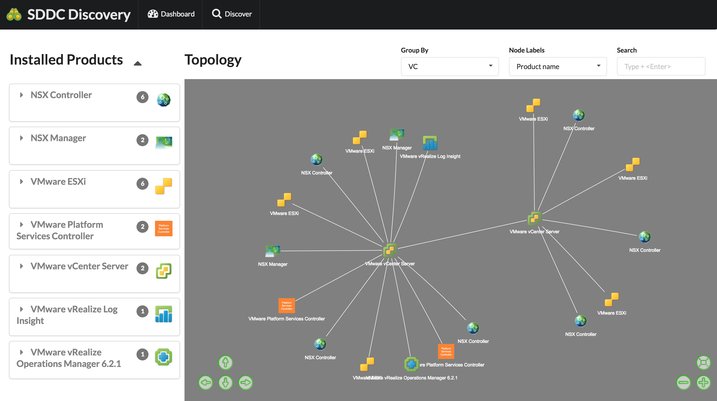
You still recall the days where you had the awesome map view in the vCenter Client? That unfortunately was removed from the Web Client. A shame as it was very useful for troubleshooting and seeing relationships between components of their stack. Guess what?! We just released a fling where we show you a map of your VMware products and how they are connected. I think it is brilliant to have that fling made available, and it would even be better if we can get this in to our products at some point. If you want to test it out, go to the SDDC Discovery Tool fling page and download it, don’t forget to leave feedback!

Awesome tool if you ask me, very useful, and if I can do a feature request, I would love to see some sort of grouping for the hosts which belong to the same cluster. Maybe stack the hosts in a cluster object and allow to drill down to see them all. Just a thought.
Hyper-Converged is here, but what is next?

Duncan Epping · Oct 11, 2016 ·

Last week I was talking to a customer and they posed some interesting questions. What excites me in IT (why I work for VMware) and what is next for hyper-converged? I thought they were interesting questions and very relevant. I am guessing many customers have that same question (what is next for hyper-converged that is). They see this shiny thing out there called hyper-converged, but if I take those steps where does the journey end? I truly believe that those who went the hyper-converged route simply took the first steps on an SDDC journey.

Hyper-converged I think is a term which was hyped and over-used, just like “cloud” a couple of years ago. Lets breakdown what it truly is: hardware + software. Nothing really groundbreaking. It is different in terms of how it is delivered. Sure, it is a different architectural approach as you utilize a software based / server side scale-out storage solution which sits within the hypervisor (or on top for that matter). Still, that hypervisor is something you were already using (most likely), and I am sure that “hardware” isn’t new either. Than the storage aspect must be the big differentiator right? Wrong, the fundamental difference, in my opinion, is how you manage the environment and the way it is delivered and supported. But does it really need to stop there or is there more?

There definitely is much more if you ask me. That is one thing that has always surprised me. Many see hyper-converged as a complete solution, reality is though that in many cases essential parts are missing. Networking, security, automation/orchestration engines, logging/analytic engines, BC/DR (and orchestration of it) etc. Many different aspects and components which seem to be overlooked. Just look at networking, even including a switch is not something you see to often, and what about the configuration of a switch, or overlay networks, firewalls / load-balancers. It all appears not to be a part of hyper-converged systems. Funny thing is though, if you are going on a software defined journey, if you want an enterprise grade private cloud that allows you to scale in a secure but agile manner these components are a requirement, you cannot go without them. You cannot extend your private cloud to the public cloud without any type of security in place, and one would assume that you would like to orchestrate every thing from that same platform and have the same networking / security capabilities to your disposal both private and public.

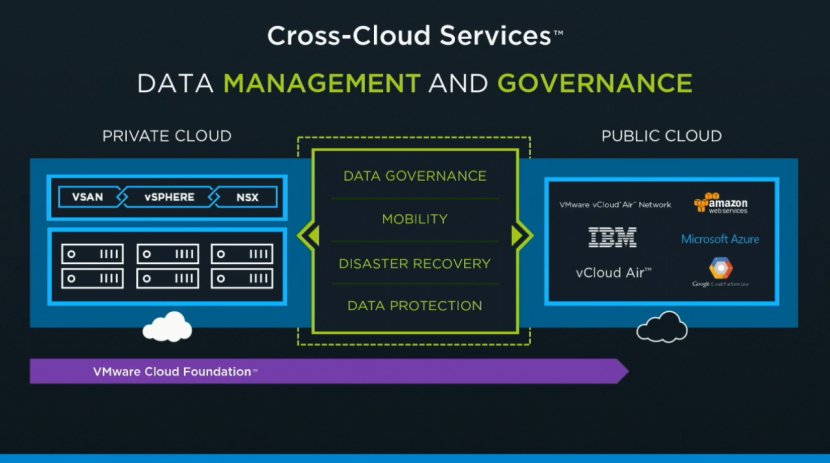
That is why I was so excited about the VMworld US keynote. Cross Cloud Services on top of hyper-converged leveraging all the tools VMware provides today (vSphere, VSAN, NSX) will exactly allow you to do what I describe above. Whether that is to IBM, vCloud Air or any other of the mega clouds listed in the slide below is even besides the point. Extending your datacenter services in to public clouds is what we have been talking about for a while, this hybrid approach which could bring (dare I say) elasticity. This is a fundamental aspect of SDDC, of which a hyper-converged architecture is simply a key pillar.

Hyper-converged by itself does not make a private cloud. Hyper-converged does not deliver a full SDDC stack, it is a great step in to the right direction however. But before you take that (necessary) hyper-converged step ask yourself what is next on the journey to SDDC. Networking? Security? Automation/Orchestration? Logging? Monitoring? Analytics? Hybridity? Who can help you reach full potential, who can help you take those next steps? That’s what excites me, that is why I work for VMware. I believe we have a great opportunity here as we are the only company who holds all the pieces to the SDDC puzzle. And with regards to what is next? Deliver all of that in an easy to consume manner, that is what is next!


This blog has been hacked by @vS0ciety

Duncan Epping · Sep 27, 2016 ·

As some seemed to have taken this too serious:

Thanks to all who took part in the viral video hoax today, the vCommunity Rocks – No vBloggers were harmed in the making of this video

— vS0ciety (@vS0ciety) September 27, 2016

How to make a host win the HA Master Election

Duncan Epping · Sep 27, 2016 ·

On the community forums someone asked if it was possible to influence the HA/FDM master election. (For those who don’t know, FDM is the engineering name for vSphere HA.) Let me state first that I wouldn’t recommend doing this, but there actually is a way to make it very likely a certain host becomes the HA master. In this case this customer wanted to influence the outcome of the election as hosts are distributed across rooms and one host is less likely to fail than others due to power layout etc.

The setting is:

fdm.nodeGoodness

The explanation provided is:

When a master election is held, the FDMs exchange a goodness value, and the FDM with the largest goodness value is elected master. Ties are broken using the host IDs assigned by vCenter Server. This parameter can be used to override the computed goodness value for a given FDM. To force a specific host to be elected master each time an election is held and the host is active, set this option to a large positive value. This option should not be specified at the cluster level.

You can set this by manually editing the following file on the host where you want to increase the chances of winning the election:

/etc/opt/vmware/fdm/fdm.cfg

More details about this can be found in this KB, which also lists many other advanced options.

** Disclaimer: This article contains references to the words master and/or slave. I recognize these as exclusionary words. The words are used in this article for consistency because it’s currently the words that appear in the software, in the UI, and in the log files. When the software is updated to remove the words, this article will be updated to be in alignment. **

Startup intro: Reduxio

Duncan Epping · Sep 23, 2016 ·

About a year ago my attention was drawn to a storage startup called Reduxio, not because of what they were selling (they weren’t sharing much at that point though even) but because two friends joined them, Fred Nix and Wade O’Harrow (EMC / vSpecialist fame). I tried to set up a meeting back then and it didn’t happen for whatever reason and it slipped my mind completely. Before VMworld Fred asked me if I was interested in meeting up and we ended up having an hour long conversation at VMworld with Reduxio’s CTO Nir Peleg and Jacob Cherian who is the VP of Product. This week we followed up that conversation with a demo, we had an hour scheduled but the demo was done in 20 minutes… not because it wasn’t interesting, but because it was that simple and intuitive. So who is Reduxio and what do they have to offer?

Reduxio is a storage company which was founded in 2012 and backed by Seagate Technology, Intel Capital, JVP and Carmel Ventures. I probably shouldn’t say storage company as they are more positioning themselves as a data management company, which makes sense if you know their roadmap. For those who care, Reduxio has a head office in San Francisco and an R&D site in Israel. Today Reduxio offers a hybrid storage system. The system is called HX550 and is a dual controller (active/standby) solution which comes in a 2U form factor with 8 SSDs and 16 HDDs, of course connected over 10GbE, dual power supply which also includes a cache protection unit for power failures. Everything you would expect from a storage system I guess.

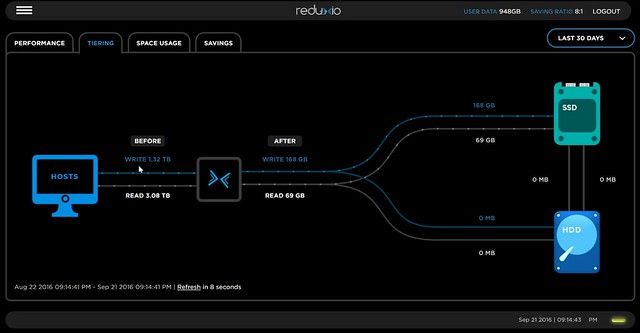
But the hardware specs are not what interested me. The features offered by the platform, or Reduxio’s TIME OS (as they call it) is what sets them apart from others. First of all, not surprisingly, the architecture revolves around flash. It is a tiering based architecture which provides in-memory deduplication and compression, this means that dedupe and compressions happens before data is stored on SSD or HDD. What I found interesting as well is that Reduxio expects IO to be random and all IO will go to SSD, however if it does detect sequential streams then the SSD is bypassed and the IO stream will go directly to HDD. This goes for both  reads and writes by the way. Also, they take proximity of the data in to account when IO moves between SSD and HDD, very smart as that ensures data moves efficiently. All of this by the way, is shown in the UI of course, including dedupe/compression results etc.

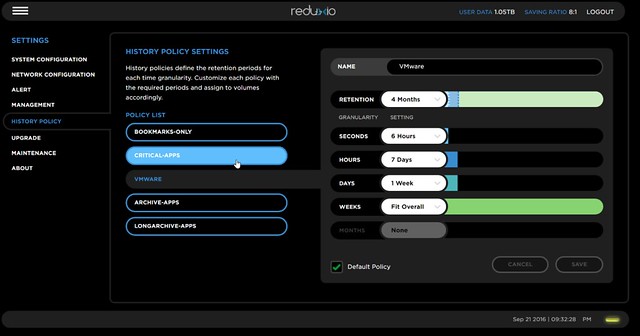
Now the interesting part is the “BackDating” feature Reduxio offers. Basically in their UI you can specify the retention time of data and automatically all volumes with the created policy will adhere to those retention times. You could compare it to snapshots, but Reduxio solved it differently. They asked themselves first what the outcome was a customer expected and then looked at how they could solve the problem, without taking existing implementations like snapshots in to account. In this case they added time as an attribute to a stored block. The screenshot below by the way shows how you can create BackDating policies and what you can set in terms of granularity. So “seconds” need to be saved for 6 hours in this example, hourly for 7 days and so on.

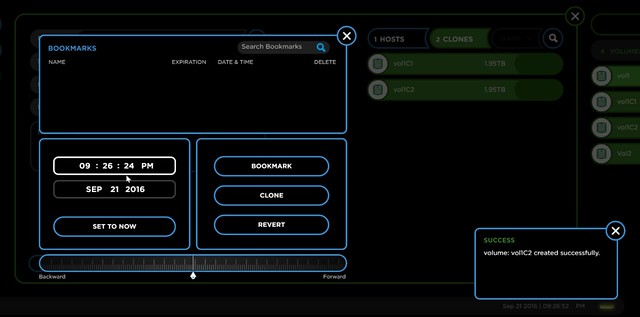
Big benefit is that as a result you can go to a volume and go back to a point in time and simply revert the volume to that point in time or create a clone from that volume for that point in time. This is also how the volume will be presented back to vSphere by the way, so you will have to re-signature it before you can access it. The screenshot below shows what the UI looks like, very straight forward, select a date / time or just use the slide if you need to go back seconds/minutes/hours.

What struck me when they demoed this by the way was how fast these volume clones were created. Jacob, who was driving the demo, explained that you need to look at their system as a database. They are not creating an actual volume, the cloned volume seen by the host is more the result of a query where the data set consists of volume, offset, reference and time. Just a virtual construct that points to data.

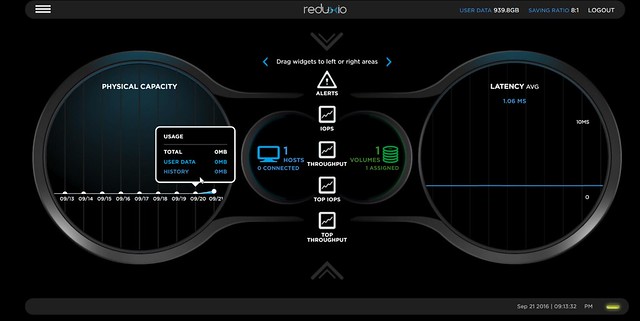
Oh and before I forget, just to keep things simple the UI also allows you to set a bookmark for a certain point in time so that it is easier to go back to that point using your own naming scheme. Talking about the UI, I think this is the thing that impressed me most, it is a simple concept, but allowing you to drag and drop widgets in to your front page dashboard is something I appreciate a lot. I may want to see different info on the frontpage than someone else, having the ability to change this is very welcome. The other thing about their UI, it doesn’t feel crammed. In most cases with enterprise systems we seem to have the habit of cramming as much as we can on a single page which then usually results in users not knowing where to start. Reduxio took a clean slate approach, what do we need and what don’t we need?

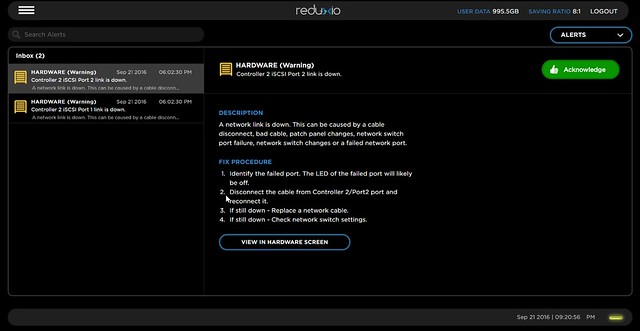
One other thing I liked was a feature they call StorSense. This is basically a SaaS based support infrastructure where analytics and an event database can help you prevent issues from occurring. When there is an error for instance the UI will inform you about the issue and also tells you how to mitigate it. Something which I felt was very useful as you don’t need to search an external KB system to figure out what is going on. Of course they also still offer traditional logging etc for those who prefer that.

That sounds cool right? So what’s the catch you may ask? Well there is one thing I feel is missing right now and that is replication. Or I should rather say the ability to sync data to different locations. Whether that is traditional sync replication or async replication or something in a different shape or form is to be seen. I am hoping they take a different approach again, as that is what Reduxio seems to be good at, coming up with interesting alternative ways for solving the same problem.

All in all they impressed me with what they have so far, and I didn’t even mention it, but they also have a vSphere plugin which allows for VM Level recovery. Hopefully we can expect support for VVols soon and some form of replication, just imagine how powerful that combination can be. Great work guys, and looking forward to hearing more in the future!

If you want to know more about them I encourage you to fill out their contact form so they can get back to you and give you a demo as I am sure you will appreciate it. (Or simply hit up someone like Fred Nix on twitter) Thanks Fred, Jacob and Nir for taking the time to have a chat!

  • « Go to Previous Page
  • Page 1
  • Interim pages omitted …
  • Page 102
  • Page 103
  • Page 104
  • Page 105
  • Page 106
  • Interim pages omitted …
  • Page 502
  • Go to Next Page »

Primary Sidebar

About the Author

Duncan Epping is a Chief Technologist and Distinguished Engineering Architect at Broadcom. Besides writing on Yellow-Bricks, Duncan is the co-author of the vSAN Deep Dive and the vSphere Clustering Deep Dive book series. Duncan is also the host of the Unexplored Territory Podcast.

Follow Us

  • X
  • Spotify
  • RSS Feed
  • LinkedIn

Recommended Book(s)

Also visit!

For the Dutch-speaking audience, make sure to visit RunNerd.nl to follow my running adventure, read shoe/gear/race reviews, and more!

Do you like Hardcore-Punk music? Follow my Spotify Playlist!

Do you like 80s music? I got you covered!

Copyright Yellow-Bricks.com © 2026 · Log in