This week I had the pleasure to join Pete and John again on the Virtually Speaking podcast, together with Ken Werneburg. We spoke about the upcoming VMworld event in Las Vegas. Throughout the show there are tips around sessions and vendors to look out for on the show floor. I think it was an interesting conversation…
@DuncanYB’s recommended reads part 3
 What most of you don’t know is that I was on a holiday for 3.5 weeks in China (beautiful country!)and just got back, hence the delay, I did not bring a laptop and tried to avoid doing any work (enforced by my kids). I had a huge backlog of articles to read so I figured I would start with creating this list based on those articles. I may (and probably will) have missed some gems, do share them with me in the comments.
- New Leading IOmark-VM-HC results for Intel server with NVMe with VSAN
Talking about a compelling story, all-flash with NVMe definitely delivers the goods! What interested me the most: NVMe storage delivered 3 times better performance and nearly 3 times better price-performance than the previous leading results - VSAN upgrading from 6.1 to 6.2 Hybrid to All-Flash – PART 2 by Anthony Spiteri
When there is a Part 2 there also is a Part 1 so read that first. Great two part series that explains how to go from 6.1 hybrid to 6.2 all-flash VSAN. I think this is one of those advantages of a solution which is not tied to hardware. If there is a change of requirement and you want to upgrade to all-flash you can simply do that. No need to replace the full cluster or replace hosts, simply swap out HDDs with SSDs and follow the steps described by Anthony. - Bandwidth reduction for erasure coded storage by Robin Harris
Interesting post about erasure coding and bandwidth reduction. It is a follow up to an earlier post, also read the comments and the mentioned paper! - Announcing Open Hardware Management Services by T. Sridhar
SDDC doesn’t stop at the virtualization layer. It will need a way to manage the hardware as well, and the SDDC team within VMware just announced their open initiative around it. Working closely with partners like Intel to ensure deep integration. Great to see that this is being open-sourced and hoping we will see many partners contribute! - VMware Validated Design for Software-Defined Data Center 2.0 Poster by Ryan Johnson
Not an article or a video, but a poster, and a great one if you ask me. A lot of detail in there around SDDC validated designs, and it just looks nice and crisp. Can I get a printed copy please? Thanks! - Big news for VSAN and VVol customers by Infinio
Small article, but interesting as the first VSAN and VVol certified VAIO filter (caching solution by Infinio) was announced. Can’t wait for replication filters to show up as well on this list. - VSAN 6.2 All Flash Review by Storage Review
Personally I am a bit surprised about the outcome, especially as I’ve seen numbers that differ a lot from what is shown by Storage Review (where all-flash performance much better than hybrid), not sure why this is to be honest, still a very thorough and in-depth review which is worth reading. - Sweating Springpath fails to defuse SimpliVity’s patent bomb by The Register
Not sure what to think here to be honest… It is a strange situation with Cisco sitting in the middle.
And as a bonus, nothing to do with virtualization, but I read this one during my holiday and found it interesting as I could relate to it very much. I stopped drinking a long time ago for a couple of years and can definitely agree with these “findings”.
VSAN Healthcheck: Read Cache Reservations test failed
** Please note: this has been solved in vSAN/vSphere 6.5GA and 6.0 p04 **
I’ve seen this popping up a bunch of times now, and it seems that the problem and solution is not easy to find for people so I thought I would give it a try as well. When running VSAN all-flash and Horizon View it can happen that you see a failed test for Read Cache Reservations in the VSAN Healthcheck. The reason for this failed test is simple: you are using read cache reservations but All-Flash has no read cache. So this is why the read cache reservations test failed. You can see the error below.
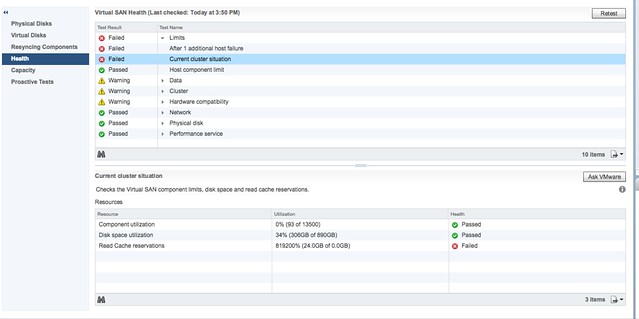
The solution is even easier, you change the policy that you are using on those objects. Change the policy to state 0% read cache and apply this policy to all objects! When applied you click “retest” on the Healthcheck and the error should go away. If you want to know more about Horizon View and policies make sure to read Cormac’s post here. There is also a KB on this topic, which can be found here.
Playing around with Tintri Global Center and Tintri storage systems
Last week the folks from Tintri reached out and asked me if I was interested to play around with a lab they have running. They gave me a couple of hours of access to their Partner Lab. It had a couple of hosts, 4 different Tintri VMStore systems including their all-flash offering and of course their management solution Global Center. I have done a couple of posts on Tintri in the past, so if you want to know more about Tintri make sure to read those as well. (1, 2, 3, 4)
For those who have no clue whatsoever, Tintri is a storage company which sells “VM-Aware” storage. This basically means that all of the data services they offer can be enabled on a VM/VMDK level and they give visibility all the way down to the lowest level. And not just for VMware, they support other hypervisors as well by the way. I’ve been having discussions with Tintri since 2011 and it is safe to say they came a long way, most of my engagements however were presentations and the occasional demo so it was nice to actually go through the experience personally.
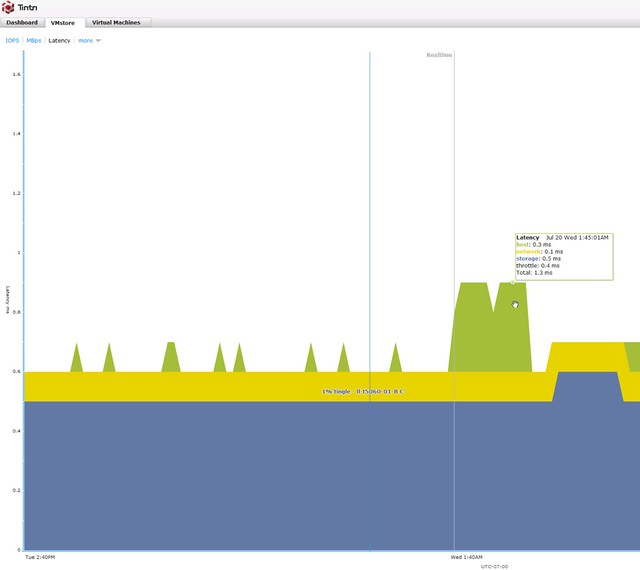
First of all their storage system management interface. If you login to one of them you are presented with all the info you would want to know, IOPS / Bandwidth / Latency, but even for latency you can see a split in network, host and storage latency. So if anything is misbehaving you will find out what and why probably relative fast.
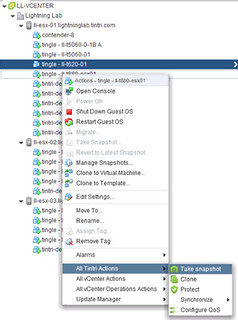
Not just that, if you look at the VMs running on your system from the array side you can also do things like take a storage snapshot, clone the vm, restore the VM, replicate it or set QoS for that VM. Very powerful, all of that is also available in vCenter by the way through a plugin.
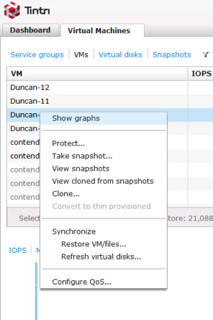
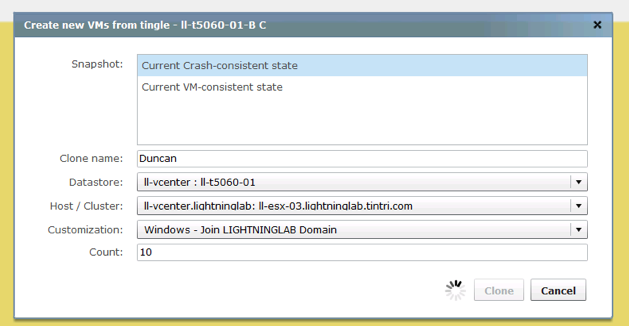
Now when you clone a VM, you can also create many VMs, pretty neat. I say give me 10 with the name Duncan and you get 10 of those called Duncan-01 –> Duncan-10.
Their central management solution is what I was interested in as I had only seen it once in a demo and that is it, it is called Tintri Global Center. Now one thing I have to say, it has been said by some that Tintri offers a scale out solution but the storage system itself is not a scale out system. When they refer to scale out, they refer to the ability to manage all storage systems through a single interface and the ability to group storage systems and load balance between those, which is done through Global Center and their “Pools” functionality. Pools kind of feels like SDRS to me as said in a previous post, now that I have played with it a bit it definitely feels a lot like SDRS. When I was playing with the lab I received the following message.
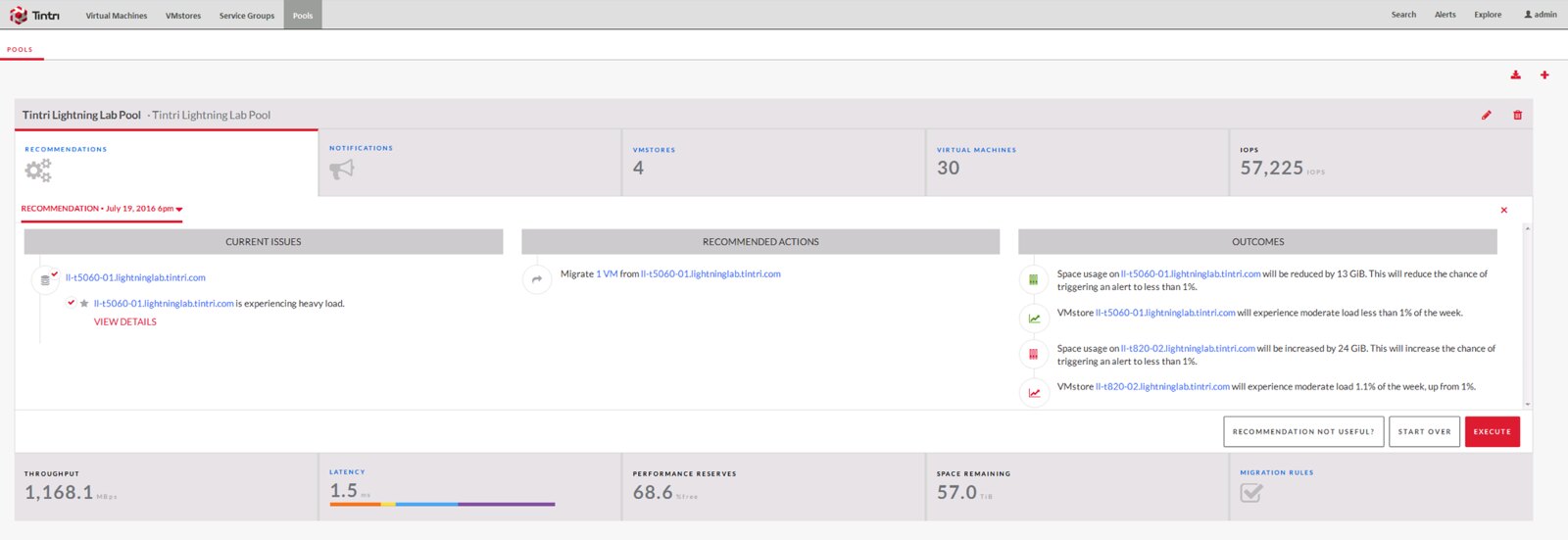
If you have used SDRS at some point in time and look at the screenshot (click it for bigger screenshot) you know what I mean. Anyway, good functionality to have. Pool different arrays and balance between based on space and performance. Nothing wrong with that. But that is not the best thing about Global Center, like I said I like the simplicity of Tintri’s interfaces and that also applies to Global Center. For instance when you login, this is the first you see
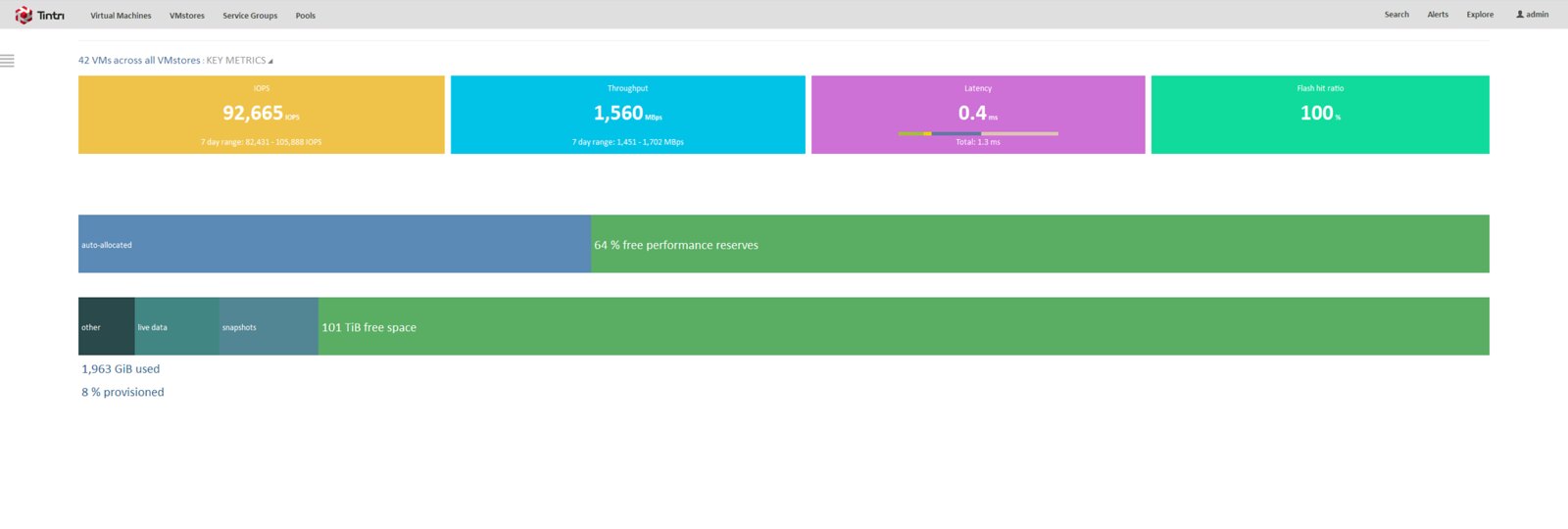
I really like the simplicity, it gives a great overview of the state of the total environment, and at the same time it will give you the ability to dive deeper when needed. You can look for per VMstore details, and figure out where your capacity is going for instance. (Snapshots, live data etc) But also see basic trending in terms of how what VMs are demanding from a storage performance and capacity point of view.
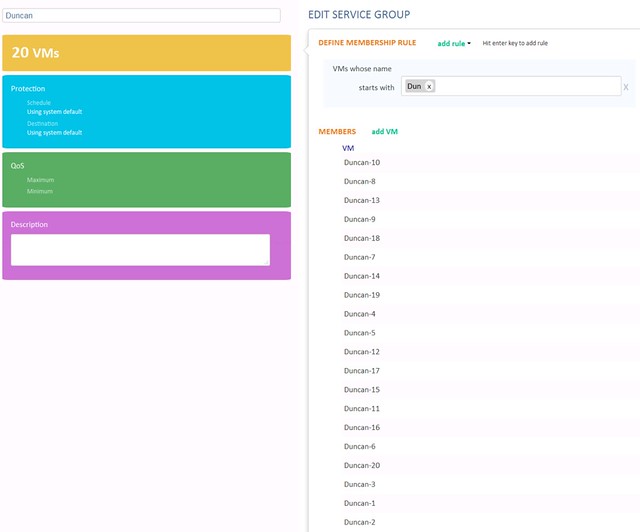
Having said all of that there is one thing that bugs me. Yes Tintri provides a VASA Provider but this is the “old style” VASA Provider which revolves around the datastore. Now if you look at VVols, it is all about the VM and which capabilities it needs. I would definitely welcome VVol support from Tintri, now I can understand this is no big priority for them as they have “similar” functionality, it is just that as a VM-Aware storage system I would expect there to be deep(er) integration from that perspective as well. But that is just me nitpicking I guess, as a VMware employee working for the BU that brought you VVols, it is safe to say I am biased when it comes to this. Tintri does offer an alternative which makes it easy to manage groups of VMs and it is called Service Groups. It allows you to apply data service to a logical grouping, which is defined by a rule. I could for instance say, all VMs that start with “Dun” need to be snapshotted every 5 hours, and this snapshot needs to be replicated etc etc. Pretty powerful stuff, and fairly easy to use as well. Still, for consistency it would be nice to be able to do this through SPBM in vSphere so that if I have other storage systems I can use the same mechanism to define services all through the same interface.
** Update: I was just pointed to the fact that there is a VVol capable VASA Provider, at least according to the VMware HCL. I have not seen the implementation and what is / what is not exposed unfortunately. Also just read the documentation and VVol is indeed supported. With a caveat for some systems: Tintri OS 4.1 supports VMware VMware vSphere Aware Storage API (VASA), 3.0 (VVOL 1.0). The Tintri vCenter Web Client Plugin is not required to run VVOLs on Tintri. VVOLs is not available for Tintri VMstore T540 or T445 systems. Also, the docs I’ve see don’t show the capabilities exposed through VVols unfortunately. **
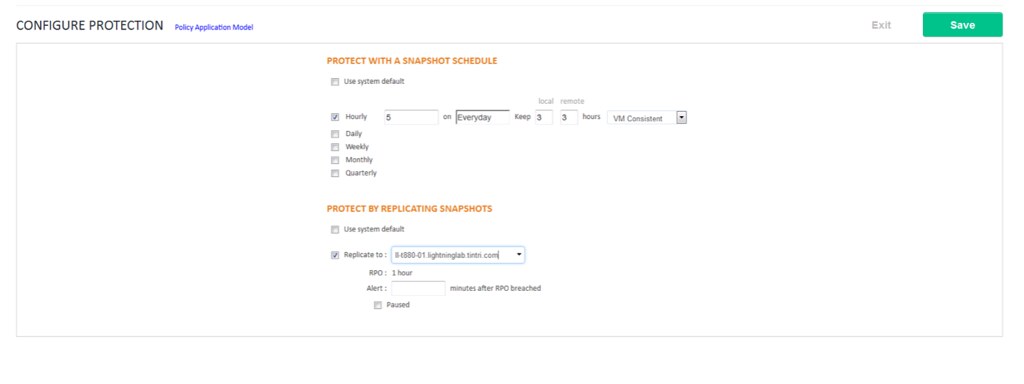
Again, I really liked the simplicity of the solution. The overall user experience was great, I mean taking a snapshot is dead simple. Replicating that snapshot? One click. Clone? One click. QoS? 3 settings. Do I need to say more? Well done Tintri, and looking forward to what you guys will release next and thanks for providing me the opportunity to play around in your lab, I hope I didn’t break anything.
@DuncanYB’s recommended reads part 2
The last edition was 2 weeks ago, in that article I pointed to the rumour of Pernix being acquired by Nutanix and since then it has gone silent. Well almost silent, Frank Denneman has announced he is no longer with Pernix (which was picked up by The Register) so I think it is safe to say there is a truth to the rumour. Sad moment as I really liked the company and really liked the technology, hope the product will live on. I guess time will tell and I am sure that by the time the next edition of recommended reads is published we will have seen an announcement.
- Springpath to focus on Cisco OEM Development
It is an interesting development if true. Springpath is one of the “newer” hyper-converged players and initially sold through various OEMs. Now they seem to solely focus on Cisco, which I guess makes sense as it will make it easier to work on deeper integration with Cisco tooling. Wouldn’t surprise me if Cisco picks these guys up at some point in time. - Build a Xeon D-1500 (Open) Home Lab with me? by Joep Piscaer
I’ve had this Intel proc family and SuperMicro board on my list for the longest time for a homelab, never got around to ordering anything but I have to agree it is a great piece of kit with a lot of power combined with relative low power consumption and a great WAF (wife acceptance factor), read Joep’s post and his wiki entry on OpenHomeLab.org for more details - On the topic of homelabs: Supermicro SuperServer SYS-E300-8D and SYS-E200-8D close-up pictures by Paul Braren (another one by Paul here on the same subject)
This is a nice piece of kit. It also holds the D-1500 CPU, is nice and small and has 10GbE on-board. Could be great for a VSAN lab, small but still packing a lot of power. - Thoughts on Pokemon G0
Nothing to do directly with Infrastructure, but I had to list this as I think it is a brilliant concept. Especially the use of the camera is smart, and I bet it got many kids walking around the neighbourhood instead of sitting on the couch playing on their PS4. Another interesting aspect is that it seems to be bringing people together and have people talking whom normally probably wouldn’t be talking to each other. Plus of course create traffic chaos and dangerous situations as no one is paying attention anymore where they are walking / driving. - Disrupt Your Data Center with Transformative CI & HCI Technologies by Jason Nash
Well not really a blog, but an awesome panel session with Jason Nash, Chad Sakac, Dheeraj Pandey, and Matt Smorto on the hyper-converged market today. Some great insights and good discussion. Always impressed with Chad, I just love the way he handles the discussion/situation during these types of conversations.- Media Headlines by Chad Sakac. Setting the record straight when it comes to the Dell/EMC strategy and hyper-converged offerings. This was a response to an article in The Register, not to the video by the way.
- Samsung 850 EVO SSD 4Tb Review
Not the most exciting article, but more important here is 4TB SSD which is relatively affordable. Prices are still dropping, can I have that 16TB SSD now? Please?! - How the queen of Silicon Valley is helping Google go after Amazon’s most profitable business
Some interesting bits and pieces in here, especially how the organization is being transformed by Diane within Google. - NUMA Deep Dive Part 1: From UMA to NUMA by Frank Denneman
Last one on the list, so it has to be something good. You like deepdives? Well this is going to be your cup of tea then. Frank is diving in to it deep immediately and even followed up with Part 2 in the same week. And this week part 3 and 4 also dropped. Those diagrams by the way are insane… Considering Frank is looking for a new challenge, I wouldn’t be surprised if Intel made him an offer.