• Skip to primary navigation
  • Skip to main content
  • Skip to primary sidebar

Yellow Bricks

by Duncan Epping

  • Home
  • Unexplored Territory Podcast
  • HA Deepdive
  • ESXTOP
  • Stickers/Shirts
  • Privacy Policy
  • About
  • Show Search
Hide Search

Server

Project Fargo aka VMFork and TPS?

Duncan Epping · Nov 11, 2014 ·

I received some questions this week around how VMFork (aka Instant Clone) will work when TPS is disabled in the future, already answered some questions in comments but figured this would be easier to google. First of all, I would like to point out that in future versions TPS will not be globally disabled, but rather it will disabled for inter-VM page collapsing. Within the VM though pages will be collapsed as normal and the way it works is that each virtual machine configuration will contain a salt and all virtual machines with the same salt will share pages… However, each virtual machine by default will have a unique salt. Now this is where a VMFork’ed virtual machine will differ in the future.

VMFork’ed virtual machines in the future will share the salt, which means that “VMFork groups” can be considered a security domain and pages will be shared between all of these VMs. In other words, the parent and all of its children have the same salt and will share pages (see sched.mem.pshare.salt). If you have a different parent then pages between those VMFork Groups (both parents and its children) will not be shared.
Non-Uniform configurations for VSAN clusters

Duncan Epping · Nov 6, 2014 ·

I have been receiving various questions around support for non-uniform configurations in VSAN environments (sometimes also referred to as “unbalanced” configurations) . I was a bit surprised by it to be honest as personally I am not a big fan of non-uniform configurations to begin with. First, with “non-uniform” I am referring to different hardware configurations. In other words you have four hosts with 400GB Intel s3700 flash and one host with 200GB Intel s3500 flash. The question was if this is an acceptable configuration if the overall flash capacity still meets the recommended practice of 10% of used capacity.

Although technically speaking this configuration will work and is supported, from an operational and user experience perspective you need to ask yourself if this is a desired scenario. I have seen people doing these type of constructions out in the field as well with “flash caching” solutions and believe me when I say that the result were very mixed. The problem is that when you have a non-uniform configuration your predictability of performance will be impacted. As you can imagine cutting your flash capacity in half on a host could impact the cache hit ratio for that particular host. Also using a different type of flash will change your results / experience more then likely. On top of that, imagine you need to do maintenance on your hosts, it could be that the “non-uniform” host will have different procedures for whatever maintenance you are doing… it just complicates things unnecessarily.

So again, although this is supported and will work from a technical perspective it is not something I would recommend from an operational and user experience point of view.

(Inter-VM) TPS Disabled by default, what should you do?

Duncan Epping · Oct 27, 2014 ·

We’ve all probably seen the announcement around inter-VM(!!) TPS (transparent page sharing) being disabled by default in future releases of vSphere, and the recommendation to disable it in current versions. The reason for this is the fact there was a research paper published which demonstrates how it is possible to get access to data under certain highly controlled conditions. As the KB article describes:

Published academic papers have demonstrated that by forcing a flush and reload of cache memory, it is possible to measure memory timings to determine an AES encryption key in use on another virtual machine running on the same physical processor of the host server if Transparent Page Sharing is enabled. This technique works only in a highly controlled environment using a non-standard configuration.

There were many people who blogged about what the potential impact is on your environment or designs. Typically in the past people would take a 20 to 30% memory sharing in to account when sizing their environment. With inter-VM TPS disabled of course this goes out of the window. Frank described this nicely in this post. However, as Frank also described and I mentioned in previous articles when large pages are being used (usually the case) then TPS is not used by default and only under pressure…

The under pressure part is important if you ask me as TPS is the first memory reclaiming technique used when a host is under pressure. If TPS cannot sufficiently reduce the memory pressure then ballooning is leveraged, followed by compression and swapping ultimately. Personally I would like to avoid swapping at all costs and preferably compression as well. Ballooning typically doesn’t result in a huge performance degradation so it could be acceptable, but TPS is something I prefer as it just breaks up large pages in to small pages and collapses those when possible. Performance loss is hardly measurable in that case. Of course TPS would be way more effective when pages between VMs can be shared rather then just within the VM.

Anyway, the question remains should you have (inter-VM) TPS disabled or not? When you assess the risk you need to ask yourself first who has access to your virtual machines as the technique requires you to login to a virtual machine. Before we look at the scenarios, not that I mentioned “inter-VM” a couple of times now, TPS is not completely disabled in future versions. It will be disabled for inter-VM sharing by default, but can be enabled. More to be found on that in this article on the vSphere blog.

Lets explore 3 scenarios:

  1. Server virtualisation (private)
  2. Public cloud
  3. Virtual Desktops

In the case of “Server virtualisation”, in most scenarios I would expect that only the system administrators and/or application owners have access to the virtual machines. The question then is, why would they go to this level when they have access to the virtual machines anyway? So in the scenario where Server Virtualization is your use case, and access to your virtual machines is restricted to a limited number of people, I would definitely reconsider enabling inter-VM TPS.

In a public cloud environment this however is different of course. You can imagine that a hacker could buy a virtual machine and try to retrieve the AES encryption key. What he (the hacker) does with it next of course is even then still the question. Hopefully the cloud provider ensures that that the tenants are isolated from each other from a security/networking point of view. If that is the case there shouldn’t be much they could do with it. Then again, it could be just one of the many steps they have to take to break in to a system so I would probably not want to take the risk, although the risk is low. This is one of the scenarios where I would leave inter-VM TPS disabled.

Third and last scenario is Virtual Desktops. In the case of a virtual desktop many different users have access to virtual machines… The question though is if you are running any applications or accessing applications which are leveraging AES encryption or not. I cannot answer that for you, so I will leave that up in the air… you will need to assess that risk.

I guess the answer to whether you should or should not disable (inter-VM) TPS is as always: it depends. I understand why inter-VM TPS was disabled, but if the risk is low I would definitely consider enabling it.

What is coming for vSphere and VSAN? VMworld reveals…

Duncan Epping · Oct 21, 2014 ·

I’ve been prepping a presentation for upcoming VMUGs, but wanted to also share this with my readers. The session is all about vSphere futures, what is coming soon? Before anyone says I am breaking NDA, I’ve harvested all of this info from public VMworld sessions. Except for the VSAN details, those were announced to the press at VMworld EMEA. Lets start with Virtual SAN…

The Virtual SAN details were posted in this Computer Weekly article, and by the looks of it they interviewed VMware’s CEO Pat Gelsinger and Alberto Farronato from the VSAN product team. So what is coming soon?

  • All Flash Virtual SAN support
    Considering the price of MLC has lowered to roughly the same price as SAS HDDs per GB I think this is a great new feature to have. Being able to build all-flash configurations at the price point of a regular configuration, and with probably many supported configurations is a huge advantage of VSAN. I would expect VSAN to support various types of flash as the “capacity” layer, so this is an architects dream… designing your own all-flash storage system!
  • Virsto integration
    I played with Virsto when it was just released and was impressed by the performance and the scalability. Functions that were part of Virst such as snapshots and clones these have been built into VSAN and it will bring VSAN to the next level!
  • JBOD support
    Something many have requested, and primarily to be able to use VSAN in Blade environments… Well with the JBOD support announced this will be a lot easier. I don’t know the exact details, but just the “JBOD” part got me excited.
  • 64 host VSAN cluster support
    VSAN doesn’t scale? Here you go,

That is a nice list by itself, and I am sure there is plenty more for VSAN. At VMworld for instance Wade Holmes also spoke about support for disk controller based encryption for instance. Cool right?! So what about vSphere? Considering even the version number was dropped during the keynote and it hints at a major release you would expect some big functionality to be introduced. Once again, all the stuff below is harvested from various public VMworld sessions:

  • VMFork aka Project Fargo – discussed here…
  • Increased scale!
    • 64 host HA/DRS cluster, I know a handful of customers who asked for 64 host clusters, so here it is guys… or better said: soon you will have it!
  • SMP vCPU FT – up to 4 vCPU support
    • I like FT from an innovation point of view, but it isn’t a feature I would personally use too much as I feel “fault tolerance” from an app perspective needs to be solved by the app. Now, I do realize that there are MANY legacy applications out there, and if you have a scale-up application which needs to be highly available then SMP FT is very useful. Do note that with this release the architecture of FT has changed. For instance you used to share the same “VMDK” for both primary and secondary, but that is no longer the case.
  • vMotion across anything
    • vMotion across vCenter instances
    • vMotion across Distributed Switch
    • vMotion across very large distance, support up to 100ms latency
    • vMotion to vCloud Air datacenter
  • Introduction of Virtual Datacenter concept in vCenter
    • Enhance “policy driven” experience within vCenter. Virtual Datacenter aggregates compute clusters, storage clusters, networks, and policies!
  • Content Library
    • Content Library provides storage and versioning of files including VM templates, ISOs, and OVFs.
      Includes powerful publish and subscribe features to replicate content
      Backed by vSphere Datastores or NFS
  • Web Client performance / enhancement
    • Recent tasks pane drops to the bottom instead of on the right
    • Performance vastly improved
    • Menus flattened
  • DRS placement “network aware”
    • Hosts with high network contention can show low CPU and memory usage, DRS will look for more VM placements
    • Provide network bandwidth reservation for VMs and migrate VMs in response to reservation violations!
  • vSphere HA component protection
    • Helps when hitting “all paths down” situations by allowing HA to take action on impacted virtual machines
  • Virtual Volumes, bringing the VSAN “policy goodness” to traditional storage systems

Of course there is more, but these are the ones that were discussed at VMworld… for the remainder you will have to wait until the next version of vSphere is released, or you can also sign up for the beta still I believe!

VMworld attendees: Give Back!

Duncan Epping · Oct 14, 2014 ·

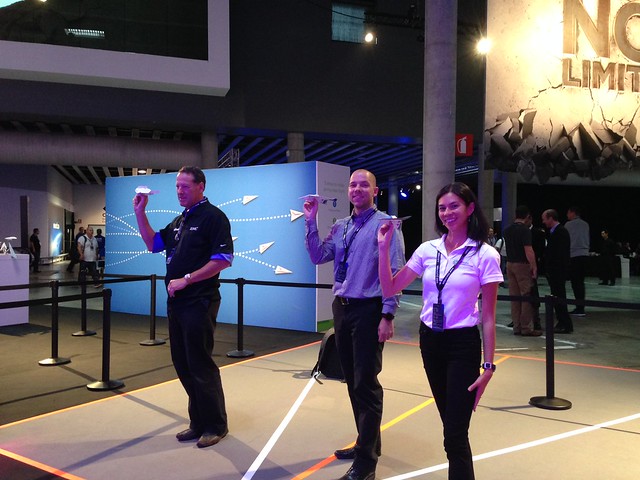
Always wanted to give back to the community but can’t find the time? How about VMware help you with that? If you are attending VMworld Europe you can simply do this by going to the hangspace and throw a paper airplane as far as you can. The VMware Foundation did the same thing in the US and it was a big success, I am hoping we can repeat that! The amount that will be donated will depend on where your airplane lands. It could be as little as 15 dollars, but also easily a 1000. I just went to the hangspace and threw a paper airplane  with my friend Jessica from the VMware Foundation and and former colleague but now EMC, Paul Manning.

Take the time, go to the hangspace… it literally only takes 2 minutes and give back!

  • « Go to Previous Page
  • Page 1
  • Interim pages omitted …
  • Page 96
  • Page 97
  • Page 98
  • Page 99
  • Page 100
  • Interim pages omitted …
  • Page 336
  • Go to Next Page »

Primary Sidebar

About the Author

Duncan Epping is a Chief Technologist and Distinguished Engineering Architect at Broadcom. Besides writing on Yellow-Bricks, Duncan is the co-author of the vSAN Deep Dive and the vSphere Clustering Deep Dive book series. Duncan is also the host of the Unexplored Territory Podcast.

Follow Us

  • X
  • Spotify
  • RSS Feed
  • LinkedIn

Recommended Book(s)

Also visit!

For the Dutch-speaking audience, make sure to visit RunNerd.nl to follow my running adventure, read shoe/gear/race reviews, and more!

Do you like Hardcore-Punk music? Follow my Spotify Playlist!

Do you like 80s music? I got you covered!

Copyright Yellow-Bricks.com © 2026 · Log in