• Skip to primary navigation
  • Skip to main content
  • Skip to primary sidebar

Yellow Bricks

by Duncan Epping

  • Home
  • Unexplored Territory Podcast
  • HA Deepdive
  • ESXTOP
  • Stickers/Shirts
  • Privacy Policy
  • About
  • Show Search
Hide Search

Server

New fling: DRS Lens

Duncan Epping · Jul 14, 2017 ·

A cool new fling was just released: DRS Lens. As stated on the flings website:

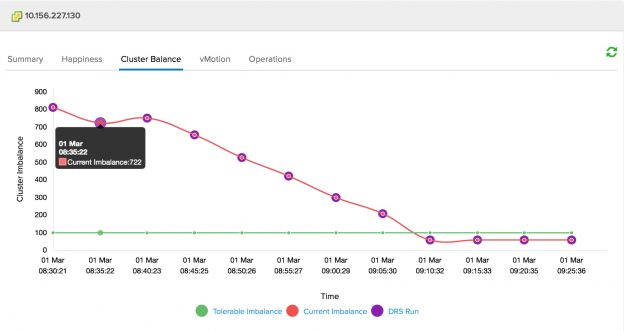
DRS Lens provides a simple, yet powerful interface to highlight the value proposition of vSphere DRS. Providing answers to simple questions about DRS will help quell many of the common concerns that users may have. DRS Lens provides different dashboards in the form of tabs for each cluster being monitored.

It tracks things like VM Happiness, balance of the cluster itself, User and System initiated vMotions etc. It truly allow you to dig in to your cluster and it could be very useful during cross cluster rebalancing, or trying to figure out where an imbalance is coming from by correlating different vCenter tasks/events to resource contention / VM unhappiness situations. I hope to see this info in the HTML-5 UI at some point! If you are interested, download the fling, give it a try and provide feedback through the comments, the developers will read those and follow up! https://labs.vmware.com/flings/drs-lens
 

VMkernel Observations (VOBs)

Duncan Epping · Jul 7, 2017 ·

I never really looked at VOBs but as this came up last week during a customer meeting I decided to look in to it a bit. I hadn’t realized there was such a large number of them in the first place. My conversation was in the context of vSAN, but there are many different VOBs. For those who don’t know VOBs are system events. These events are logged and you can create different alarms for when they are being logged.

You can check the full list of VOBs on ESXi, SSH in to it and then look at this file:

  • /usr/lib/vmware/hostd/extensions/hostdiag/locale/en/event.vmsg

When they are triggered you will see them here:

  •  /var/log/vobd.log

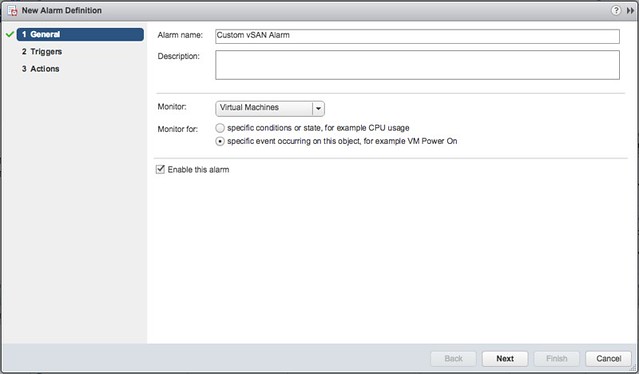
And as stated when you want to do something with them you can create a customer alarm. Select “specific event occuring on this object” and click next:

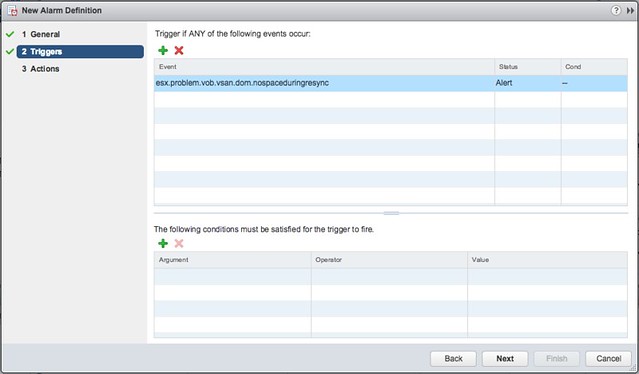
Now you add an event, simply click the “+” and remove the current value and simply copy/paste the VOB string in, the string will look something like this: “esx.problem.vob.vsan.pdl.offline”. Hit enter when you added it and then click “Next” and “Finish”.

I find the following useful myself:

  • esx.problem.vsan.net.redundancy.reduced
  • esx.problem.vob.vsan.lsom.componentthreshold
  • esx.problem.vob.vsan.lsom.diskerror
  • esx.problem.vob.vsan.pdl.offline
  • esx.problem.vsan.lsom.congestionthreshold
  • esx.problem.vob.vsan.dom.nospaceduringresync

There are many more, and I just listed those I found useful for vSAN, for more detail check the following links:

  • https://docs.vmware.com/en/VMware-vSphere/6.0/com.vmware.vsphere.virtualsan.doc/GUID-FB21AEB8-204D-4B40-B154-42F58D332966.html
  • http://www.virtuallyghetto.com/2015/03/new-vobs-for-creating-vcenter-server-alarms-in-vsphere-6-0.html
  • http://www.virtuallyghetto.com/2014/04/handy-vsan-vobs-for-creating-vcenter-alarms.html
  • http://www.virtuallyghetto.com/2014/04/other-handy-vsphere-vobs-for-creating-vcenter-alarms.html


Virtually Speaking Podcast: VMworld 2017 Preview

Duncan Epping · Jun 29, 2017 ·

I had the pleasure to be on the Virtually Speaking Podcast again, this episode is all about VMworld. Which sessions to attend and some general tips as well. Have a listen. Thanks John and Pete for having me on again.

Must have book: Host Resources Deep Dive

Duncan Epping · Jun 20, 2017 ·

Yesterday I was fortunate enough to receive a copy of a new book by Frank Denneman and Niels Hagoort. This new book is titled Host Resources Deep Dive and is available as of today in the US through Amazon. As most of you know I wrote the Clustering Deepdive series together with Frank, which means I kinda knew what to expect in terms of level of depth. Kinda, as this is a whole new level of depth. I don’t think I have ever seen (for example) topics like NUMA or NIC drivers explained at this level of depth. If you ask me, it is fair to say that Frank and Niels redefined the term “deep dive”.
Some fun facts before I write a bit more about the book:

  • Started writing in March 2016
  • 122.543 words
  • 5217 paragraphs
  • 23 chapters
  • 569 pages
  • 311 screenshots and diagrams
  • ISBN-10: 1540873064
  • ISBN-13: 978-1540873064

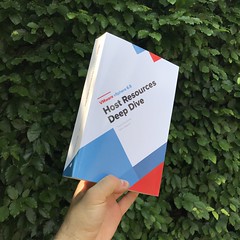
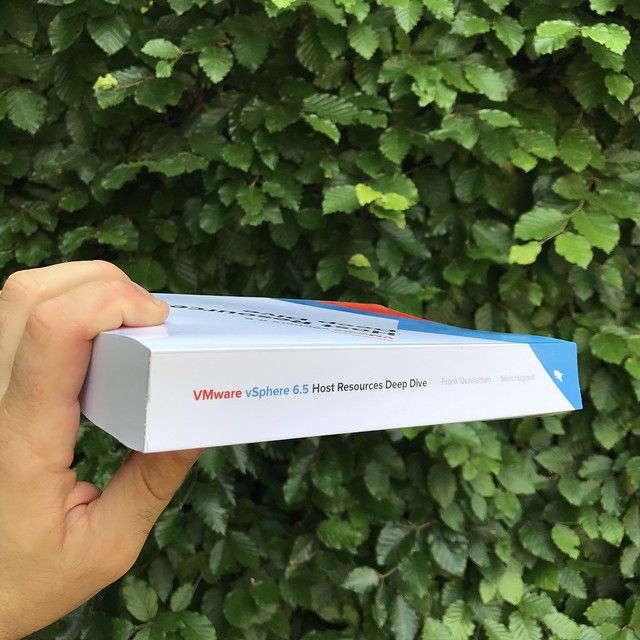
569 pages and 120k+ words… that is a lot. Especially considering this is “only” covering “host resources” and not things like HA and DRS. It is thick, this is a proper book, I took a quick pic, just to give you an idea.

As mentioned, the topic is Host Resources, but what does that mean? The book is carved up in 4 sections: CPU, Memory, Storage and Networking. The book starts with a great foreword by VMware’s CTO Kit Colbert. And then each section starts with a prologue. Frank and Niels managed to ask 4 industry titans if you ask me to write these prologues. VMware’s CEO Pat Gelsinger wrote the CPU prologue. Carl Waldspurger, the inventor of TPS and DRS, wrote the Memory prologue. The CTO for Storage & Availability, Christos Karamanolis, wrote the Storage prologue. Last but definitely not least, Andrew Lambeth (VMware Fellow), who was responsible for the ESX network stack and was part of the team who developed NSX (in the Nicira days!), wrote the Network prologue. A great addition if you ask me to excellent content.

Now that you know the book discusses CPU, Memory, Storage and Networking, what kind of topics can you expect? Well this is what Amazon states, which is spot on: This book explains the concepts and mechanisms behind the physical resource components and the VMkernel resource schedulers, which enables you to:

  • Optimize your workload for current and future Non-Uniform Memory Access (NUMA) systems.
  • Discover how vSphere Balanced Power Management takes advantage of the CPU Turbo Boost functionality, and why High Performance does not.
  • How the 3-DIMMs per Channel configuration results in a 10-20% performance drop.
  • How TLB works and why it is bad to disable large pages in virtualized environments.
  • Why 3D XPoint is perfect for the vSAN caching tier.
  • What queues are and where they live inside the end-to-end storage data paths.
  • Tune VMkernel components to optimize performance for VXLAN network traffic and NFV environments.
  • Why Intel’s Data Plane Development Kit significantly boosts packet processing performance.

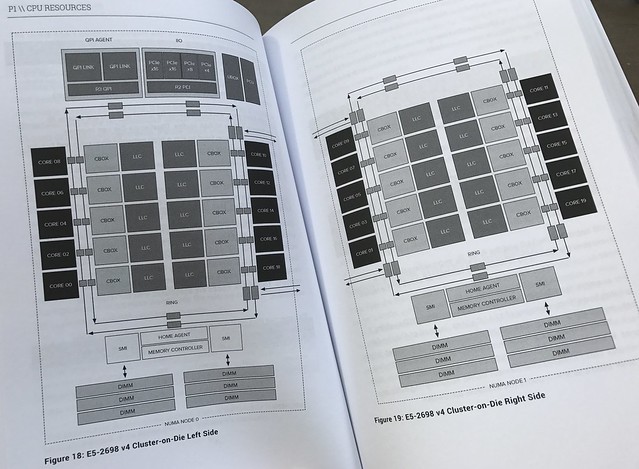
What is unique about this book, in my opinion, is that it contains details on various topics which I have not been abled to find anywhere else. I guess the fact that Frank had various conversations with the lead architect for the Intel Xeon CPU Microarchitecture helped (Chris Gianos). Some of the diagrams on NUMA for instance, I could easily see Intel wanting to use them for their documentation.

One more quote from Frank and Niels on the book, which I think describes the essence:

The idea is to debunk long-lived myths and reinvigorate the extraordinary world of virtualization. We hope to wake them up, and get them to shy away from the statement that the hypervisor is commodity. While the customers and partners where focusing on creating platforms that run on top the hypervisor, they have lost sight of the improvements of hardware and software made the last 5 years. Revealing these features allow them to create better performing systems that are easier to manage. The book is all about the focus on host level building blocks that helps you to create and operate a consistent infrastructure layer that runs modern and future compute, network and storage platforms.

What more can I say? Just go out and pick it up! Now it is time for me to relax in my chair and get educated! (Don’t tell my daughter though I am relaxing in her chair :))

Vote for your fav bloggers / podcast etc!

Duncan Epping · Jun 1, 2017 ·

The time has come again, vote for your top blog / podcast etc! Just a heads up, I decided to have my blog removed from the list. I have been listed in the top 10 for the past 9 years and had the number 1 spot for the past 8 editions. I felt it was time for new blood to enter the top 10. It was time for a big change. Eric’s blog lists what he feels people should be basing their votes/ranking on. I sincerely hope though that people will look at the list in a different way this year. Last year I strongly felt that William deserved to win, but I suspect a lot of people voted for me for “longevity” reasons and what I produced in the years before.

I would like to ask people to look at the list in a different way this year and vote based on what people produced over the past 12 months. Who stood out the past 12 months, who produced those awesome deep dives, who had unique material and didn’t just copy the release notes, or produced just “next next finish” type blogs, or just copied/pasted the slides from blogger briefings. I know frequency is part of Eric’s list. Personally I rank a person with 10 high quality deep dives higher than someone with 100 ‘next next finish’ posts. (While the ‘next next finish’ posts may get more google clicks, it has hardly any value in my opinion.)

Let me list a couple of blogs that stood out to me for various reasons, I am not going to list the full top 12 I voted for, just 5 people I wanted to call out for various reasons:

  • Cormac Hogan – Currently listed as number 3, high quality and high quantity, always love to read his insights / opinion on startups etc! Having worked with Cormac on papers / books, I know how fast he knocks out material, it is insane.
  • William Lam – Currently listed as number 2, high quality and high quantity number of blogs, with really unique content. Is there anyone sharing more unique info than William these days? I don’t think so.
  • Cody Hosterman – Currently listed as number 54. What stood out to me, Cody is not a VMware employee, but the level of depth and detail in his blogs are astonishing. Hence he got a place in my top 12!
  • Myles Gray – One of the “newer” bloggers. Some great networking blogs on there with content I have not seen anywhere else, it is time for some new folks to bubble up!
  • Luc Dekens – He has been around for ages. Hasn’t really received the respect, from a top bloggers point of view, he deserves. The undisputed king of PowerCLI and VMTN response time, and a great blogger.

Honourable mention: Brian Graf aka vTagion. His blog posts on HA/DRS last year around the release were awesome, but than again he was the PM for those products so I didn’t expect anything else.

Oh and before I forget, my fav podcast: Virtually Speaking with Pete Flecha and John Nicholson for sure. Only one I tune in to every week! Anyway, I hope you folks all go over the list in a similar way. Think about the past 12 months and which blogs helped you the most, which were unique, which stood out consistently. Think outside the box, don’t vote on someone simply because he was in the top 25 last year. Vote for them based on what they have produced the past 12 months!

http://topvblog2017.questionpro.com/

  • « Go to Previous Page
  • Page 1
  • Interim pages omitted …
  • Page 53
  • Page 54
  • Page 55
  • Page 56
  • Page 57
  • Interim pages omitted …
  • Page 336
  • Go to Next Page »

Primary Sidebar

About the Author

Duncan Epping is a Chief Technologist and Distinguished Engineering Architect at Broadcom. Besides writing on Yellow-Bricks, Duncan is the co-author of the vSAN Deep Dive and the vSphere Clustering Deep Dive book series. Duncan is also the host of the Unexplored Territory Podcast.

Follow Us

  • X
  • Spotify
  • RSS Feed
  • LinkedIn

Recommended Book(s)

Also visit!

For the Dutch-speaking audience, make sure to visit RunNerd.nl to follow my running adventure, read shoe/gear/race reviews, and more!

Do you like Hardcore-Punk music? Follow my Spotify Playlist!

Do you like 80s music? I got you covered!

Copyright Yellow-Bricks.com © 2026 · Log in