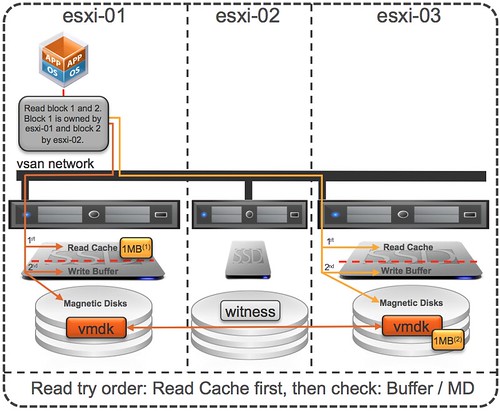
I had a question around how Virtual SAN read IO is handled when data can be anywhere: read cache, write buffer, disks. On VMTN one of the engineers recently explained this. I figured I would create a quick diagram to illustrate it. Basically how it works is that VSAN will check the read cache, if the block that needs to be read is not available in the read cache it will check whether the block is in the write buffer or on disk. Simple right?
In the scenario I drew below two blocks needs to be read. Block 1 is actively served by ESXi-01 and Block 2 is actively served by ESXi-03. In the case of ESXi-01 the block resides in the read cache so it is read from the cache. In the case of ESXi-03 it is not in the read cache and neither in the write buffer, hence it is read from the magnetic disks. Do note that this is 1 virtual machine, so reads are being served from 2 hosts and depending who is actively serving IO for that block the block can reside on that host in the read cache. The host which is not actively serving IO for that block will also not place the block in the read cache! (Of course if the host which is actively serving IO for a block fails the other host will take over.)
I hope that helps.
 Yeah that title got your attention right… For now it is just me writing about it and nothing has been announced or promised. At VMworld I believe it was Intel who demonstrated the possibilities in this space, an All Flash Virtual SAN. A couple of weeks back during my holiday someone pointed me to a couple of articles which were around SSD endurance. Typically these types of articles deal with the upper-end of the spectrum and as such are irrelevant to most of us, and some of the articles I have read in the past around endurance were disappointing to be honest.
