• Skip to primary navigation
  • Skip to main content
  • Skip to primary sidebar

Yellow Bricks

by Duncan Epping

  • Home
  • Unexplored Territory Podcast
  • HA Deepdive
  • ESXTOP
  • Stickers/Shirts
  • Privacy Policy
  • About
  • Show Search
Hide Search

Software Defined

Startup News Flash part 14

Duncan Epping · Mar 3, 2014 ·

Part 13 of the Startup News Flash… Hopefully not an unlucky one for the startups featured. Just a short one considering I am in Vietnam and away ‘from work’ for the last 2 weeks.

A3Cube is a startup which came out of stealth recently and announced as they call it a ‘brain inspired’ data plane encapsulated in a NIC designed to bridge supercomputing benefits to the enterprise. The core of their solution is called Ronnie Express. They aim is to eliminate the I/O performance gap between CPU power and data access performance for HPC, Big Data and data center applications. A3CUBE’s In-Memory Network technology allows direct shared non-coherent global memory across the entire network, enabling global communication based on shared memory segments and direct load/store operations between the nodes. Basically a server “interconnect” solutions for lrge scale. They took the word “scale” serious by the way and can go up to 64,000 nodes. For more details, I highly recommend to read this excellent article by Enrico.

Infinio just announced Infinio Accelerator 1.2. This new version of the Infinio Accelerator now supports vSphere 5.5. Useful to know for those who have a home lab, Infinio is running a limited-time offer of free non-expiring licenses for test labs. Hit their website to find out more.
What is Virtual SAN really about?

Duncan Epping · Feb 18, 2014 ·

When talking about Virtual SAN you hear a lot of people talking about the benefits, what Virtual SAN is essentially about. You see the same with various other so-called Software Defined Storage solutions. People typically, when talking about these solutions, talk about things like “enabling within 2 clicks”… Or maybe about how easy it is to scale out, or scale-up for that matter. How much performance you have because of the way they use flash drives. Or about some of the advanced data services they offer.

While all of these are important, when it comes to Virtual SAN I don’t think that is the true strength. Sure, it is great to be able to provide a well performing easy to install scale-out storage solution… but the true strength in my opinion is: Policy Based Management & Integration. After having worked with VSAN for months, that is probably what stood out the most… policy based management

What does this deep integration and what do these policies allow you to do?

  • It provides the ability to specify both Performance and Availability characteristics using the UI (Web Client) or through the API.
    • Number of replicas
    • Stripe width
    • Cache reservations
    • Space reservations
  • It allows you to apply policies to your workload in an easy way through the UI (or API).
  • It provides the ability to do this in a granular way, per VMDK and not per datastore.
  • To a group of VMs or even all VMs in a programmatic way when needed.

Over the last couple of months I have played extensively with this feature of VSAN and vCenter, and in my opinion it is by far the biggest benefit of a hypervisor-converged storage solution. Deep integration with the platform, exposed in a simplistic VM-centric way through the Web Client and/or the vSphere APIs.

Startup News Flash part 13

Duncan Epping · Feb 13, 2014 ·

Edition 13 of the Startup News Flash already. This week is VMware Partner Exchange 2014 so I expected some announcements to be made. There were a couple of announcements the last week(s) which I felt were worth highlighting. There is one that is not really a startup, but I figured should at least be included in the article and that is the fact that Scale.IO and SuperMicro / LSI / Mellanox / VMware showed an appliance at PEX that was optimized for View deployments. I found it an interesting move, and appealing solution. Chris Mellor wrote an article about it here for the Register.

DataGravity announced their Partner Early Access Program this week. They haven’t revealed what they are building, but judging by the quotes in the announcement publication they are aiming to bring a simple cost-effictive solution to enable analysis of unstructured data. Definitely interesting, and something I will look more closer in to at some point in time.

Atlantis ILIO USX was announced this week. I already mentioned it in my VSAN update. Atlantis ILIO USX is an in-memory storage solution. They added the ability to pool and optimize any class of storage including SAN, NAS, RAM or any type of DAS (SSD, Flash, SAS, SATA) to create a hybrid solution. A change of direction for Atlantis as there primary focus was caching so far, but it makes a lot of sense to me especially as they already have many of the data services for their caching platform.

PernixData announced their Beta program for FVP 1.5. They added support for vSphere 5.5, the vSphere Web Client and also in this version allow you to use a different VMkernel interface other than the vMotion interface which their product uses by default. If you want to know more, Chris Wahl wrote a nice article on his experience with FVP 1.5.

Tintri announced it has closed a $75 million Series E funding round led by Insight Venture Partners, with participation from existing investors Lightspeed Venture, Menlo Ventures and NEA. Good to see Tintri getting another boost, and will be interesting to see how they move forward. I have been following them from the very start and have always been impressed with the ease of the solution they have built.

Virtual SAN (related) PEX Updates

Duncan Epping · Feb 12, 2014 ·

I am at VMware Partner Exchange this week and there and figured I would share some of the Virtual SAN related updates.

  • 6th of March their is an online Virtual SAN event with Pat Gelsinger, Ben Fathi and John Gilmartin… Make sure to register for it!
  • Ben Fathi (VMware CTO) stated that VSAN will be GA in Q1, more news in the upcoming weeks
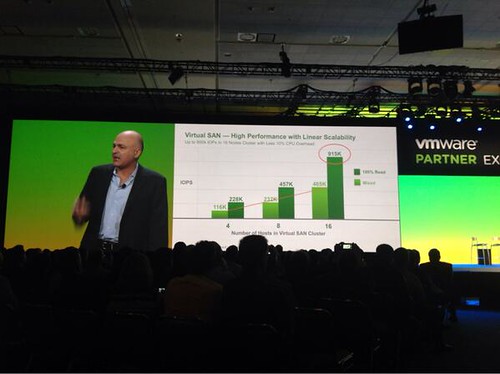
  • Maximum cluster size has been increased from 8 (beta) to 16 according to Ben Fathi, VMware VSAN engineering team is ahead of schedule!
  • VSAN has linear scalability, close to a million IOPS with 16 hosts in a cluster (100% read, 4K blocks). Mixed IOPS close to half a million. All of this with less than 10% CPU/Memory overhead. That is impressive if you ask me. Yeah yeah I know, numbers like these are just a part of the overall story… still it is nice to see that this kind of performance numbers can be achieved with VSAN.
  • I noticed a tweet Chetan Venkatesh and it looks like Atlantis ILIO USX (in memory storage solution) has been tested on top of VSAN and they were capable of hitting 120K IOPS using 3 hosts, WOW. There is a white paper on this topic to be found here, interesting read.
  • It was also reinstated that customers who sign up and download the beta will get a 20% discount on the first purchase of 10 VSAN licenses or more!
  • Several hardware vendors announced support for VSAN, a nice short summary by Alberto to be found here.

vSphere HA and VMs per Datastore limit!

Duncan Epping · Feb 5, 2014 ·

I felt I would need to get this out there, as it is not something many seem to be aware off . More and more people are starting to use storage solutions which offer 1 large shared datastore, examples are solutions like Virtual SAN, Tintri and Nutanix. I have seen various folks saying: unlimited number of VMs per datastore, but of course there are limits to everything! If you are planning to build a big cluster (HA enabled), keep in mind that per cluster your limit for a datastore is 2048 powered-on virtual machines! Say what? Yes that is right, per cluster you are limited to 2048 powered-on VMs on a single datastore. This is documented in the Max Config Guide of both vSphere 5.5 and vSphere 5.1. Please note it says datastore and not VMFS or NFS explicitly, this applies to both!

The reason for this today is the vSphere HA poweron list. I described that list in this article, in short: this list keeps track of the power-state of your virtual machines If you need more VMs in your cluster than 2048 you will need to create multiple datastores for now. (More details in the blog post) Do note that this is a known limitation and I have been told that the engineering team is researching a solution to this problem. Hopefully it will be in one of the upcoming releases.

  • « Go to Previous Page
  • Page 1
  • Interim pages omitted …
  • Page 54
  • Page 55
  • Page 56
  • Page 57
  • Page 58
  • Interim pages omitted …
  • Page 71
  • Go to Next Page »

Primary Sidebar

About the Author

Duncan Epping is a Chief Technologist and Distinguished Engineering Architect at Broadcom. Besides writing on Yellow-Bricks, Duncan is the co-author of the vSAN Deep Dive and the vSphere Clustering Deep Dive book series. Duncan is also the host of the Unexplored Territory Podcast.

Follow Us

  • X
  • Spotify
  • RSS Feed
  • LinkedIn

Recommended Book(s)

Also visit!

For the Dutch-speaking audience, make sure to visit RunNerd.nl to follow my running adventure, read shoe/gear/race reviews, and more!

Do you like Hardcore-Punk music? Follow my Spotify Playlist!

Do you like 80s music? I got you covered!

Copyright Yellow-Bricks.com © 2026 · Log in