• Skip to primary navigation
  • Skip to main content
  • Skip to primary sidebar

Yellow Bricks

by Duncan Epping

  • Home
  • Unexplored Territory Podcast
  • HA Deepdive
  • ESXTOP
  • Stickers/Shirts
  • Privacy Policy
  • About
  • Show Search
Hide Search

Software Defined

Virtual SAN >> vSAN, and grown to 5500 customers!

Duncan Epping · Oct 28, 2016 ·

Not that it is a big deal, but as some people are like me they probably prefer to use the right name. As of this week Virtual SAN was renamed to vSAN. I am not sure we will see the change in the product in 6.5 (I doubt it) and even the website changes will take a while, but expect to see this soon.

The correct name is vSAN. The small v shows the integration with vSphere. https://t.co/3FAHPCqFdA

— Lee Caswell (@leecaswell) October 24, 2016

Oh, and before I forget, there was the Q3 earnings announcement, vSAN is still growing strong, 5500 customers at the moment! And lets not forget: “software license bookings continue to exceed expectations with vSAN and VxRail increasing over 150% year over year.” I say: Bring on Q4! And I can’t wait for 6.5 to ship 🙂
vSphere 6.5 what’s new – Storage IO Control

Duncan Epping · Oct 26, 2016 ·

There are many enhancements in vSphere 6.5, an overhaul of Storage IO Control is one of them. In vSphere 6.5 Storage IO Control has been reimplemented by leveraging the VAIO framework. For those who don’t know VAIO stands for vSphere APIs for IO Filtering. This is basically a framework that allows you to filter (storage) IO and do things with it. So far we have seen caching and replication filters from 3rd party vendors, and now a Quality of Service filter from VMware.

Storage IO Control has been around for a while and hasn’t really changed that much since its inception. It is one of those features that people take for granted and you actually don’t know you have turned on in most cases. Why? Well Storage IO Control (SIOC) only comes in to play when there is contention. When it does come in to play it ensure that every VM gets its fair share of storage resources. (I am not going to explain the basics, read this posts for more details.) Why the change in SIOC design/implementation? Well fairly simple, the VAIO framework enabled policy based management. This goes for caching, replication and indeed also QoS. Instead of configuring disks or VMs individually, you will now have the ability to specify configuration details in a VM Storage Policy and assign that policy to a VM or VMDK. But before you do, make sure you enable SIOC first on a datastore level and set the appropriate latency threshold. Lets take a look at how all of this will work:

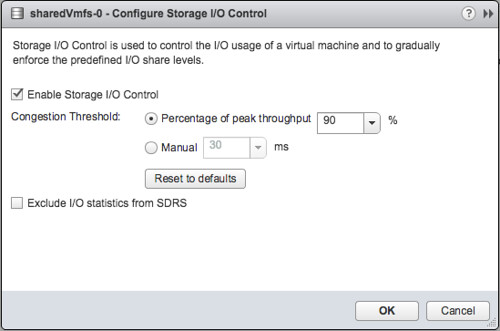
  • Go to your VMFS or NFS Datastore and right click datastore and click “Configure SIOC” and enable SIOC
  • By default the congestion threshold is set to 90% of peak throughput you can change this percentage or specify a latency threshold manually by defining the number of miliseconds latency
  • Now go to the VM Storage Policy section
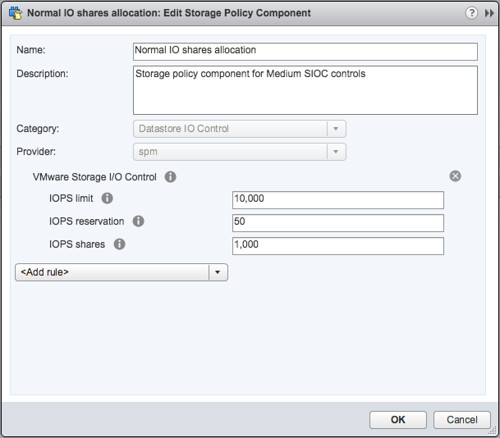
  • Go to Storage Policy Components section first and check out the pre-created policy components, below I show “Normal” as an example
  • If you want you can also create a Storage Policy Component yourself and specify custom shares, limits and a reservation. Personally I would prefer to do this when using SIOC and probably remove the limit if there is no need for it. Why limit a VM on IOPS when there is no contention? And if there is contention, well then SIOC shares based distribution of resource will be applied.
  • Next you will need to do is create a VM Storage Policy, click that tab and click “create VM storage policy”
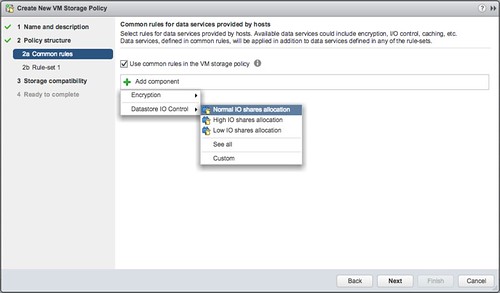
  • Give the policy a name and next you can select which components to use
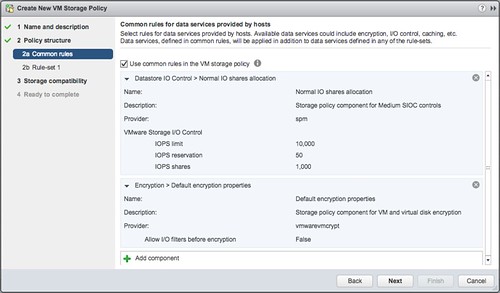
  • In my case I select the “Normal IO shares allocation” and I also add Encryption, just so we know what that looks like. If you have other data services, like replication for instance, you could even stack those on top. That is what I love about the VAIO Framework.
  • Now you can add rules, I am not going to do this. And next the compatible datastores will be presented and that is it.
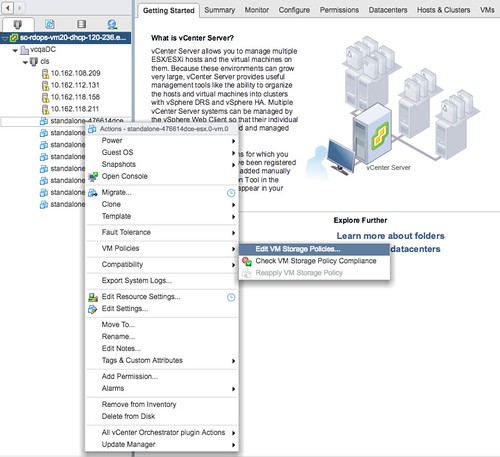
  • You can now assign the policy to a VM. You do this by right clicking a particular VM and select “VM Policies” and then “Edit VM Storage Policies”
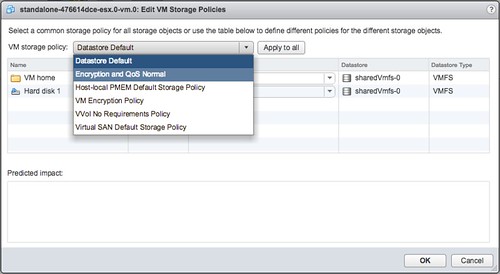
  • Now you can decide which VM Storage Policy to apply to the disk. Select your policy from the dropdown and then click “apply to all”, at least when that is what you would like to do.
  • When you have applied the policy to the VM you simply click “OK” and now the policy will be applied to the VM and for instance the VMDK.

And that is it, you are done. Compared to previous versions of Storage Policy Based Management this may all be a bit confusing with the Storage Policy Components, but believe me it is very powerful and it will make your life easier. Mix and match whatever you require for a workload and simply apply it.

Before I forget, note that the filter driver at this point is used to enforce limits only. Shares and the Reservation still leverages the mClock scheduler.


vSphere 6.5 what’s new – VVols

Duncan Epping · Oct 20, 2016 ·

Well I guess I can keep this one short, what is new for VVols? Replication. Yes, that is right… finally if you ask me. This is something I know many of my customers have been waiting for. I’ve seen various customers deploy VVols in production, but many were holding off because of the lack of support for Replication and with vSphere 6.5 that has just been introduced. Note that alongside with new VVol capabilities we have also introduced VASA 3.0. VASA 3.0 provides Policy Components in the SPBM UI which allows you to combine for instance a VVol policy with a VAIO Filter based solution like VMCrypt / Encryption or for instance Replication or Caching from a third party vendor.

When it comes to replication I think it is good to know that there will be Day 0 support from both Nimble and HPE 3PAR. More vendors can be expected soon. Not only is replication per object supported, but also replication groups. Replication groups can be viewed as consistency groups, but also a unit of granularity for failover. By default each VM will be in its own replication group, but if you need some form of consistency or would like a group of VMs always to failover at the same time then they can be lumped together through using the replication group option.

There is a full set of APIs available by the way, and I would expect most storage vendors to provide some tooling around their specific implementation. Note that through the API you will for instance be able to “failover” or do a “test failover” and even reverse replication if and when desired. Also, this release will come with a set of new PowerCLI cmdlets which will also allow you to failover and reverse replication, I can’t remember having seen the test failover cmdlet but as it is also possible through the API that should not be rocket science for those who need this functionality. Soon I will have some more stuff to share with regards to scripting DR scenarios…

vSphere 6.5 what’s new – DRS

Duncan Epping · Oct 19, 2016 ·

Most of us have been using DRS for the longest time. To be honest, not much has changed over the past years, sure there were some tweaks and minor changes but nothing huge. In 6.5 however there is a big feature introduced, but lets just list them all for completeness sake:

  • Predictive DRS
  • Network-Aware DRS enhancements
  • DRS profiles

First of all Predictive DRS. This is a feature that the DRS team has been working on for a while. It is a feature that integrates DRS with VROps to provide placement and balancing decisions. Note that this feature will be in Tech Preview until vRealize Operations releases their version of vROPs which will be fully compatible with vSphere 6.5, hopefully sometime in the first half of next year. Brian Graf has some additional details around this feature here by the way.

Note that of course DRS will continue to use the data provided by vCenter Server, it will on top of that however also leverage VROps to predict what resource usage will look like, all of this based on historic data. You can imagine a VM currently using 4GB of memory (demand), however every day around the same time a SQL Job runs which makes the memory demand spike up to 8GB. This data is available through VROps now and as such when making placement/balancing recommendations this predicted resource spike can now be taken in to consideration. If for whatever reason however the prediction is that the resource consumption will be lower then DRS will ignore the prediction and simply take current resource usage in to account, just to be safe. (Which makes sense if you ask me.) Oh and before I forget, DRS will look ahead for 60 minutes (3600 seconds).

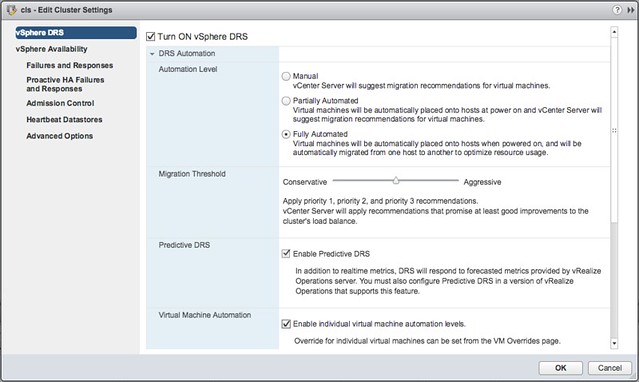
How do you configure this? Well that is fairly straight forward when you have VROps running, go to your DRS cluster and click edit settings and enable the “Predictive DRS” option. Easy right? (See screenshot below) You can also change that look ahead value by the way, I wouldn’t recommend it though but if you like you can add an advanced setting called ProactiveDrsLookaheadIntervalSecs.

One of the other features that people have asked about is the consideration of additional metrics during placement/load balancing. This is what Network-Aware DRS brings. Within Network IO Control (v3) it is possible to set a reservation for a VM in terms of network bandwidth and have DRS consider this. This was introduced in vSphere 6.0 and now with 6.5 has been improved. With 6.5 DRS also takes physical NIC utilization in to consideration, when a host has higher than 80% network utilization it will consider this host to be saturated and not consider placing new VMs.

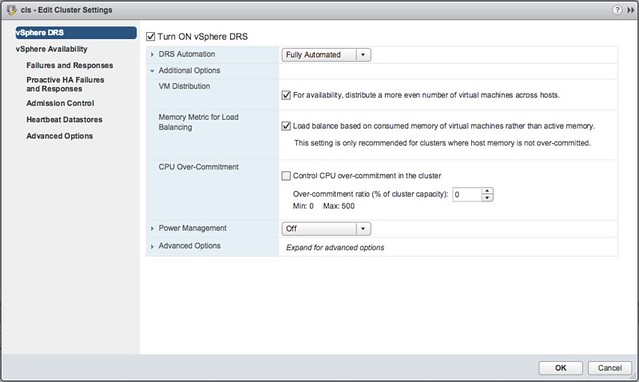
And lastly, DRS Profiles. So what are these? In the past we’ve seen many new advanced settings introduced which allowed you to tweak the way DRS balanced your cluster. In 6.5 several additional options have been added to the UI to make it easier for you to tweak DRS balancing, if and when needed that is as I would expect that for the majority of DRS users this would not be the case. Lets look at each of the new options:

So there are 3 options here:

  • VM Distribution
  • Memory Metric for Load Balancing
  • CPU Over-Commitment

If you look at the description then I think they make a lot of sense. Especially the first two options are options I get asked about every once in a while. Some people prefer to have a more equally balanced cluster in terms of number of VMs per host, which can be done by enable “VM Distribution”. And for those who much rather load balance on “consumed” vs “active” memory you can also enable this. Now the “consumed” vs “active” is almost a religious debate, personally I don’t see too much value, especially not in a world where memory pages are zeroed when a VM boots and consumed is always high for all VMs, but nevertheless if you prefer you can balance on consumed instead. Last is the CPU Over-Commitment, this is one that could be useful when you want to limit the number of vCPUs per pCPU, apparently this is something that many VDI customers have asked for.

I hope that was useful, we are aiming to update the vSphere Clustering Deepdive at some point as well to include some of these details…

What is new for Virtual SAN 6.5?

Duncan Epping · Oct 18, 2016 ·

As most of you have seen by the explosion of tweets, Virtual SAN 6.5 was just announced. Some may wonder how 6.5 can be announced so fast after the Beta Announcement, well this is not the same release. This release has a couple of key new features, lets look at those:

  • Virtual SAN iSCSI Service
  • 2-Node Direct Connect
    • Witness Traffic Separation for ROBO
  • 512e drive support

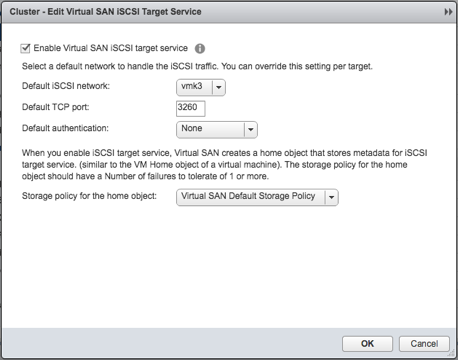
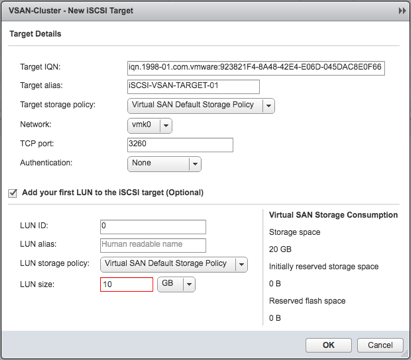
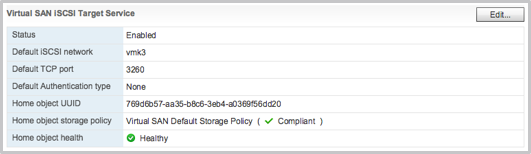
Lets start with the biggest feature of this release, at least in my opinion, Virtual SAN iSCSI Service. This provides what you would think it provides: the ability to create iSCSI targets and LUNs and expose those to the outside world. These LUNs by the way are just VSAN objects, and these objects have a storage policy assigned to them. This means that you get iSCSI LUNs with the ability to change performance and/or availability on the fly. All of it through the interface you are familiar with, the Web Client. Let me show you how to enable it:

  • Enable the iSCSI Target Service
  • Create a target, and a LUN in the same interface if desired
  • Done

How easy is that? Note that there are some restrictions in terms of use cases. It is primarily targeting physical workloads and Oracle RAC. It is not intended for connecting to other vSphere clusters for instance. Also, you can have a max of 1024 LUNs per cluster and 128 targets per cluster at most. LUN capacity limit is 62TB.

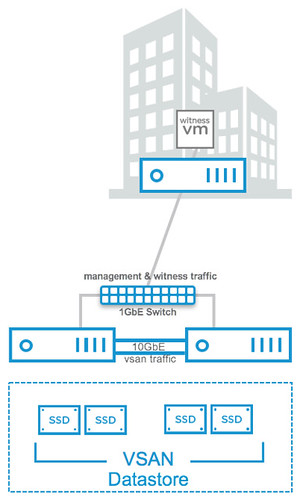
Next up on the list is 2-node direct connect. What does this mean? Well it basically means you can now cross-connect two VSAN hosts with a simple ethernet cable as shown in the diagram in the right. Big benefit of course is that you can equip your hosts with 10GbE NICs and get 10GbE performance for your VSAN traffic (and vMotion for instance) but don’t incur the cost of a 10GbE switch.

This can make a huge difference when it comes to total cost of ownership. In order to achieve this though you will also need to setup a separate VMkernel interface for Witness Traffic. And this is the next feature I wanted to mention briefly. For 2-node configurations it will be possible as of VSAN 6.5 to separate witness traffic by tagging a VMkernel interface as a designated witness interface. There’s a simple “esxcli” command for it, note that <X> needs to be replaced with the number of the VMkernel interface:

esxcli vsan network ip set -i vmk<X> -T=witness

Then there is the support for 512e drives, note that 4k native is not supported at this point. Not sure what more to say about it than that… It speaks for itself.

Oh and one more thing… All-Flash has been moved down from a licensing perspective to “Standard“. This means anyone can now deploy all-flash configuration at no additional licensing cost. Considering how fast the world is moving to all-flash I think this only makes sense. Note though that data services like dedupe/compression/raid-5/raid-6 are still part of VSAN Advanced. Nevertheless, I am very happy about this positive licensing change!

  • « Go to Previous Page
  • Page 1
  • Interim pages omitted …
  • Page 26
  • Page 27
  • Page 28
  • Page 29
  • Page 30
  • Interim pages omitted …
  • Page 71
  • Go to Next Page »

Primary Sidebar

About the Author

Duncan Epping is a Chief Technologist and Distinguished Engineering Architect at Broadcom. Besides writing on Yellow-Bricks, Duncan is the co-author of the vSAN Deep Dive and the vSphere Clustering Deep Dive book series. Duncan is also the host of the Unexplored Territory Podcast.

Follow Us

  • X
  • Spotify
  • RSS Feed
  • LinkedIn

Recommended Book(s)

Also visit!

For the Dutch-speaking audience, make sure to visit RunNerd.nl to follow my running adventure, read shoe/gear/race reviews, and more!

Do you like Hardcore-Punk music? Follow my Spotify Playlist!

Do you like 80s music? I got you covered!

Copyright Yellow-Bricks.com © 2026 · Log in