• Skip to primary navigation
  • Skip to main content
  • Skip to primary sidebar

Yellow Bricks

by Duncan Epping

  • Home
  • Unexplored Territory Podcast
  • HA Deepdive
  • ESXTOP
  • Stickers/Shirts
  • Privacy Policy
  • About
  • Show Search
Hide Search

Software Defined

New white paper available: vSphere APIs for I/O Filtering (VAIO)

Duncan Epping · Oct 13, 2017 ·

Over the past couple of weeks Cormac Hogan and I have been updating various Core Storage white papers which had not been touched in a while for different reasons. We were starting to see more and more requests come in for update content and as both of used to be responsible for this at some point in the past we figured we would update the papers and then hand them over to technical marketing for “maintenance” updates in the future.

You can expect a whole series of papers in the upcoming weeks on storagehub.vmware.com and the first one was just published. It is on the topic of the vSphere APIs for I/O Filtering and provides an overview of what it is, where it sits in the I/O path and how you can benefit from it. I would suggest downloading the paper, or reading it online on storagehub:
  • vSphere APIs for I/O Filtering White Paper online
  • vSphere APIs for I/O Filtering White Paper download

What is the overhead for Swap in a stretched cluster?

Duncan Epping · Oct 10, 2017 ·

Last week internally we had a debate about the overhead of a swap file in a stretched cluster. With the ability to have a double protection (across site and within a site) the question was what the overhead for a swap file would be. You can imagine that for a stretched cluster you set your VMs to have RAID-1 across site and RAID-1 within or RAID-5 within the site. (Depending on whether you have all-flash or not.) So the question is, how many copies of the swap file would you end up with?

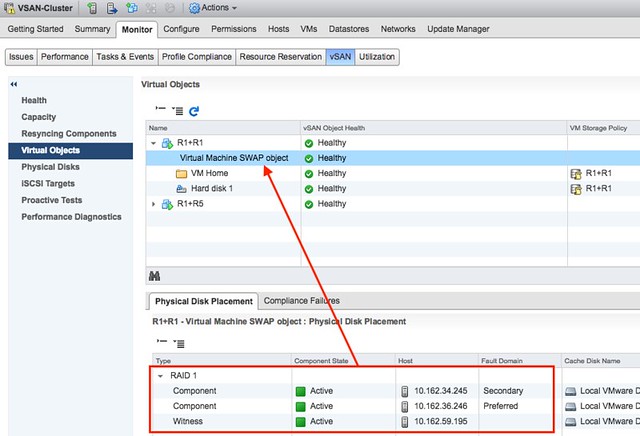
The swap file with vSAN is a special object. Regardless of how the policy you associate with the VM, it is always created as a RAID-1 object. This goes for a normal cluster as well as a stretched cluster. That means that the Swap object will always consist of 3 components. Two of those are data components and one of them is a witness.

In the first screenshot you see a VM which is called R1+R1. This VM has Primary Failures To Tolerate (PFTT) set to 1 and Secondary Failures To Tolerate (SFTT) set to 1. The swap however, as it is a special object, is created with PFTT=1 and SFTT=0 as the screenshot shows. It has 1 data component in each site, and a witness in the witness site.

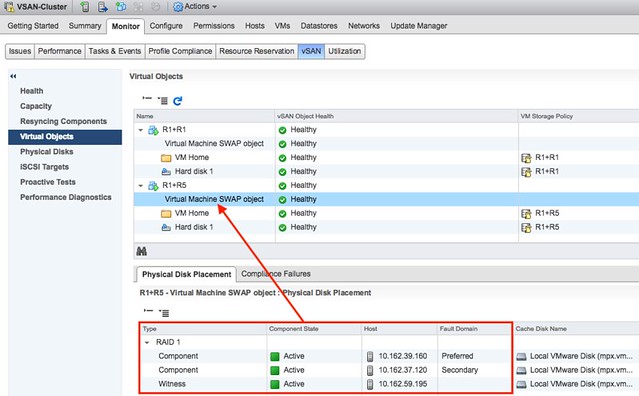
Same applies for the situation when PFTT=1 and SFTT=1 but the failure tolerance method selected is RAID-5. In that case the swap file is also PFTT=1 and SFTT=0 as shown in the screenshot below.

And of course I also double checked through RVC:

vsan.object_info . bf7fdc59-dd62-2983-ee34-02002304a139

DOM Object: bf7fdc59-dd62-2983-ee34-02002304a139 
(v5, owner: 10.162.39.160, proxy owner: None, policy: hostFailuresToTolerate = 1, 
forceProvisioning = 1, proportionalCapacity = 100, CSN = 2)
  RAID_1
    Component: bf7fdc59-86bc-4884-d236-02002304a139 
      (state: ACTIVE (5), host: 10.162.39.160, md: mpx.vmhba1:C0:T1:L0, ssd: mpx.vmhba1:C0:T4:L0,
      votes: 1, usage: 4.1 GB, proxy component: false)
    Component: bf7fdc59-1830-4b84-5138-02002304a139 
      (state: ACTIVE (5), host: 10.162.37.120, md: mpx.vmhba1:C0:T2:L0, ssd: mpx.vmhba1:C0:T4:L0,
      votes: 1, usage: 4.1 GB, proxy component: false)
    Witness: bf7fdc59-6f4a-4d84-725b-02002304a139 
      (state: ACTIVE (5), host: 10.162.59.195, md: mpx.vmhba1:C0:T1:L0, ssd: mpx.vmhba1:C0:T4:L0,
      votes: 1, usage: 0.0 GB, proxy component: false)

So this means the overhead of swap is always “only” 100%. However, you can of course create “thin swapfiles” when you are not over-provisioning on memory and avoid that cost completely!

Which disk controller to use for vSAN

Duncan Epping · Sep 28, 2017 ·

I have many customers going through the plan and design phase for implementing a vSAN based infrastructure. Many of them have conversations with OEMs and this typically results in a set of recommendations in terms of which hardware to purchase. One thing that seems to be a recurring theme is the question which disk controller a customer should buy. The typical recommendation seems to be the most beefy disk controller on the list. I wrote about this a while ago as well, and want to re-emphasize my thinking. Before I do, I understand why these recommendations are being made. Traditionally with local storage devices selecting the high-end disk controller made sense. It provided a lot of options you needed to have a decent performance and also availability of your data. With vSAN however this is not needed, this is all provided by our software layer.

When it comes to disk controllers my recommendation is simple: go for the simplest device on the list that has a good queue depth. Just to give an example, the Dell H730 disk controller is often recommended, but if you look at the vSAN Compatibility Guide then you will also see the HBA330. The big difference between these two is the RAID functionality offered on the H730 and the cache on the controller. Again, this functionality is not needed for vSAN, by going for the HBA330 you will save money. (For HP I would recommend the H240 disk controller.)

Having said that, I would at the same time recommend customers to consider NVMe for the caching tier instead of SAS or SATA connected flash. Why, well for the caching layer it makes sense to avoid the disk controller. Place the flash as close to the CPU as you can get for low latency high throughput. In other words, invest the money you are saving on the more expensive disk controller in NVMe connected flash for the caching layer.

VMworld vSAN Sessions Playlist

Duncan Epping · Sep 27, 2017 ·

I just created a simple playlist up on youtube which has most (if not all) vSAN sessions on there. If you are interested in vSAN simply have a look at the playlist and pick what you want to watch.

Sharing the “Top 10 things to know about vSAN” slides…

Duncan Epping · Sep 19, 2017 ·

I was asked by a few people to share the slides for our Top 10 vSAN session at VMworld. Instead of sending the slides around via email I figured I would simply throw it up on slideshare and share it here.

  • « Go to Previous Page
  • Page 1
  • Interim pages omitted …
  • Page 17
  • Page 18
  • Page 19
  • Page 20
  • Page 21
  • Interim pages omitted …
  • Page 71
  • Go to Next Page »

Primary Sidebar

About the Author

Duncan Epping is a Chief Technologist and Distinguished Engineering Architect at Broadcom. Besides writing on Yellow-Bricks, Duncan is the co-author of the vSAN Deep Dive and the vSphere Clustering Deep Dive book series. Duncan is also the host of the Unexplored Territory Podcast.

Follow Us

  • X
  • Spotify
  • RSS Feed
  • LinkedIn

Recommended Book(s)

Also visit!

For the Dutch-speaking audience, make sure to visit RunNerd.nl to follow my running adventure, read shoe/gear/race reviews, and more!

Do you like Hardcore-Punk music? Follow my Spotify Playlist!

Do you like 80s music? I got you covered!

Copyright Yellow-Bricks.com © 2026 · Log in