• Skip to primary navigation
  • Skip to main content
  • Skip to primary sidebar

Yellow Bricks

by Duncan Epping

  • Home
  • Unexplored Territory Podcast
  • HA Deepdive
  • ESXTOP
  • Stickers/Shirts
  • Privacy Policy
  • About
  • Show Search
Hide Search

Management & Automation

You wanted VMTN back? VMUG to the rescue!

Duncan Epping · Jan 15, 2015 ·

I’ve written about VMTN in the past and discussed the return of VMTN many times within VMware with various people all the way up to our CTO. Unfortunately due to various reasons it never happened, but fortunately the VMUG organization jumped on to it not too long ago and managed to get it revamped. If you are interested in it then see the blurb below, visit the VMUG website and sign up. I can’t tell you how excited I am about this and how surprised I was that the VMUG team has managed to pull this off in a relatively short time frame. Thanks VMUG!

Source: VMUG – EVALExperience!
VMware and VMUG have partnered with Kivuto Solutions to provide VMUG Advantage Subscribers a customized web portal that provides VMUG Advantage Subscribers with self-service capability to download software and license keys. Licenses to available VMware products are regularly updated and posted to the self-service web portal. The licenses available to VMUG Advantage Subscribers are 365-day evaluation licenses that require a one-time, annual download. Annual product downloads ensure that Subscribers receive the most up-to-date versions of products.

Included products are:

  • VMware vCenter Server™ 5 Standalone for vSphere 5
  • VMware vSphere® with Operations Management™ Enterprise Plus
  • VMware vCloud Suite® Standard
  • VMware vRealize™ Operations Insight™
  • VMware vRealize Operations™ 6 Enterprise
  • VMware vRealize Log Insight™
  • VMware vRealize Operations for Horizon®
  • VMware Horizon® Advanced Edition
  • VMware Virtual SAN™

A new 365 entitlement will be offered with the renewal of your yearly VMUG Advantage Subscription. Software is provided to VMUG Advantage Subscribers with no associated entitlement to support services, and users may not purchase such services in association with the EVALExperience licenses.

We are DevOps

Duncan Epping · Nov 27, 2014 ·

devopsOver the last couple of months I have started running in to more and more customers who are wondering what that DevOps thing is they keep hearing about. They want to know if they need to start hiring DevOps engineers and which software they need to procure for DevOps. I more or less already alluded to what I think it really is or means in my blog post about The Phoenix Project, let me re-use a quote from the review that I wrote for that book:

After reading the book I am actually left wondering if DevOps is the right term, as it is more BizDevOps then anything else. All of IT enabling the development of business through operational efficiency / simplicity.

DevOps is not something you buy, it is not about specific tools you use, it is a state-of-mind … an operational model, a certain level of maturity. I would argue that it is just a new fancy way of describing IT maturity. At VMware we have had this professional services engagement called Operational Readiness where IT (Ops and Dev) and business owners would be interviewed to identify the shortcomings in terms of the IT offerings and agility, the outcome would a set of recommendations that would allow an organization to align better with the business demands. (This engagement has been around for at least 6 years now to my knowledge.)

Typically these types of engagements would revolve around people and process and focus less on the actual tools used. The theme of the recommendations generally was around breaking down the silos in IT (between the various teams in an IT department: dev / ops / security / networking / storage), and of course reviewing processes / procedures. It is strange how even today we still encounter the same types of problems we encountered years ago. You can deploy a new virtual machine in literally minutes, you can configure physical servers in about 10 minutes (when the installation is fully automated)… yet it takes 3 weeks to get a networking port configured, 2 weeks to get additional LUNs, 4 days to prepare that test/dev environment or even worse the standard change process from start to finish takes 6 weeks.

What is probably most striking is that we live in an ever changing world, the pace at which this happens is unbelievably fast and we happen to work in the industry which enables this… Yet, when you look at IT (in most cases) we forget to review our processes (or design) and do not challenge the way we are doing things today. We (no not you I know, but that guy sitting next to you) take what was described 5 years ago and blindly automate that. We use the processes we developed for the physical world in a virtualized world, and we apply the same security policies and regulations to a virtual machine as to a physical machine. In many cases, unfortunately, from a people perspective things are even far worse… no communication whatsoever between the silos besides through an ancient helpdesk ticketing tool probably, sadly enough.

In todays world, if you want to stay relevant, it is important that you can anticipate as fast as possible to the (ever changing) demands of your business / customers. IT has the power to enable this. This is what this so-called “Operational Readiness” was there for, identify the operational and organizational pain-points, solve them and break down those silos to cater for the business needs. In todays world the expected level of operational maturity is a couple of levels higher even, and that level is what people (to a certain extent) refer to when they talk about DevOps in my opinion.

So the question then remains, what can you do to ensure you stay relevant? Lets make it clear that DevOps is not something you buy, it is not a role in your organization, and it is not a specific product, it is an IT mindset… hence the title: we are DevOps. Joe Baguley’s keynote at the UK VMUG was recorded, and although he did not drop the word DevOps he does talk about staying relevant, what it is IT does (provide applications), how you can help your company to beat the competition and what your focus should be. (On top of that, he does look DevOps with his beard and t-shirt!) I highly recommend watching this thought provoking keynote. Make sure to sit down afterwards, do nothing for 30 to 60 minutes besides reflecting back on what you have done the last 12 months and then think about what it is you can do to improve business development, whether new or existing markets, for your company.

Project Fargo aka VMFork and TPS?

Duncan Epping · Nov 11, 2014 ·

I received some questions this week around how VMFork (aka Instant Clone) will work when TPS is disabled in the future, already answered some questions in comments but figured this would be easier to google. First of all, I would like to point out that in future versions TPS will not be globally disabled, but rather it will disabled for inter-VM page collapsing. Within the VM though pages will be collapsed as normal and the way it works is that each virtual machine configuration will contain a salt and all virtual machines with the same salt will share pages… However, each virtual machine by default will have a unique salt. Now this is where a VMFork’ed virtual machine will differ in the future.

VMFork’ed virtual machines in the future will share the salt, which means that “VMFork groups” can be considered a security domain and pages will be shared between all of these VMs. In other words, the parent and all of its children have the same salt and will share pages (see sched.mem.pshare.salt). If you have a different parent then pages between those VMFork Groups (both parents and its children) will not be shared.

Startup Into: Platform9

Duncan Epping · Aug 13, 2014 ·

Yesterday a startup came out of stealth which was founded by a couple of former VMware veterans. I happen to know the majority of them, and have had the pleasure to have worked with them on various things in the past. For instance Platform9‘s three of the four co-founders were all heavily involved in vCloud Director, and the fourth co-founder was VMware employee number 27… but that is not where it stops… there is much more talent on-board. But that is not what this blog is about, this blog is about Platform9, the new company that they have formed and the product they are building.

** note, I did not test the product… it is impossible to provide an analysis of what works / does not work and how they play in this space or compete with others, this is based on a conversation and a demo **

Platform9 is as they say themselves:

… the easiest way for enterprises to implement a private cloud, with intelligent, self-service provisioning of workloads onto their computing infrastructure.

  • 100% Cloud Managed: Platform9’s cloud-based model means that there is no complex management software to setup, monitor and upgrade, thus simplifying the operational experience.
  • Single Pane of Glass: Platform9 offers unified management across diverse environments – Docker, KVM and VMware vSphere – across datacenters and geographies.
  • Based on OpenStack: Platform9 customers get the best of OpenStack with 100% API compatibility.

When I met them last month, they gave a demo and showed me what they had implemented so far: Management of KVM based hypervisors using a very easy to use and slick using web-based user interface. Where the whole management solution was running in “the cloud”.

Creating a new “instance” was literally a few clicks, snapshotting / cloning it… same thing, just a couple of clicks. Now what stood out to me during the demo was the use of the word “instance” instead of “virtual machine”. So I asked them why not “virtual machine”, considering they are all VMware veterans that made more sense to me. The explanation was simple: we want to manage multiple layers. We want to manage KVM VMs, vSphere VMs but for instance also Docker containers. That is why we used a different term than we would normally use… and yes that did make sense to me. I also wondered if they would be able to mix different environments and type of instance in their UI, and the answer was yes. Docker containers, KVM VMs, vSphere VMs (etc) will also be seen in the same single pane of glass. I really like the fact that Platform9 did not limit themselves to just vSphere, or just VMs but rather is focusing on the needs of developers and providing what they require.

Similar to CloudPhysics, Platform9 is taking SaaS approach. The major benefit of course being the agility at which new features/functionality can be introduced to the outside world, or tested against a small subset of customers. Same of course applies to bug fixes / updates. No need to do that yourself, Platform9 will take care of that for you. Promising indeed.

Now there is a lot of competition in this space, as also emphasized by  Ben Kepes in his post on Platform9… But to be honest, if I look at one of the examples listed like ServiceMesh, they seem to cater for a completely different market. Platform9 is all about simplicity and managing instances, not so much about creating complex recipes etc. I agree though that there are a lot of vendors playing in this space (and as such competition), or somewhat related space, but that makes it even more interesting to see how Platform9 evolves in my opinion.

For more info, a demo, or a trial:

Platform9 will showcase its product in its booth #324 at VMware’s VMworld Conference, taking place the week of August 25th in San Francisco. The product is currently in beta with general availability planned for later this year. Platform9 currently supports KVM with upcoming support for Docker and VMware vSphere. To register for a free trial, go to: http://www.platform9.com.

CloudPhysics Storage Analytics and new round of funding

Duncan Epping · Jun 24, 2014 ·

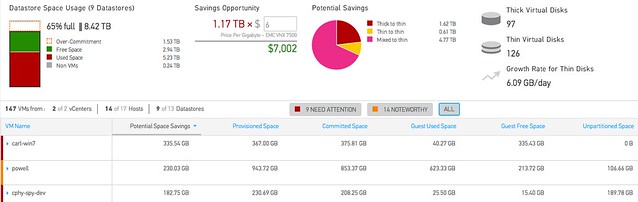
When I just woke up I saw the news was out… A new round of funding for CloudPhysics! CloudPhysics raised $15 million in a series C investment round, bringing the company’s total funding to $27.5 million! Congratulations folks, I can’t wait to see what this new injection will result in to. One of the things that CloudPhysics heavily invested in to the past 12 months has been the storage side of the house. In their SaaS based solution one of the major pillars today is Storage Analytics, along side General Health Checks and Simulations.

The Storage Analytics section is available as of today to everyone out there! It will allow you to monitor things like “datastore contention”, “unused VMs” and everything there is to know about capacity savings ranging from inside the guest to datastore level details. If you ever wondered how “big data” could be of use to you, I am sure you will understand when you start using CloudPhysics. Not just their monitoring and simulation cards are brilliant, the Card Builder is definitely one of their hidden gems. If you need to convince your management, than all you should do is show the above screenshot: savings opportunity!

Of course there is a lot more to it than I will be able to write about in this short post. In my opinion if you truly want to understand what they bring to the table, just try it out for free for 30 days here!

PS: How about this brilliant Infographic… from the people who taught you how to fight the noisy neighbour, they now show you how to defeat that bully!

**disclaimer: I am an advisor to CloudPhysics **

  • « Go to Previous Page
  • Page 1
  • Interim pages omitted …
  • Page 5
  • Page 6
  • Page 7
  • Page 8
  • Page 9
  • Interim pages omitted …
  • Page 44
  • Go to Next Page »

Primary Sidebar

About the Author

Duncan Epping is a Chief Technologist and Distinguished Engineering Architect at Broadcom. Besides writing on Yellow-Bricks, Duncan is the co-author of the vSAN Deep Dive and the vSphere Clustering Deep Dive book series. Duncan is also the host of the Unexplored Territory Podcast.

Follow Us

  • X
  • Spotify
  • RSS Feed
  • LinkedIn

Recommended Book(s)

Also visit!

For the Dutch-speaking audience, make sure to visit RunNerd.nl to follow my running adventure, read shoe/gear/race reviews, and more!

Do you like Hardcore-Punk music? Follow my Spotify Playlist!

Do you like 80s music? I got you covered!

Copyright Yellow-Bricks.com © 2026 · Log in