• Skip to primary navigation
  • Skip to main content
  • Skip to primary sidebar

Yellow Bricks

by Duncan Epping

  • Home
  • Unexplored Territory Podcast
  • HA Deepdive
  • ESXTOP
  • Stickers/Shirts
  • Privacy Policy
  • About
  • Show Search
Hide Search

Management & Automation

vSphere Quick Start Guide – PowerCLI and PDF

Duncan Epping · Jan 10, 2010 ·

Alan Renouf posted an article on the vSphere Quick Start Guide we recently wrote which triggered this article. First let me quote from Alan’s article:

I was responsible for adding all the PowerCLI throughout the book, basically if something is explained and there is an easy way to do it in PowerCLI, we have added a code reference, this enables you to see how much is covered by PowerCLI and also how easy it actually is.

In writing the PowerCLI areas I didn’t actually realise how many we had put in until the book was completed and I extracted them all into a nice zip file which can be downloaded and used from here: http://www.yellow-bricks.com/wp-content/uploads/quickstartguide.zip

All in all there are 67 scripts, now obviously if you want to know more information about these scripts and exactly where they fit in you will need to buy the book.

Download these scripts as they will definitely help you manage your environment better and more consistent. Secondly they will help you learn Powershell/PowerCLI faster, especially if you also own the book. Which is the second part of this post, the book… it’s available in print via Amazon and Lulu. But also available as a PDF via Lulu. You can find the links below, but keep in mind that depending on shipping costs sometimes the US one might be cheaper. Let me also be crystal clear about the PDF, it’s a separate item. If you want the PDF you will need to order it. We do however have added it to our “must haves” for the next book, we hope we will be able to offer a printed and pdf version in one package by then.

Anyway, close to 2000 copies have been sold by now. Amazon has books on stock which should make a fast delivery possible.

Amazon – US $15.99
Lulu – Europe: € 14.29
Lulu – PDF: €7.14 / $9.99

Cool Tool Update: RVTools 2.7.3

Duncan Epping · Dec 19, 2009 ·

Rob de Veij has just updated RVTools to version 2.7.3. This excellent tool now includes the following additional features and fixes:

Version 2.7.3 (December 19, 2009)

  • Files in .snapshot directories are no longer reported as zombies.
  • CTK files are no longer reported as zombies.
  • The problems with VM files which are placed in the root directory are now solved.
  • Under some condition the filter screen terminated with an exception. This is fixed now.
  • New fields on vDisk tab: ThinProvisioned and split.
  • New field on vTools tab: Virtual machine hardware version.

Read the full releasenotes/documentation here. And make sure to get this new version, in my opinion this is one of the most valuable tools out there.

vscsiStats output in esxtop format?

Duncan Epping · Dec 17, 2009 ·

This week we(Frank Denneman and I) played around with vscsiStats, it’s a weird command and hard to get used to when you normally dive into esxtop when there are performance issues. While asking around for more info on the metrics and values someone emailed us nfstop. I assumed it was NDA or at least not suitable for publication yet  but William Lam pointed me to a topic on the VMTN Communities which contains this great script. Definitely worth checking out. This tool parses the vscsiStats output into an esxtop format. Below a screenshot of what that looks like:

Book: VMware VI and vSphere SDK

Duncan Epping · Dec 13, 2009 ·

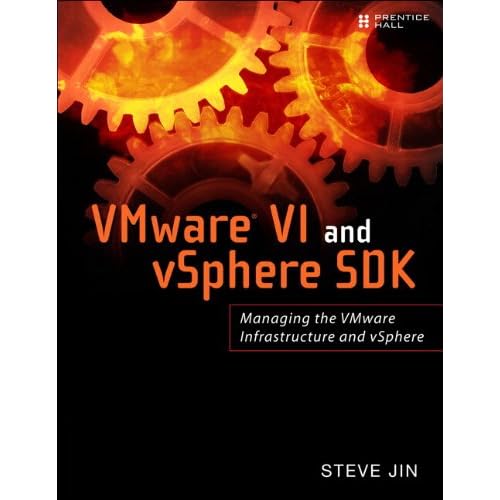
I received Steve Jin’s book VMware VI and vSphere SDK: Managing the VMware Infrastructure and vSphere two weeks ago. For those who don’t know Steve, he is the man behind the VI and vSphere Java API which can be found here. But that’s not the topic today, the topic is the book Steve recently published. The book is available via Amazon and most other large (online) bookstores.

VMware VI and vSphere SDK takes you on a tour through the SDK trenches. Knowing the SDK is essential when scripting or programming with for instance Powershell, Perl, Java and Python.

I am not a developer and always had a tough time understanding the structure and getting my head wrapped around the “managed objects” and “data objects” concepts. Steve managed to get me on the track. I’m half way through the book right now and can already highly recommend it to everyone who wants to know more about the SDK, everyone who recently started scripted and is running into limitations of provided examples, and everyone who wants to know more about the core of vSphere / VI3.

One of the Amazon reviews that stood out to me is the following by David Rousseau:

If like me you are tired of using vSphere or VI 2.5 official SDK, this book is for you.

Steve Jin has done a great job simplifying SDK access and improving performance drastically.
After using his VI Java API described in this book, you will no longer return to official VI Java SDK or other VI Toolkit.

You can code in Java but also in Python using Jython or IronPython.

We’ve choosed Jython and coupled it with some great web frameworks in python like Django. We’ve built a powerful web app exposing a RESTful API.

Add to this a real talent in popularizing VI objects in the SDK, this book saved me lots of time.

getvSwitchMacTable.pl

Duncan Epping · Dec 4, 2009 ·

I’ve been following William Lam‘s VMTN account in my RSS reader for a while as William regularly releases useful scripts. Lately he has been pumping iron and releasing new scripts or new versions of scripts on an almost daily basis. One of the most useful scripts that William released lately is “getvSwitchMacTable.pl”. Make sure to add William to you RSS reader or just follow him on twitter.

Source

This script allows you to dump information about your vSwitche(s) pertaining to the VM(s) that are attached, the portgroups in which the VM(s) are attached to and the corresponding MAC Address that maps to the portgroup/vswitch

You can specify a specific Cluster, Datacenter or if execute against vCenter without options, it will extract ALL VMs or you execute against an individual ESX(i).

  • « Go to Previous Page
  • Page 1
  • Interim pages omitted …
  • Page 15
  • Page 16
  • Page 17
  • Page 18
  • Page 19
  • Interim pages omitted …
  • Page 44
  • Go to Next Page »

Primary Sidebar

About the Author

Duncan Epping is a Chief Technologist and Distinguished Engineering Architect at Broadcom. Besides writing on Yellow-Bricks, Duncan is the co-author of the vSAN Deep Dive and the vSphere Clustering Deep Dive book series. Duncan is also the host of the Unexplored Territory Podcast.

Follow Us

  • X
  • Spotify
  • RSS Feed
  • LinkedIn

Recommended Book(s)

Also visit!

For the Dutch-speaking audience, make sure to visit RunNerd.nl to follow my running adventure, read shoe/gear/race reviews, and more!

Do you like Hardcore-Punk music? Follow my Spotify Playlist!

Do you like 80s music? I got you covered!

Copyright Yellow-Bricks.com © 2026 · Log in