• Skip to primary navigation
  • Skip to main content
  • Skip to primary sidebar

Yellow Bricks

by Duncan Epping

  • Home
  • Unexplored Territory Podcast
  • HA Deepdive
  • ESXTOP
  • Stickers/Shirts
  • Privacy Policy
  • About
  • Show Search
Hide Search

VMware

Virtual SAN / EVO:RAIL use cases versus supported

Duncan Epping · Sep 8, 2014 ·

I have seen this being debated many times on twitter now, and I’ve seen various Virtual SAN (VSAN) and EVO:RAIL competitors use this in the past to mislead potential customers.

@vmwevorail Exchange/SQL etc is use case for EVO:RAIL? No objection by VMware for whatever reason to run such apps on rail?

— ᗰᗩᖇᑕEᒪ ᐯᗪ ᗷEᖇG (@marcelvandenber) September 7, 2014

I think we have all seen these slides at VMworld or at a VMUG when it comes to VSAN or EVO:RAIL. The slide contains a couple of primary use cases:
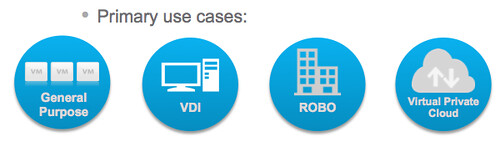
evo:rail use cases

So what does that mean? Does this mean that VMware does not support Exchange or MS SQL on top of VSAN or EVO:RAIL? Does that mean that VMware does not support it as a DR target? Or what about a management cluster? Or what about running Oracle? Or maybe SAP? Or what about my WordPress instance? Or what about MySQL? Or although you mention VDI, would that only be VMware View? What about… Yes by now you get my drift.

Let me try to make it really simple: Primary use cases says nothing about support. Primary use case means that this where the vendor expects the product or solution to fit best. In this case it is where VMware expect VSAN/EVO:RAIL to fit best, this is the target market VMware will be going after with this release.

Why include this in a slide deck? Well it allows you (the user / consultant / architect) to quickly identify where the majority of opportunities will be with the current version for your environment or for your customers. It does NOT mean that if your use case, like running your Exchange environment for instance on top of VSAN, is not listed that it is not supported. (Try listing all use cases on a slide, it will get pretty lengthy.)

Running Tier-1 applications on top of VSAN (or EVO:RAIL) is fully supported as it stands today, however … your application requirements and your service level agreement will determine if EVO:RAIL or VSAN is a good fit. One example would for instance be that if your agreed SLA requires an RPO (recovery point objective) of zero then sync replication is the only option (or stretched clustering), now you will need to determine if this is possible with the platform you want to use (this goes for any solution!). (Yes, you can make that happen with the platform pretty soon before anyone wants to go there…)

I hope that clears things up a bit.

Re: Re: The Rack Endgame: A New Storage Architecture For the Data Center

Duncan Epping · Sep 5, 2014 ·

I was reading Frank Denneman’s article with regards to new datacenter architectures. This in its turn was a response to Stephen Fosket’s article about how the physical architecture of datacenter hardware should change. I recommend reading both articles as that will give a bit more background, plus they are excellent reads by itself. (gotta love these blogging debates) Lets start with an out take of both articles which summarizes blog posts for those who don’t want to read the full article.

Stephen:
Top-of-rack flash and bottom-of-rack disk makes a ton of sense in a world of virtualized, distributed storage. It fits with enterprise paradigms yet delivers real architectural change that could “move the needle” in a way that no centralized shared storage system ever will. SAN and NAS aren’t going away immediately, but this new storage architecture will be an attractive next-generation direction!

If you look at what Stephen describes I think it is more or less in line with what Intel is working towards. The Intel Rack Scale Architecture aims to disaggregate traditional server components and then aggregate by type of resource backed by a super performing and optimized rack fabric. Rack fabric enabled by the new photonic architecture Intel is currently working on. This is not long term future, this is what Intel showcased last year and said to be available in 2015 / 2016.

Frank:
The hypervisor is rich with information, including a collection of tightly knit resource schedulers. It is the perfect place to introduce policy-based management engines. The hypervisor becomes a single control plane that manages both the resource as well as the demand. A single construct to automate instructions in a single language providing a correct Quality of Service model at application granularity levels. You can control resource demand and distribution from one single pane of management. No need to wait on the completion of the development cycles from each vendor.

There’s a bit in Frank’s article as well where he talks about Virtual Volumes and VAAI and how long it took for all storage vendors to adopt VAAI and how he believes that the same may apply to Virtual Volumes and Frank aims more towards the hypervisor being the aggregator instead of doing it through changes in the physical space.

So what about Frank’s arguments? Well Frank has a point with regards to VAAI adoption and the fact that some vendors took a long time to implement these. However, reality is though that Virtual Volumes is going full steam ahead. With many storage vendors demoing it at VMworld in San Francisco last week I have the distinct feeling that things will be different this time. Maybe timing is part of it, as it seems that many customers or on a crosspoint and want to optimize their datacenter operations / architecture by adopting SDDC, of which policy based storage management happens to be a big chunk.

I agree with Frank that the hypervisor is positioned perfect to be that control plane. However, in order to be that control plane for the future there needs to be a way to connect “things” to it which allows for far better scale and more flexibility. VMware, if you ask me, has done that for many parts of the datacenter but one aspect that stills needs to be overhauled for sure is storage. VAAI was a great start, but with VMFS there simply are too many constraints and it doesn’t cater for granular controls.

I feel that the datacenter will need to change on both ends in order to take that next step in the evolution to the SDDC. Intel Rack Scale architecture will allow for far greater scale and efficiency then seen ever before. But it will only be successful when the layer that sits on top has the ability to take all of these disaggregated resources, turn them in to large shared pools and allows to assign resources in a policy driven (and programmable) manner. Not just assign resources but also allow you to specify what the level of availability (HA, DR but also QoS) should be for whatever consumes those resources. Granularity is important here and of course it shouldn’t stop with availability but applies to any other (data) service that one may require.

So where does what fit in? If you look at some of the initiatives that were revealed at VMworld like Virtual Volumes, Virtual SAN and vSphere APIs for IO Filters you can see where the world is moving towards fast. You can see how vSphere is truly becoming that control plane for all resources and how it will be able to provide you end-to-end policy driven management. In order to make all of this reality the current platform will need to change. Changes that allow for more granularity /flexibility and higher scalability and that is where all these (new) initiatives come in to play. Some partners may take longer to adopt than others, especially those that require fundamental changes to the architecture of underlaying platforms (storage systems for instance), but just like with VAAI I am certain that over time this will happen as customers will drive this change by making decisions based on availability of functionality.

Exciting times ahead if you ask me.

VMware EVO:RAIL demo

Duncan Epping · Sep 4, 2014 ·

I just wanted to share the VMware EVO:RAIL demo with my readers. I shared it on twitter / linkedin but figured it made sense as well to have it here. The demo shows both the configuration and the management interface. Note that it takes less than 15 minutes normally to complete the configuration, but of course the video has been edited to keep it short and sweet… No point in watching a percentage completed counter go up.

VMware / ecosystem / industry news flash… part 2

Duncan Epping · Sep 1, 2014 ·

There we go, part two of the VMware / ecosystem / industry news flash. I expected a lot of news around VMworld as traditionally is always the case. I hope the below is a good summary, these are the articles / announcements I read and found interesting. It is the Monday after VMworld and I figured I would get this out there as I will be out for most of this week to recover.

  • Maginatics: A Virtual Filer for VMware’s Virtual SAN
    Last week I mentioned the Nexenta solution for VSAN… this week Maginatics is up. They also announced it last week, but somehow it fell through the cracks so I figured I would list it this week. MSCP offers a distributed file system with global deduplication, multiple caching layers and Content Distribution Network logic build in.
  • VMware EVO:RAIL was of course all over the news, with these being my fav posts Chris Wahl, Julian Wood, Dell, Chad Sakac)
    Do I really need to comment on this one? I am hoping everyone read my blog… Also, make sure to watch the demo!
  • Infinio announced version 2.0 of their acceleration platform
    A whole bunch of announcements around the 2.0 version of Infinio Acellerator. Support for Fibre Channel, iSCSI and FCoE is probably the biggest piece of functionality added. On top of that the extension of the monitoring / reporting section is very handy for those who want to tweak based on latency / IO information you will be able to do so. There are some more features announced, make sure to read the announcement for the full details.
  • VMware joins Open Compute Project
    I was surprised about this announcement, did not know it was coming… but I am very excited. The OCP solution is interesting as it is highly optimized around efficiency / power consumption / rack units etc. I have looked at some of the configurations for Virtual SAN but the problem I saw was hardware compatibility / support. Hopefully with this announcement these constraints will be lifted soon! Definitely one I will be following with a lot of interest!
  • Nutanix announced a new round of funding: 140 million
    What more can I say than: Congratulations! Hyper-converged infrastructure is hot, and Nutanix has a compelling solution for sure. 140 million (series e) is significant, and I guess they are on their way to an IPO (rumours have been floating around for months now).

That was it for now.

Liking the VMware EVO:RAIL look? How about a desktop / phone wallpaper?

Duncan Epping · Aug 31, 2014 ·

Dave Shanley (lead engineer for VMware EVO:RAIL) dropped me an email with an awesome looking wallpaper for desktops and smart phones. I asked him if I could share with the world and I guess it is needless to say what the answer was. Grab ’em below while they are still hot :). Thanks Dave! Note, that each pic below links (so click it) to Flickr with various resolutions available!

Desktop wallpaper:

evo:rail desktop wallpaper

Smart phone (optimized for iPhone 5s):

evo:rail smartphone wallpaper

  • « Go to Previous Page
  • Page 1
  • Interim pages omitted …
  • Page 56
  • Page 57
  • Page 58
  • Page 59
  • Page 60
  • Interim pages omitted …
  • Page 124
  • Go to Next Page »

Primary Sidebar

About the Author

Duncan Epping is a Chief Technologist and Distinguished Engineering Architect at Broadcom. Besides writing on Yellow-Bricks, Duncan is the co-author of the vSAN Deep Dive and the vSphere Clustering Deep Dive book series. Duncan is also the host of the Unexplored Territory Podcast.

Follow Us

  • X
  • Spotify
  • RSS Feed
  • LinkedIn

Recommended Book(s)

Also visit!

For the Dutch-speaking audience, make sure to visit RunNerd.nl to follow my running adventure, read shoe/gear/race reviews, and more!

Do you like Hardcore-Punk music? Follow my Spotify Playlist!

Do you like 80s music? I got you covered!

Copyright Yellow-Bricks.com © 2026 · Log in