Recently Data Services Manager 2.2 was released, so it was time for me to ask my friend Cormac Hogan back on the show to share with us what was introduced. Although it was just a “minor” release, there were some major announcements, of which the S3 Object Storage capabilities are probably what will excite you the most! Make sure to listen to the episode either via the player below or on your favorite podcast app. (Spotify, Apple, etc)
vcf
Can I have an AF-4 ReadyNode for vSAN ESA with less memory?
I got this question the other day, and it was around the amount of memory the AF-4 ReadyNode configuration needs to have in order for it to be supported. I can understand where the question comes from, but what most people don’t seem to understand is that there’s a set of minimal requirements, and that the ReadyNode profiles are as the KB states a “guidance”. The listed configurations are a guidance. This guidance is based on the anticipated resource consumption for a given set of VMs. Of course, this could be very different for your workload. That is why this article that describes the hardware guidance now clearly states the following:
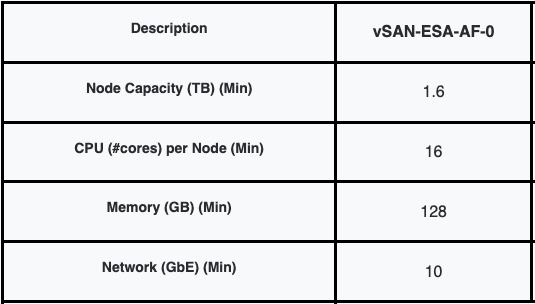
To maintain a configuration supported by VMware Global Services (GS), all ReadyNodes certified for vSAN ESA must meet or exceed the resources of the smallest configuration (vSAN-ESA-AF-0 for vSAN HCI or vSAN-Max-XS for vSAN Max).
This not only applies to memory, but also to other components, as long as you meet the minimum specified below.
Unexplored Territory Episode 087 – Microsoft on VMware VCF featuring Deji Akomolafe
For the last episode of 2024, I invited Deji Akomolafe to discuss running Microsoft workloads on top of VCF. I’ve known Deji for a long time, and if anyone is passionate about VMware and Microsoft technology, it is him. Deji went over the many caveats, and best practices when it comes to running for instance SQL on top of VMware VCF (or vSphere for that matter). NUMA, CPU Scheduling, latency sensitive settings, power settings, virtual disk controllers, just some of the things you can expect in this episode. You can listen to the episode on Spotify, Apple, or via the embedded player below.
VCF-9 announcements at Explore Barcelona – vSAN Site Takeover and vSAN Site Maintenance
At Explore in Barcelona we had several announcements and showed several roadmap items which we did not reveal in Las Vegas. As the sessions were not recording in Barcelona, I wanted to share with you the features I spoke about at Explore which are currently planned for VCF 9. Please note, I don’t know when these features will be generally available, and there’s always a chance they are not released at all.
I created a video of the features we discussed, as I also wanted to share the demos with you. Now for those who don’t watch videos, the functionality that we are working on for VCF-9 is the following, I am just going to do a brief description, as we have not made a full public announcement about this, and I don’t want to get into trouble.
vSAN Site Maintenance
In a vSAN stretched cluster environment when you want to do site maintenance, today you will need to place every host into maintenance mode one by one. This not only is an administrative/operational burden, it also increases the chances of placing the wrong hosts into maintenance mode. On top of that, as you need to do this sequentially, it could also be that the data stored on host-1 in site A differs from host-2 in site A, meaning that there’s an inconsistent set of data in a site. Normally this is not a problem as the environment will resync when it comes back online, but if the other data site fails, now that existing (inconsistent) data set cannot be used to recover. With Site Maintenance we not only make it easier to place a full site into maintenance mode, we also remove that risk of data inconsistency as vSAN coordinates the maintenance and ensures that the data set is consistent within the site. Fantastic right?!
vSAN Site Takeover
One of the features I felt we were lacking for the longest time was the ability to promote a site when 2 out of the 3 sites had failed simultaneously. This is where Site Takeover comes into play. If you end up in a situation where both the Witness Site and a data site goes down at the same time, you want to be able to still recover. Especially as it is very likely that you will have healthy objects for each VM in that second site. This is what vSAN Site Takeover will help you with. It will allow you to manually (through the UI or script) inform vSAN that even though quorum is lost, it should make the local RAID set for each of the VMs impacted accessible again. After which, of course, vSphere HA would instruct the hosts to power-on those VMs.
If you have any feedback on the demos, and the planned functionality, feel free to leave a comment!
Unexplored Territory #004: vVols with Cody Hosterman!
Episode 004 is out! This time we talk to Cody Hosterman, Director of Product Management at Pure Storage, about Virtual Volumes aka vVols! Cody shares with us the past, present, and future of vVols. I especially enjoyed his explanations around the benefits of vVols for traditional and cloud-native workload. It is also great to hear that VMware is working with Pure Storage on designing and developing a stretched cluster capability for vVols based environments. Listen below, or via Apple, Google, Spotify etc.