• Skip to primary navigation
  • Skip to main content
  • Skip to primary sidebar

Yellow Bricks

by Duncan Epping

  • Home
  • Unexplored Territory Podcast
  • HA Deepdive
  • ESXTOP
  • Stickers/Shirts
  • Privacy Policy
  • About
  • Show Search
Hide Search

Death to false myths: The type of virtual disk used determines your performance

Duncan Epping · Dec 19, 2012 ·

I was reading Eric Sloof’s article last week about how the disk type will impact your performance. First of all, let me be clear that I am not trying to bash Eric here… I think Eric has a valid point, well at least in some cases and let me explain why.

On his quest of determining if the virtual disk type determines performance Eric tested the following on his environment:

  • Thin
  • Lazy zero thick
  • Eager zero thick

These are the three disk types you can choose from when creating a new virtual disk. The difference between them is simple. Thick are fully allocated virtual disk files. Lazy zero means that the disk is not zeroed out yet, eager zero means the full disk is zeroed out during the provisioning process. Thin, well I guess you know what it means… not fully allocated and not also not zeroed. This also implies that in the case of “thin” and “lazy zero thick” something needs to happen when a new “block” is accessed. This is what Eric showed in his test. But is that relevant?

First of all, the test was conducted with an Iomega PX6-300d. One thing to point out here  is that this device isn’t VAAI capable and limited from a performance perspective due to the CPU power and limited set of spindles. The lack of VAAI however impacts the outcome the most. This, in my opinion means, that the outcome cannot really be used by those who have VAAI capable arrays. The outcome would be different when one of the following two (or both) VAAI primitives are supported and used by the array:

  • Write Same aka “Zero Out”
  • ATS aka “Hardware Offloaded Locking”

Cormac Hogan wrote an excellent article on this topic and an excellent white paper, if you want to know more about ATS and Write Same make sure to read them.

Secondly, it is important to realize that most applications don’t have the same write pattern as the benchmarking tool used by Eric. In his situation the tool basically fills up an X amount of blocks sequentially to determine the max performance. Only if you do fill up a disk at once, or very large unwritten sections, you potentially could see a similar result. Let me emphasize that, could potentially.

I guess this myth was once a fact, back in 2009 a white paper was released about Thin/Thick disks. In this paper they demonstrate the difference between thin, lazy zero and eager zero thick… yes they do proof there is a difference but this was pre-VAAI. Now if you look at another example, a nice extreme example, which is a performance test done by my friends of Pure Storage you will notice there is absolutely no difference. This is an extreme example considering it’s an all-flash VAAI based storage system, nevertheless it proofs a point. But not just all-flash arrays see a huge improvement, take a look at this article by Derek Seaman about 3Par’s “write same” (zero’ing) implementation, I am pretty sure that in his environment he would also not see the huge discrepancy Eric witnessed.

I am not going to dispel this myth as it is a case of “it depends”. It depends on the type of array used, and for instance how VAAI was implemented as that could make difference. In most cases however it is safe to say that the performance difference will not be big, if noticeable at all during normal usage. I am not even discussing all the operational implications of using eager-zero-thick… (as Frank Denneman will respond soon to this blog post has a nice article about that. :-))
Failed to connect to VMware Lookup Service, SSL certificate verification failed

Duncan Epping · Dec 19, 2012 ·

I ran in to this error today that which says “Failed to connect to VMware Lookup Service”. Or to be more precise:

Failed to connect to VMware Lookup Service.
SSL certificate verification failed.

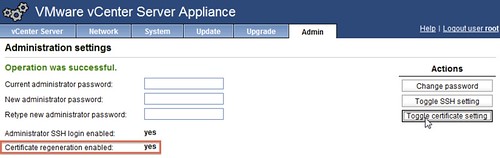
I had been playing around in my lab and I am guessing this error was caused by the fact that I changed the hostname of my vCenter Server Appliance after configuring it. When I rebooted the VCVA I bumped in to this issue. Luckily it is very easy to solve:

  1. Go to http://<vcenter ip address or fqdn>:5480
  2. Click “Admin” Tab
  3. Click “Toggle certificate setting” under “Actions”
  4. Restart the vCenter Server Appliance
  5. During the restart the certificates will be regenerated
  6. Click “Admin” Tab and disable the “Toggle certificate setting”

Failed to connect to VMware Lookup Service

VMware Technical Journal, pick it up!

Duncan Epping · Dec 18, 2012 ·

VMware just published the second VMware Technical Journal. This winter edition contains great publications on topics like vProbes, Paravirtual vRDMA Devices, Cloud Tenant UI design process, Storage DRS and FrobOS. There is also a nice introduction by VMware’s CEO Pat Gelsinger. Simply to much to mention, I suggest you just download it… I think it is a great read and it gives an idea about some of the things VMware engineers work on.

VMware Technical Journal


Death to false myths: Storage IO Control = Storage DRS IO load balancing

Duncan Epping · Dec 17, 2012 ·

I often hear people making comments around Storage IO Control and Storage DRS IO Load Balancing being one and the same thing. It has been one of those myths that has been floating around for a long time now, and with this article I am going to try to stop it.

I guess where this myth comes from is that when you create a Datastore Cluster and you enable Storage DRS IO Load Balancing then it configures Storage IO Control for you automatically on all datastores which are part of that particular Datastore Cluster. This seems to give people the impression that they are the same thing.

I have heard people making these claims especially around interoperability discussions. For example, one of the common made mistakes is that you should not enable Storage IO Control on a datastore which has auto-tiering (like EMC FAST for instance) enabled. Now the thing is that in the Storage DRS Interop white paper it is listed that when using an auto-tiering array you should disable IO Load Balancing when using Storage DRS. However, let is be clear Storage IO Control and Storage DRS Load Balancing are not one and the same thing and Storage IO Control is supported in those scenarios!

Storage DRS uses Storage IO Control to retrieve the IO metrics required to create load balancing recommendations. So lets repeat that, Storage DRS leverages Storage IO Control. Storage IO Control works perfectly fine without Storage DRS. Storage IO Control is all about handling queues and limiting the impact of short IO spikes. Storage DRS is about sustained latency and moving virtual machines around to balance out the environment.

I guess I can summarize this article in just one sentence:
Storage IO Control != Storage DRS IO Load Balancing


Death to false myths: Admission Control lowers consolidation ratio

Duncan Epping · Dec 11, 2012 ·

Death to false myths probably sounds a bit euuhm well Dutch probably, or “direct” as others would label it. Lately I have seen some statements floating around which are either false or misused. One of them is around Admission Control and how it impacts consolidation ratio even if you are not using reservations. I have had multiple questions around this in the last couple of weeks and noticed this thread on VMTN.

The thread referred to is all about which Admission Control policy to use, as the selected policy potentially impacts the amount of virtual machines you can run on a cluster. Now lets take a look at the example in this VMTN thread, and I have rounded up some of the numbers to simplify things:

  • 7 host cluster
  • 512 GB of memory
  • 132 GHz of CPU resources
  • 217 MB of Memory Overhead (no reservations used)

So if you do the quick math. According to Admission Control (host failures example) you can power-on about ~2500 virtual machines. That is without taking N-1 resiliency in to account. When I take out the largest host we are still talking about ~1800 virtual machines that can be powered on. Yes that is 700 slots/virtual machines less due to the N-1, admission control needs to be able to guarantee that even if the largest host fails all virtual machines can be restarted.

Considering we have 512GB in total that means that if those 1800 virtual machines on average actively use 280MB we will see TPS / swapping / ballooning / compression. (512GB / 1800 VMs) Clearly you want to avoid most of these, swapping / ballooning / compression that is. Especially considering most VMs are typically provisioned with 2GB of memory or more.

So what does that mean or did we learn? Two things:

  • Admission Control is about guaranteeing virtual machine restarts
  • If you set no reservation you can power-on an insane amount of virtual machines

Let me reemphasize the last bullet, you can power-on an INSANE amount of virtual machines on just a couple of hosts when no reservations are used. In this case HA would allow for 1800 virtual machines to be powered-on before it starts screaming it is out of resources. Is that going to work in real life, would your virtual machines be happy with the amount of resources they are getting? I don’t think so… I don’t believe that 280MB of physically backed memory is sufficient for most workloads. Yes, maybe TPS can help a bit, but chances of hitting the swap file are substantial.

Let it be clear, admission control is no resource management solution. It is only guaranteeing virtual machines can be restarted and if you have no reservations set then the numbers you will see are probably not realistic. At least not from a user experience perspective. I bet your users / customers would like to have a bit more resources available than just the bare minimum required to power-on a virtual machine! So don’t let these numbers fool you.

  • « Go to Previous Page
  • Page 1
  • Interim pages omitted …
  • Page 207
  • Page 208
  • Page 209
  • Page 210
  • Page 211
  • Interim pages omitted …
  • Page 502
  • Go to Next Page »

Primary Sidebar

About the Author

Duncan Epping is a Chief Technologist and Distinguished Engineering Architect at Broadcom. Besides writing on Yellow-Bricks, Duncan is the co-author of the vSAN Deep Dive and the vSphere Clustering Deep Dive book series. Duncan is also the host of the Unexplored Territory Podcast.

Follow Us

  • X
  • Spotify
  • RSS Feed
  • LinkedIn

Recommended Book(s)

Also visit!

For the Dutch-speaking audience, make sure to visit RunNerd.nl to follow my running adventure, read shoe/gear/race reviews, and more!

Do you like Hardcore-Punk music? Follow my Spotify Playlist!

Do you like 80s music? I got you covered!

Copyright Yellow-Bricks.com © 2026 · Log in