• Skip to primary navigation
  • Skip to main content
  • Skip to primary sidebar

Yellow Bricks

by Duncan Epping

  • Home
  • Unexplored Territory Podcast
  • HA Deepdive
  • ESXTOP
  • Stickers/Shirts
  • Privacy Policy
  • About
  • Show Search
Hide Search

Storage vMotion does not rename files?

Duncan Epping · Jan 25, 2013 ·

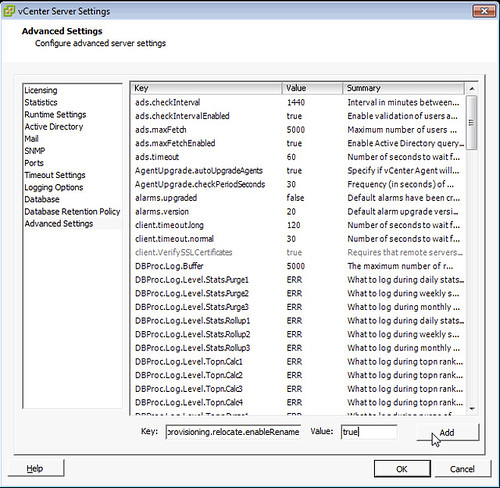
A while back I posted that 5.0 U2 re-introduced the renaming behavior for VM file names. I was just informed by our excellent Support Team that unfortunately the release notes missed something crucial and Storage vMotion does not rename files by default. In order to get the renaming behavior you will have to set an advanced setting within vCenter.. This is how you do it:

  • Go to “Administration”
  • Click on “vCenter Server Settings”
  • Click “Advanced Settings”
  • Add the key “provisioning.relocate.enableRename” with value “true” and click “add”
  • Restart vCenter service or vCenter Server

Now the renaming of the files during the SvMotion process should work again!
All of you who need this functionality, please make sure to add this advanced setting.
storage vmotion does not rename files

Awesome appliance, vCenter Support Assistant

Duncan Epping · Jan 25, 2013 ·

Today an awesome appliance called the vCenter Support Assistant was made available to the world. I have seen some screenshots and a demo and feel that this appliance is a MUST HAVE for anyone who files Support Requests. Just the fact that you can do that from a single interface, which also allows you to upload the support bundle just makes life a whole lot easier.

vCenter Support Assistant

Ryan Johnson wrote an excellent article on this topic… and I am going to steal his thunder so I suggest you head over to the VMware TAM Program blog (open to everyone) and read up on this excellent Appliance.

Disk.SchedulerWithReservation aka mClock

Duncan Epping · Jan 23, 2013 ·

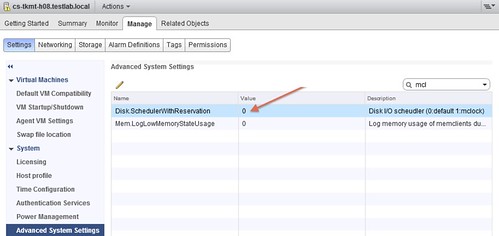
A long time ago when playing around in my lab with vSphere 5.1 I stumbled across this advanced setting called Disk.SchedulerWithReservation. I start digging to see what I could do with it and what it was about… if I could anything with it at all.

The description was kind of vague but it revealed what this disk scheduler was, it mentioned “mClock”. For those who don’t collect academic papers for night time reading like me, mClock is a new disk scheduler which is being researched by VMware and partners. The disk scheduler, in contrary to the current scheduler SFQ, will allow you to do some more advanced stuff.

For instance mClock will allow you to set an IOps reservation on a VM. So in other words, when you have a virtual machine that needs to have 500 IOps guaranteed you will be able to do so with mClock. Now I have been digging and asking around and unfortunately this logic to set reservations has not been implemented in 5.1.

If you are interested in mClock and its benefits I would recommend reading this academic paper by my colleagues Ajay Gulati (One of the leads on: DRS, Storage DRS, SIOC). I find it very interesting and hope it will be fully available sometime soon. And before you ask, no I don’t know when or even if this will ever be available.

How to disable ESXi firewall

Duncan Epping · Jan 23, 2013 ·

For a project I had to disable the ESXi firewall on a host permanently. To be honest, it isn’t something I would do normally or would recommend even. It wasn’t listed in “chkconfig”, which kinda makes sense, so I looked at the networking section of esxcli. What an awesome command by the way! Quickly after “tab’ing” through esxcli I figured out how to disable it permanently:

esxcli network firewall set --enabled false

I figured I would write it down, because this is the stuff I tend to forget easily.

PS: If you ever need anything around esxcli, the vSphere Blog is a good place to check as most of the relevant posts are tagged with “esxcli”.

How does vSphere recognize an NFS Datastore?

Duncan Epping · Jan 21, 2013 ·

This question has popped up various times now, how does vSphere recognize an NFS Datastore? This concept has changed over time and hence the reason many people are confused. I am going to try to clarify this. Do note that this article is based on vSphere 5.0 and up. I had a similar article a while back, but figured writing it in a more explicit way might help answering these questions. (and gives me the option to send people just a link :-))

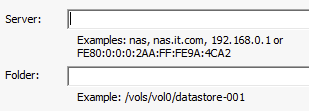
When an NFS share is mounted a unique identifier is created to ensure that this volume can be correctly identified. Now here comes the part where you need to pay attention, the UUID is created by calculating a hash and this calculation uses the “server name” and the folder name you specify in the “add nfs datastore” workflow.

Add NFS Datastore

This means that if you use “mynfserver.local” on Host A you will need to use to use the exact same on Host B. This also applies to the folder. Even “/vols/vol0/datastore-001” is not considered to be the same as “/vols/vol0/datastore-001/”. In short, when you mount an NFS datastore make absolutely sure you use the exact same Server and Folder name for all hosts in your cluster!

By the way, there is a nice blogpost by NetApp on this topic.

  • « Go to Previous Page
  • Page 1
  • Interim pages omitted …
  • Page 203
  • Page 204
  • Page 205
  • Page 206
  • Page 207
  • Interim pages omitted …
  • Page 502
  • Go to Next Page »

Primary Sidebar

About the Author

Duncan Epping is a Chief Technologist and Distinguished Engineering Architect at Broadcom. Besides writing on Yellow-Bricks, Duncan is the co-author of the vSAN Deep Dive and the vSphere Clustering Deep Dive book series. Duncan is also the host of the Unexplored Territory Podcast.

Follow Us

  • X
  • Spotify
  • RSS Feed
  • LinkedIn

Recommended Book(s)

Also visit!

For the Dutch-speaking audience, make sure to visit RunNerd.nl to follow my running adventure, read shoe/gear/race reviews, and more!

Do you like Hardcore-Punk music? Follow my Spotify Playlist!

Do you like 80s music? I got you covered!

Copyright Yellow-Bricks.com © 2026 ยท Log in