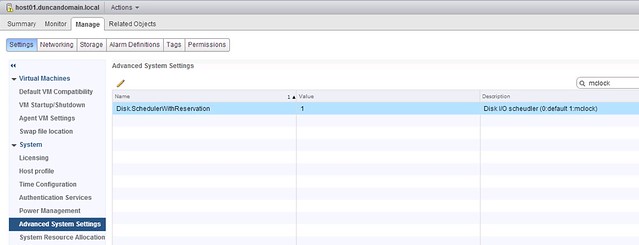
I mentioned the new disk IO scheduler in vSphere 5.5 yesterday. When discussing this new disk IO scheduler one thing that was brought to my attention is a caveat around disk limits. Lets get started by saying that disk limits are a function of the host local disk scheduler and not, I repeat, not Storage IO Control. This is an often made mistake by many.
Now, when setting a limit on a virtual disk you define a limit in IOPS. The IOPS specified is the maximum number of IOPS the virtual machine can drive. The caveat is is as follows: IOPS takes the IO size in to account. (It does this as a 64KB IO has a different cost than a 4KB IO.) The calculation is in multiples of 32KB. Note that if you do a 4KB IO it is counted as one IO, however if you do a 64KB IO it is counted as two IOs. Any IO larger than 32KB will be 2 IOs at a minimum as it is rounded up. In other words, a 40KB IO would be 2 IOs and not 1.25 IOs. This also implies that there could be an unexpected result when you have an application doing relatively large blocksize IOs. If you set a limit of 100 IOPS but your app is doing 64KB IOs than you will see your VM being limited to 50 IOPS as each 64KB IO will count as 2 IOs instead of 1. So the formula here is: ceil(IO Size / 32).
I think that is useful to know when you are limiting your virtual machines. Especially cause this is a change in behaviour compared to vSphere 5.1.