• Skip to primary navigation
  • Skip to main content
  • Skip to primary sidebar

Yellow Bricks

by Duncan Epping

  • Home
  • Unexplored Territory Podcast
  • HA Deepdive
  • ESXTOP
  • Stickers/Shirts
  • Privacy Policy
  • About
  • Show Search
Hide Search

vSAN

HCI1603BU – Tech Preview of Native vSAN Data Protection

Duncan Epping · Sep 4, 2018 ·

The second session I watched was HCI1603BU Tech Preview of Native vSAN Data Protection by Michael Ng. I already discussed vSAN Data Protection last year, but considering the vSAN Beta is coming up soon that includes this functionality I felt it was worth covering again. Note that the beta will be a private beta, so if you are interested please sign up, you may be one of the customers getting selected for the beta.
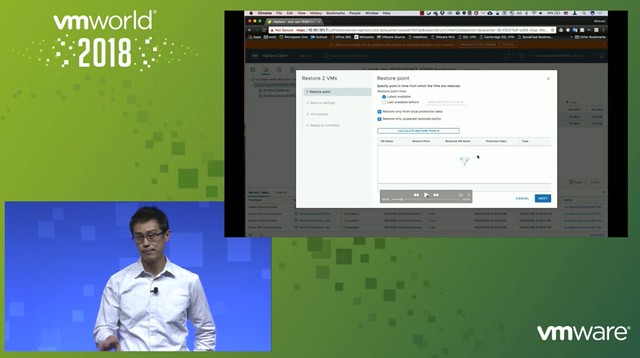
Michael started out with an explanation about what an SSDC brings to customers, and how a digital foundation is crucial for any organization that wants to be competitive in the market. vSAN, of course, is a big part of the digital foundation, and for almost every customer data protection and data recovery is crucial. Michael went over the various vSAN use cases and also the availability and recoverability mechanisms before introducing Native vSAN Data Protection.

Now it is time for the vSAN Native Data Protection introduction. Michael first explains that we will potentially have a solution in the future where we can simply create snapshots locally through specifying the number of local snapshots you want in policy. On top of that, in the future, we will potentially provide the option to specify the snapshots (plus a full copy) will need to be offloaded to secondary storage. Secondary storage could be NFS, S3 Object Storage (both on-premises and in the cloud). Also, it should be possible to replicate VMs and snapshots to a DR location through policies.

What I think is very compelling is the fact that the native protection comes as part of vSAN/vSphere, there’s no need to install an appliance or additional software. vSAN Data Protection will be baked into the platform. Easy to enable and easy to consume through policy. The first focus is vSAN Local Data Protection.

vSAN Local Data Protection will provide Crash and Application-consistent snapshots at an RPO of 5 minutes and with a low RTO. On top of that, it will be possible to instant clone the snapshot. Meaning that you can restore the snapshot as an “instant clone”, this could be interesting when you want to test a certain patch or upgrade for instance. You can even specify during the recovery that the NIC doesn’t need to be connected. Application consistency is achieved by leveraging VSS providers on Windows and on Linux the VMware Tools pre- and post-scripts are being used.

What enables vSAN Data Protection is a new snapshotting technology. This new technology provides a lot better performance than traditional vSphere (or vSAN) snapshots. It also provides for better scale, meaning that you can go way above the 32 limit we currently have.

Next Michael demoed vSAN Data Protection, which is something I have done on various occasions if you are interested in what it looks like just watch the session. If I have time I may record a demo myself just so it is easier to share with you.

What I personally hadn’t seen yet were the additional performance views added. Very useful as it allows you to quickly check what the impact is of snapshots on general performance. Is there an impact? Do I need to change my policy?

Last but not least various questions were asked, most interesting parts was the following:

  • “file level restore” is on the roadmap but the first feature they will tackle is offloading to secondary storage.
  • “consistency groups” is something that is being planned for, especially useful when you have applications or services spanning VMs.
  • Integration with vRealize Automation, some of it is planned for the first release, everything is SPBM based which already have APIs. Being planned for is “self-service restore”
  • 100 snapshots per VM is tested for the first release

Good session, worth watching!
VMworld – VMware vSAN Announcements: vSAN 6.7 U1 and beta announced!

Duncan Epping · Aug 27, 2018 ·

VMworld is the time for announcements, and of course for vSAN that is no different. This year we have 3 major announcements and they are the following:

  • VMware vSAN 6.7 U1
  • VMware vSAN Beta
  • VMware Cloud on AWS new features

So let’s look at each of these, first of all, VMware vSAN 6.7 U1. We are adding a bunch of new features, which I am sure you will appreciate. The first one is various VUM Updates, of which I feel the inclusion of Firmware Updates through VUM is the most significant one. For now, this is for the Dell HBA330 only, but soon other controllers will follow. On top of that there now also is support for custom ISO’s. VUM will recognize the vendor type and validate compliance and update accordingly when/if needed.

The other big thing we are adding os the “Cluster Quickstart wizard“. I have shown this at various sessions already, so some of you may be familiar with it. It basically is a single wizard that allows you to select the required services, add the hosts and configure the cluster. This includes the configuration of HA, DRS, vSAN and the network components needed to leverage these services. I recorded a quick demo that actually shows you what this looks like

One of the major features in my opinion that is introduced is UNMAP. Yes, unmap for vSAN. So as of 6.7 U1 we are now capable of unmapping blocks when the Guest OS sends an unmap/trim command. This is great as it will greatly enhance/improve space efficiency. Especially in environments where for instance large files or many files are deleted. You need to enable it, for now, through “rvc”. And you can do this as follows:

/localhost/VSAN-DC/computers/6.7 u1> vsan.unmap_support -e .

When you run the above command you should see the below response.

Unmap support is already disabled
6.7 u1: success
VMs need to be power cycled to apply the unmap setting
/localhost/VSAN-DC/computers/6.7 u1>

Pretty simple right? Does it really require the VM to be power cycled? Yes, it does, as during the power-on the Guest OS actually queries for the unmap capability, there’s no way for VMware to force that query without power cycling the VM unfortunately. So power it off, and power it on if you want to take advantage of unmap immediately.

There are a couple smaller enhancements that I wanted to sum up for those who have been waiting for it:

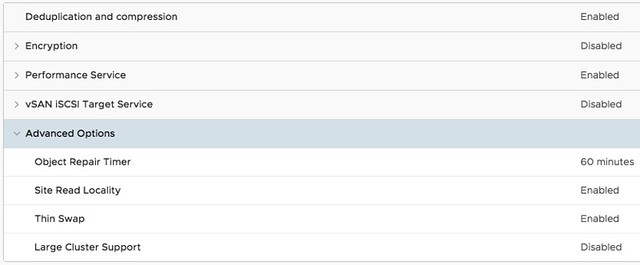
  • UI Option to change the “Object Repair Timer” value cluster-wide. This is the option which determines when vSAN starts repairing an object which has an absent component.
  • Mixed MTU support for vSAN Stretched Clusters (different MTU for Witness traffic then vSAN traffic)
  • Historical capacity reporting
  • VROps dashboards with vSAN stretched cluster awareness
  • Additional PowerCLI cmdlets
  • Enhanced support experience (Network diagnostic mode, specialized dashboards), you can find the below graphs under Monitor/vSAN/Support
  • Additional health checks (storage controllers firmware, unicast network performance test etc)

And last but not least, with vSAN Stretched we have the capability to protect data within a site. As of vSAN 6.7 U1 we also now have the ability to protect data within racks, it is however only available through an RPQ request. So if you need protection within a rack, contact GSS and file an RPQ.

Another announcement was around a vSAN Beta which is coming up. This vSAN Beta will have some great features, three though have been revealed:

  • Data Protection (Snapshot based)
  • File Services
  • Persistent Storage for Containers

I am not going to reveal anything about this, simply to avoid violating the NDA around this. Sign up for the Beta so you can find out more.

And then the last set of announcements was around functionality introduced for vSAN in VMware Cloud on AWS. Here there were two major announcements if you ask me. The first one is the ability to use Elastic Block Storage (EBS volumes) for vSAN. Meaning that in VMware Cloud on AWS you are no longer limited to the storage capacity physically available in the server, no you can now extend your cluster with capacity delivered through EBS. The second one is the availability of vSAN Encryption in VMware Cloud on AWS. This, from a security perspective, will be welcomed by many customers.

That was it, well… almost. This whole week many sessions will reveal various new potential features and futures. I aim to report on those when sitting in on those presentations, or potentially after VMworld.


My top VMworld session picks

Duncan Epping · Aug 7, 2018 ·

Every year I post a list of my favorite VMworld sessions, my top picks. There are way too many sessions to see, but these are definitely the sessions I would like to attend personally. That could be because of the speaker, or the content, and preferably both. Yes I know, this list will have some great sessions missing, not because I did not like the abstract or speaker, but simply because I forced myself to limit this list to 10. Before we get started, here are the two sessions I have scheduled, make sure to sign up for those while you still can, as both seem to be at 80+ % capacity right now

  1. The Power of Storage Policy-Based Management [HCI1270BU] – Cormac Hogan & Duncan Epping
    Tuesday, Aug 28, 12:30 p.m. – 1:30 p.m.
    The world of software-defined storage moves at a rapid pace, and VMware is one of the biggest enablers. In this session, Cormac and Duncan will guide you through the world of software-defined storage initiatives at VMware and provide a primer to VMware vSAN, VMware Virtual Volumes (VVol), persistent cloud-native storage options (Project Hatchway), the VMware vSphere APIs for I/O filtering, and the binding factor in these cases: storage policy-based management. Be warned: We will bring demos!
  2. vSphere Clustering Deep Dive, Part 1: vSphere HA and DRS [VIN1249BU] – Frank Denneman & Duncan Epping
    Monday, Aug 27, 12:30 p.m. – 1:30 p.m.
    In this session, Duncan and Frank will take you through the trenches of VMware vSphere Distributed Resource Scheduler (DRS) and vSphere High Availability (HA). Find out about options to optimize your DRS settings for your specific requirements and goals, such as if you should be load balancing on active or consumed memory, as well as what has recently changed in the DRS algorithm and if it will impact DRS behavior. And for vSphere HA, you will learn about when it restarts virtual machines (VMs), what kind of restart times to expect, and where you can find evidence that a VM (or multiple) have been restarted. You will find out about all of these items and more. Prepare to dive deep, as the basics will not be covered.

Here are my top picks, note that although I picked Ravi’s session from the Extreme Performance Series, all of them are worth attending!

  1. Extreme Performance Series: vCenter Performance Deep Dive [VIN1759BU] Ravi Soundararajan
    Tuesday, Aug 28, 5:00 p.m. – 6:00 p.m.
    In this talk, you will get a brief description of the internals of VMware vCenter before going into basic performance troubleshooting and monitoring techniques. Find out about various tools for analyzing resource usage, important metrics like sessions and API calls, and database performance (primarily for the vCenter Server Appliance, but also for vCenter Server for Windows). You will get to understand the differences between vCenter and Platform Services Controller, and consider the impact of linked mode and plug-ins/extensions. By the end of the talk, you’ll understand how your vCenter works, when you may need multiple vCenters, and how Platform Services Controller factors into performance. xPerfSeries
  2. Tech Preview: The Road to a Declarative Compute Control Plane [VIN2256BU] Maarten Wiggers & Frank Denneman
    Tuesday, Aug 28, 12:30 p.m. – 1:30 p.m.
    Declarative control planes are becoming increasingly popular in the industry. Instead of explicitly defining configurations, declarative control planes tell the architecture what the desired state should be. The desired state could be high priority, or keep particular VMs or containers separate. Within the software-defined data center (SDDC), VMware vSphere offers two declarative control planes: one for networking and one for storage. However, there is no declarative control plane for compute yet.
    Compute policy provides a framework to allow our customers the flexibility and control of VM placement and resourcing decisions based on the user’s encompassing application needs. In this session, you will learn about the capabilities introduced in the VMware Cloud SDDC as a path to achieve that goal.
  3. Clustering Deep Dive 2: Quality Control with DRS and Network I/O Control [VIN1735BU] Niels Hagoort & Sahan Gamage
    Tuesday, Aug 28, 2:00 p.m. – 3:00 p.m.
    In this session, you will go through the trenches of network-aware VMware vSphere DRS and vSphere Network I/O Control. You may ask yourself what these two have to do with each other as, unfortunately, not many people know about the enhancements added to the DRS algorithm around network-aware load balancing. If you want to understand how this can help prevent problems from occurring with network-intensive workloads like NFV, then this is a session you cannot miss!
  4. Project Fractal – The Easy Button for Edge Computing [IOT2593BU] – Dennis Lu & Sridevi Ravuri
    Tuesday, Aug 28, 4:00 p.m. – 5:00 p.m.
    Come and learn about how VMware can accelerate your adoption of Edge Computing by dealing with the additional complexity and cost of infrastructure management at the Edge, helping you quickly achieve the cost savings and revenue growth benefits of Edge Computing. This is also a great opportunity to shape the direction of VMware’s edge services to help fit customer needs.
  5. vSAN Deployment Topology and Availability Deep Dive: What You Need to Know [HCI2040BU] Paudie O’Riordan & Mansi Shah
    Wednesday, Aug 29, 8:00 a.m. – 9:00 a.m.
    Today, VMware vSAN can be deployed in many different form factors; for example, vSAN 2-Node ROBO, vSAN Fault domains, Stretch Cluster with and without local protection, and more. These deployment models make vSAN quite flexible and unique. This session will help you understand the different trade-offs and focus on the benefits and overheads of the choice you’ve made in your vSAN proposed design. Join Mansi and Paudie as they discuss these topologies in depth from both an engineering perspective and a practical real-world implementation. Paudie and Mansi will take a no-nonsense review of how to approach designing a fault-tolerant vSAN deployment and give real-world examples of how to achieve the best design from both an availability and performance perspective.
  6. Top 10 Automation Requests and How You Can Save Time [VIN2527BU] Alan Renouf & William Lam
    Monday, Aug 27, 2:00 p.m. – 3:00 p.m.
    After working firstly as customers and secondly at VMware, Alan and William have encountered hundreds of ways to save time through automation. In this session, they will take you through the top automation requests and how they were completed, teaching you not only how to reproduce them yourself, but also giving you a framework to enable you to automate your top 10 requests.
    This session will include a number of techniques and languages, such as PowerShell, PowerCLI, Python, Java, .NET, and simple web applications with JavaScript.
  7. Data Lifecycle Management in Hybrid Clouds [HCI1705BU] Christos Karamanolis & Ilya Languev
    Tuesday, Aug 28, 2:00 p.m. – 3:00 p.m.
    The focus of IT and DevOps organizations is shifting from storage toward data management independent of infrastructure and locations. This trend is partly driven by a new generation of applications that extract business value from data (big data, analytics, machine learning). Customers need cost-effective data storage but also data mobility, copy management, and on-demand access as business requirements and IT investments evolve. Join Christos Karamanolis (CTO, Storage and Availability) and Ilya Languev (Principal Engineer) as they outline the VMware vision around data lifecycle management that spans private data centers and public clouds. They will discuss VMware’s R&D investments in this space and use real-world examples and demos to highlight the benefits for our customers, both for traditional and cloud-native applications.
  8. VMware CTO Panel: What’s Over the Horizon? [CTO3496PU] Ray O’Farrell, Christos Karamanolis, Chris Wolf, Shawn Bass, Pere Monclus
    Tuesday, Aug 28, 5:30 p.m. – 6:30 p.m.
    VMware CTOs spend significant time assessing emerging technology trends, taking a practical look at their potential impacts and opportunities for VMware. This session explores emerging areas, inclusive of edge, the Internet of things, artificial intelligence (AI)/machine learning (ML), SD-WAN and network service mesh, distributed data management, and more. There will also be ample time for you to have your most pressing questions answered.
  9. Smart Placement of Workloads in Tomorrow’s Distributed Cloud [CTO2161BU] Daniel Beveridge
    Tuesday, Aug 28, 1:00 p.m. – 2:00 p.m.
    This session will offer a look at the evolution of cloud as we move from a nega-cloud-focused experience into a more distributed cloud experience where compute evolves toward a mesh of resources. Find out about a technology project sponsored by VMware’s Office of the CTO that has developed a novel approach to the placement of workloads in a vast marketplace of providers, resulting in a seamless cloud burst experience across a range of providers. You will learn about some cutting-edge cloud technology that points toward a new way of consuming cloud services with an emphasis on reducing cost, improving user experience, and offering increased flexibility and agility in workload management.
  10. Optimizing vSAN for Performance [HCI1246BU] Cormac Hogan & Paudie O’Riordan
    Tuesday, Aug 28, 3:30 p.m. – 4:30 p.m.
    The VMware vSAN team gets many questions on performance. For example, does adding a second disk group improve performance? Does adding a stripe width to an object make things faster? Does increasing the MTU size matter? Does mixing SAS and SATA make a difference? Join this session for answers to these sorts of questions. Paudie and Cormac will discuss the results of various performance tests they initiated in their labs to reach these conclusions. You will learn about the benchmark tool of choice, HCIBench, as well as all the different nuances that can make a difference to your benchmarking results.

Also note, there’s a long list of “deep dive” session at vmworld this year, do a search and register before it is too late!

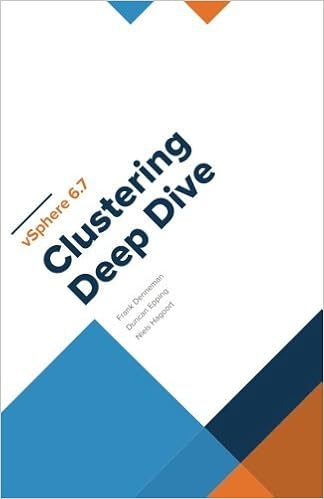
Now Available: vSphere 6.7 Clustering Deep Dive book!

Duncan Epping · Jul 30, 2018 ·

Over the past couple of months Frank, Niels and I have worked ferociously to update the vSphere Clustering Deep Dive. Some of the material was already brought up to date to vSphere 6.0 U2, but the majority was never updated after vSphere 5.1. As you can imagine, this was a tremendous undertaking. Not only did we need to validate every sentence, all diagrams needed to be updated, and with the introduction of the HTML-5 Client also all screenshots had to be retaken. 
Now, just a couple of weeks before VMworld, we are finally at the point where we can press “publish”.

What can you expect? Well, we have said this with previous books, this is not a beginners guide! This is a deep dive, and we aimed to take you in to the trenches of vSphere Clustering technologies. We cover a multitude of different features, and for those who haven’t read the previous books expect the following features to be covered:

  • vSphere HA
  • vSphere DRS
  • vSphere Storage DRS
  • vSphere Storage I/O Control
  • vSphere Network I/O Control

We also have a chapter on stretched clusters, in this chapter we describe how to design and implement a vSphere Metro Storage Cluster, leveraging all of the knowledge gained in the previous chapters.

For your convenience, I copied/pasted some of the Amazon info below.

—

  • Paperback: 566 pages
  • Publisher: CreateSpace Independent Publishing Platform; 1 edition (July 29, 2018)
  • Language: English
  • ISBN-10: 1722625325
  • ISBN-13: 978-1722625320
  • Product Dimensions: 5.5 x 1.3 x 8.5 inches
  • Shipping Weight: 1.8 pounds

—

I hope all of you will enjoy the book as much as we enjoyed writing it. And before I forget, I want to thank my co-authors for the late night discussions, the hard work, insights and fun/laughter at times.

Get it while it is hot! (Look on the right side column for the links to the book!)

Opvizor Performance Analyzer for vSAN

Duncan Epping · Jul 10, 2018 ·

At a VMUG a couple of months ago I bumped into my old friend Dennis Zimmer. Dennis told me that he was working on something cool for vSAN but couldn’t reveal what it was just yet. Last week I had a call with Dennis about what that thing was. Dennis is the CEO for Opvizor, and some of you may recall the different tooling that Opvizor has produced over the years, of which the Health Analyzer was probably the most famous one back then. I’ve used it in the past on various occasions and I had various customers using it. During the briefing, Dennis explained to me that Opvizor started focussing on performance monitoring and analytics a while ago as the health analyzer market was overly crowded and had the issue that is was a one-off business (checks once in a while instead of daily use). On top of that, many products now come with some form of health analysis included. (See vSAN for instance.) I have to agree with Dennis, so this pivot towards Performance Monitoring makes much sense to me.

Dennis explained to me how they are seeing more and more customer demand for vSAN performance monitoring especially combined with VMware ESXi, VM and App data. Although vCenter has various metrics, and there’s VROps, he told me that Opvizor has many customers who need more than vCenter or vROPS standard has to offer today and don’t own VROps advanced. This is where Opvizor Performance Analyzer comes in to play and that is why today Opvizor announced they are including vSAN specific dashboards. Now, this isn’t just for vSAN of course. Opvizor Performance Analyzer includes not just vSAN but also vSphere and various other parts of the stack. When talking with Dennis one thing became clear, Opvizor is taking a different approach than most other solutions. Where most focus on simplifying, hiding, and aggregating, the focus for Opvizor is on providing as much relevant detail as possible to fulfill the needs of beginner and professional.

So how does it work? Opvizor provides a virtual appliance. You simply deploy it in your environment and connect it to vCenter and you are ready to go. The appliance collects data every 5 minutes (but 20 seconds intervals of these 5 minutes) and has a retention of up to 5 years. As I said, the focus is on infrastructure statistics and performance analytics and as such Opvizor delivers all the data you ever need.

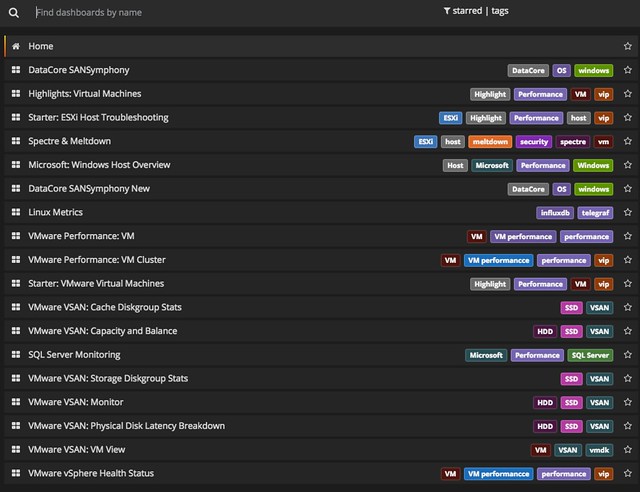
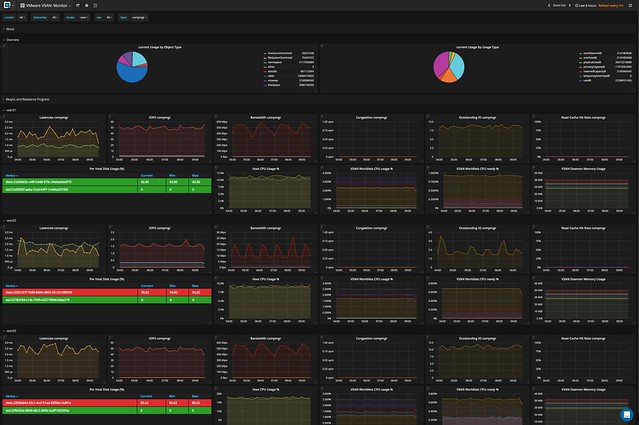
It doesn’t just provide you with all the info you will ever need. It will also allow you to overlay different metrics, which makes performance troubleshooting a lot easier, and will allow you to correlate and pinpoint particular problems. Opvizor comes with dashboards for various aspects, here are the ones included in the upcoming release for vSAN:

  • Capacity and Balance
  • Storage Diskgroup Stats
  • VM View
  • Physical disk latency breakdown
  • Cache Diskgroup stats
  • vSAN Monitor

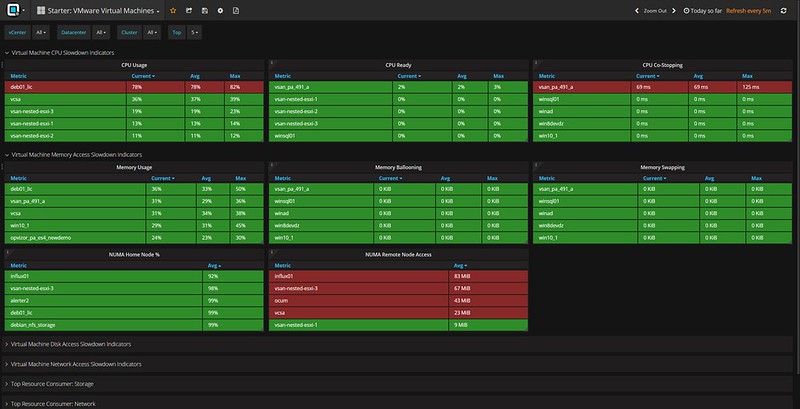
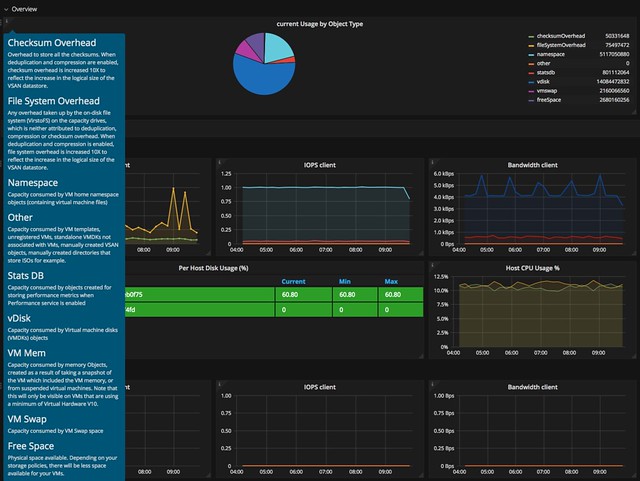
Now I said this is the expert´s troubleshooting tool, but Opvizor Performance Analyzer also provided in-depth information about what each metric is / means and provides starter dashboards for beginners. You can simply click on the “i” in the top left corner of the widget and you get all the info about that particular widget.

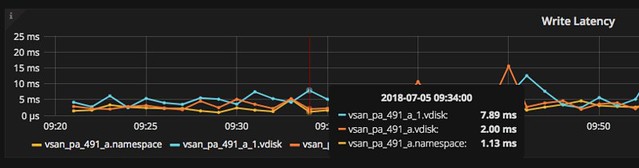
When you do know what you are looking for you can click, hover, and zoom when needed. Hover over the specific section in the graph and the point in time values of the metrics will pop up. In the case below I was drilling down on a VM in the vSAN cluster and looking at write latency in specific. As you can see we have 3 objects and in particular 2 disks and a “vm name space”.

And this is just a random example, there are many metrics to look at and many different widgets and overviews. Just to give you an idea, here are some of the metrics you can find in the UI:

  • Latency (for all different components of the stack)
  • IOPs (for all different components of the stack)
  • Bandwidth (for all different components of the stack)
  • Congestion (for all different components of the stack)
  • Outstanding I/O (for all different components of the stack)
  • Read Cache Hit rate (for all different components of the stack)\
  • ESXi vSAN host disk usage
  • ESXi vSAN host cpu usage
  • Number of Components
  • Disk Usage
  • Cache Usage

And there;s much more, too many to list in this blog. And again, not just vSAN, but there are many dashboards to chose from. If you don’t have a performance monitoring solution yet and you are evaluating solutions like SolarWinds, Turbunomics and others make sure to add Opvizor to that list. One thing I have to say, I spotted a couple of things that I liked to see changed, and I think within 24hrs the Opvizor guys managed to incorporate the feedback. That was a crazy fast turnaround, good to see how receptive they are.

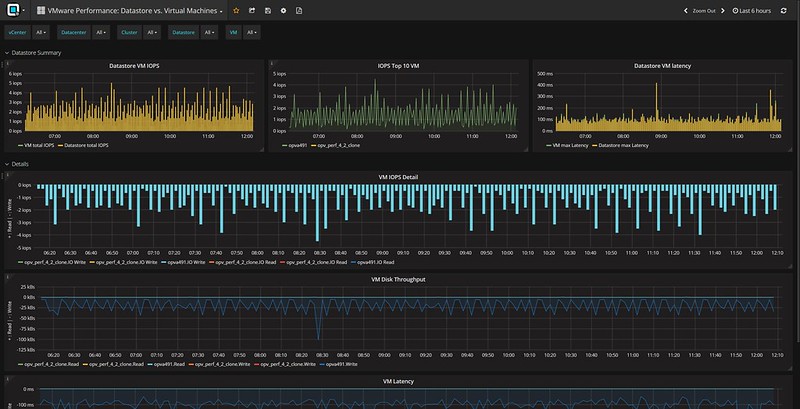
Oh, one more thing I found in the interface, it is these dashboards that deal with things like NUMA. But also things like the Top 10 VMs in terms of IOPS. Both very useful, especially when doing deep performance troubleshooting and optimizing.

I hope that gives you a sense of what they can do. There’s a fully functional 30-day trial, check it out if you want to find out more about Performance Analyzer or simply just want to play around with it. Opvizor announced this brand new version on their own blog here, make sure to give that a read as well!

  • « Go to Previous Page
  • Page 1
  • Interim pages omitted …
  • Page 27
  • Page 28
  • Page 29
  • Page 30
  • Page 31
  • Interim pages omitted …
  • Page 71
  • Go to Next Page »

Primary Sidebar

About the Author

Duncan Epping is a Chief Technologist and Distinguished Engineering Architect at Broadcom. Besides writing on Yellow-Bricks, Duncan is the co-author of the vSAN Deep Dive and the vSphere Clustering Deep Dive book series. Duncan is also the host of the Unexplored Territory Podcast.

Follow Us

  • X
  • Spotify
  • RSS Feed
  • LinkedIn

Recommended Book(s)

Also visit!

For the Dutch-speaking audience, make sure to visit RunNerd.nl to follow my running adventure, read shoe/gear/race reviews, and more!

Do you like Hardcore-Punk music? Follow my Spotify Playlist!

Do you like 80s music? I got you covered!

Copyright Yellow-Bricks.com © 2026 · Log in