• Skip to primary navigation
  • Skip to main content
  • Skip to primary sidebar

Yellow Bricks

by Duncan Epping

  • Home
  • Unexplored Territory Podcast
  • HA Deepdive
  • ESXTOP
  • Stickers/Shirts
  • Privacy Policy
  • About
  • Show Search
Hide Search

Server

Another major milestone, 5000 customers reached for VSAN!

Duncan Epping · Jul 19, 2016 ·

Yes, new quarterly results are out, and this is crazy, Yanbing (SVP/GM for Storage & Availability BU) dropped the news on twitter last night:

Amazing customer momentum in Q2. Hyper-converged license bookings (VSAN+VxRAIL SW) grew >200% YoY. Customer count grew to 5,000! Congrats!

— Yanbing Li (@ybhighheels) July 18, 2016

Yes that is correct, VSAN customer count grew with 1500 in just 1 quarter and the license bookings also grew > 200% Y0Y. Crazy numbers if you ask me, and some serious traction. Considering how well VxRail is doing I can only see this ramping up faster even. Just some quotes from last nights earnings call, you can find a transcript here and audio here if you are interested.

Pat Gelsinger:
Our hyper-converged license bookings, including VSAN and VxRail software, grew over 200% year-over-year. The new VxRail appliance we jointly developed with EMC was launched earlier this year and has enjoyed an impressive start, benefiting also from Dell’s decision to resell VxRail.

The rock stars of Q2 were NSX and VSAN and they were just fabulous

Yes, clearly the VxRail and the momentum that it is seeing was a piece of that. But a lot of the customer count was non-VxRail. So this product has now hit a point of inflection, as you suggest, that really was thrilling. And if I would call out one product in Q2 that just blew their numbers away, VSAN is it, and it was the rockstar of Q2 above all others. And what we’re seeing is that the product maturity, the channel momentum, I commented on the transactional channel before, and that really is well fit to VSAN. But also some of the enterprise use cases have clearly seen momentum, as well. And then we add to that the incremental benefits of VxRail that we jointly developed with EMC and Dell now reselling that VxRail product. It was also geographically balanced, as well. We saw VSAN growing across all of the geos, large customers, major wins, in healthcare, also mid market wins across different geos. So really, really excited about the VxRail, as well as the overall hyper-converged category for us and VSAN, the rockstar of Q2.

You know what, I will give away 5 “Essential Virtual SAN” books to 5 random people who leave a comment (and retweet / share this post on linkedin) to celebrate this great achievement. Please leave comment with your real name and correct email address so I can reply for your home address! I email winners Wednesday 19th of July end of day. [UPDATE: Winners have received an email from me, or will within the next 10 minutes]

How thermal paste can impact VM performance

Duncan Epping · Jun 30, 2016 ·

On twitter a tweet from Frank flew by pointing to an article which was written by one of my VMware colleagues: Matt Bradford aka @VMSpot. I hadn’t seen the article, while it was written in 2014 and I am surprised it never caught more attention. Matt describes in his post how the use and placement of thermal paste can influence VM performance. Who would have thought of that, and I am seriously impressed they managed to get to the bottom of this!

We haven’t had our HP BL460c Gen8’s with the new Xeon E5-2697 v2 12 core processors long. Last week we started to get e-mails from the help desk that users were complaining about sluggish performance in Citrix. Oddly, all of the XenApp VM’s happened to live on the same ESXi host. I say oddly because performance issues rarely seem to fall in line as they did here. We immediately evacuated the host and admitted it to the infirmary cluster.

…..

It didn’t seem to matter if the CPU’s were under load or idle, the temperature would not stray from 69°c. This had to be an issue with the temperature sensors, I thought. So we pulled the host and removed the heat sinks so we could look at the CPU’s through a thermal camera we borrowed from engineering.

I am not going to post the full article here, go over to Matt’s blog and have a read. It is flabbergasting if you ask me, and definitely one of the coolest reads in a long time. And thanks Frank for bringing this one up. I just had to share in on a broader platform.

That reminds me, maybe it is time to bring back my “favourite reads” post I did for a long time on the VMTN Blog, but host it here instead. Hmmm. Ah well, lets make a start here and follow up with “Recommended reads” posts in the future:

  • Compare and Contrast: Photon Controller vs VIC (vSphere Integrated Containers) by Cormac Hogan, explains the difference between these two different products/solutions. It is a great way to learn more about how VMware enables cloud native apps.
  • New Home Lab Hardware – Dual Socket Xeon v4 by Frank Denneman. I am starting to wonder who is the craziest in terms of home lab. Maybe we should do a contest, not sure Frank will win as there are some folks who have 3-4 clusters at home like Erik Bussink. Nevertheless, I like how Frank breaks down each component of his new addition.
  • Test driving ContainerX on VMware vSphere by William Lam. Always interested in learning more about what it is former VMware engineers are doing. Pradeep Padala is the CTO for ContainerX which William tested out and described in this article.
  • VMware HCL in JSON format and VMware HCL check with PowerCLI by Florian Grehl. Very useful if you want to programmatically validate your current environment against the VMware HCL.

That’s it for now, enjoy reading.

Essential Virtual SAN second edition paper copy available now!

Duncan Epping · Jun 27, 2016 ·

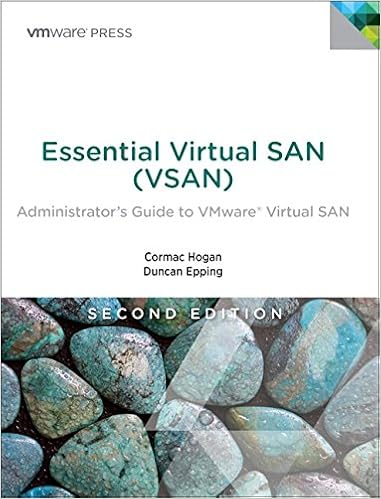
As of today Essential Virtual SAN second edition paper copy is available on Amazon! If you are interested, pick it up today, note that there is also a Kindle version out there if you prefer that!

VMware’s Virtual SAN has rapidly proven itself in environments ranging from hospitals to oil rigs to e-commerce platforms. Along the way, it has matured to offer unsurpassed features for data integrity, availability, and space efficiency. Virtual SAN 6.x makes all-flash storage practical for even more use cases, while radically simplifying IT operations and supporting the transition to hyper-converged infrastructures (HCI). Now, the authors of Essential Virtual SAN (VSAN) have thoroughly updated their definitive guide to this transformative technology. Writing for vSphere administrators, architects, and consultants, Cormac Hogan and Duncan Epping explain what Virtual SAN is, how it has evolved, what it now offers, and how to gain maximum value from it.

If you want to order the paper version at a local book store, here are the ISBN details:

  • ISBN-13: 978-0134511665
  • ISBN-10: 0134511662

Hitachi Unified Compute Platform demo impressed me

Duncan Epping · Jun 23, 2016 ·

Last week I was at the German VMUG and at the show I bumped in to a couple of former VMware colleagues (Patrick Pannekoek and Valentin Hamburger) at the Hitachi / HDS booth. I made a joke about how they are now pushing boxes around and one of them said they could give me a cool demo of their Unified Compute Platform. We setup a Webex for this week and Valentin was kind enough to give me a demo of what Unified Compute Platform (UCP from now on) is capable off. I was very impressed to be honest and it does a lot more than I expected.

I am not going to spend a lot of time discussing the physical aspects, all those details are on their website and I feel they are “less relevant” than the integration aspect of a converged offering.

Hitachi UCP for vSphere is a converged solution and takes “converged” to a next level. I cannot call it hyper-converged as it uses traditional storage, but in terms of how they integrate it is more then just a “converged” I would say. First and foremost, there is complete integration with vCenter Server. And when I say integration, I mean that you don’t just get a plugin with some extra screens, but you have additional menu options which are also object/context sensitive. With that meaning that the options you have on a host object will be different from the options you have on a cluster level. UCP comes pre-configured and pre-installed using Auto-Deploy (stateless boots) and several management components installed on a two node cluster (about 10-12 VMs). This includes vCenter Server, Active Directory (when needed), SQL Server, MS WDS for bare metal deployments, Windows Server Update Manager (WSUS). Note that if you have a local AD you can also easily tap in to that, there is no need for a second Active Directory! [Read more…] about Hitachi Unified Compute Platform demo impressed me

Goodbye SAN Huggers!

Duncan Epping · Jun 20, 2016 ·

This week I presented at the German VMUG and a day after the event someone commented on my session. Well not really on my session, but more on my title. My title was “Goodbye SAN Huggers“. Mildly provocative indeed. “SAN Huggers” is a play on the term “Server Hugger“. That term has been around for the longest time and refers to people who prefer to be able to point out their servers. People who prefer the physical world, where every application ran on one server and every server was equal to one physical box.

SAN Huggers are pretty much the same type of people. They prefer the physical world. A world where they define RAID Groups, Storage Pools and LUNs. A world where a bunch of servers end up on the LUN they created. Those LUNs have certain data services enabled and if you need other data services, well then you simply move your servers around! SAN Huggers like to maintain strict control, and to me personally they are in the same position the Server Huggers were 12-15 years ago. It is time to let go however!

Now let it be clear, 12-15 years ago when virtualization changed the world of IT and VMware exploded literally and server huggers felt threatened by the rise of virtualization servers did not go away. Server Administrators did not disappear. Server Administrators evolved. Many took on additional responsibilities, in most cases that would be the responsibility over VMware ESX / Virtual Infrastructure. The same applies to storage.

When I say goodbye SAN Huggers, I am not referring to “Virtual SAN” taking over the world. (Although I do think that Hyper-Converged will eat the traditional storage system’s lunch for a large portion.) I am talking about how the world of storage is (and has been) evolving. Literally my next slide typically has a quote on it that states the following: “Hardware evolution started the storage revolution“. The story around this slide makes it clear what I mean when I say Goodbye SAN Huggers.

The hardware evolution has literally changed the storage landscape. Software Defined Storage is quickly taking over the world, but in my opinion the key reason for this is the evolution from a hardware perspective. In the past we had to group harddisk to provide a single unit that could deliver sufficient capacity, performance and increase availability at the same time. That was achieved using RAID constructs, and with the introduction of virtualization and high demanding workloads storage systems had to resort to wide striping, introduced larger caches, disk pools etc to deliver the capabilities required.

In todays world a lot of these constructs are no longer needed. The evolution in the world of hardware allowed for the introduction of Software Defined Storage. First and foremost flash, whether PCIe, NVMe or SAS/SATA based. These devices removed the need for complex constructs to provide thousands of IOPS. A single flash device today, even consumer grade, can provide higher performance than many of the storage systems we have all managed over the years. Not even talking about enterprise grade flash devices where 100k IOPS (with sub millisecond latency) is more or less the norm. Than there is the network, 10GbE, 25GbeE, 40GbE and even higher. Low latency and high bandwidth comes at (relative) low cost, and add to that the ever growing CPU capabilities, cores and speed combined with faster bus speeds and high (and fast) memory configurations. Hardware is no longer a constraint, the revolution is now, enter the world of Software Defined Storage.

And this, this is where I typically introduce: Virtual SAN, Virtual Volumes and the vSphere APIs for IO Filtering (vSphere Data Services delivered through filter drivers). Functionality provided by VMware which enables efficient operations, simplicity and flexibility. All through the use of policy, which can simply be attached to your workloads, be it a virtual machine or virtual disk even. The days of creating LUNs, RAID groups and needing wide striping or huge amounts of devices to get a decent user experience are gone. We can say goodbye to the physical world, we can say goodbye to the SAN Hugger. We can move forward and evolve, not just our datacenters but also our personal growth and areas of interest and expertise as a result.

  • « Go to Previous Page
  • Page 1
  • Interim pages omitted …
  • Page 65
  • Page 66
  • Page 67
  • Page 68
  • Page 69
  • Interim pages omitted …
  • Page 336
  • Go to Next Page »

Primary Sidebar

About the Author

Duncan Epping is a Chief Technologist and Distinguished Engineering Architect at Broadcom. Besides writing on Yellow-Bricks, Duncan is the co-author of the vSAN Deep Dive and the vSphere Clustering Deep Dive book series. Duncan is also the host of the Unexplored Territory Podcast.

Follow Us

  • X
  • Spotify
  • RSS Feed
  • LinkedIn

Recommended Book(s)

Also visit!

For the Dutch-speaking audience, make sure to visit RunNerd.nl to follow my running adventure, read shoe/gear/race reviews, and more!

Do you like Hardcore-Punk music? Follow my Spotify Playlist!

Do you like 80s music? I got you covered!

Copyright Yellow-Bricks.com © 2026 · Log in