In this week’s Unexplored Territory Podcast we have our long time friend Dr. Wade Holmes as a guest. We’ve bumped into Wade a few times over the past couple of years, first at a VCDX defense where Wade became the first VCDX certified person outside of VMware. Of course Wade also worked at VMware for years, and now the past years Wade has been at Google, which made him the perfect person to have this discussion with on the topic of Google Cloud VMware Engine, multi-cloud, hybrid-cloud, and security implications. Listen to it via Spotify (https://spoti.fi/3NfOxIz), Apple (https://apple.co/37SXOaI), our website, or your favorite podcast app!
Server
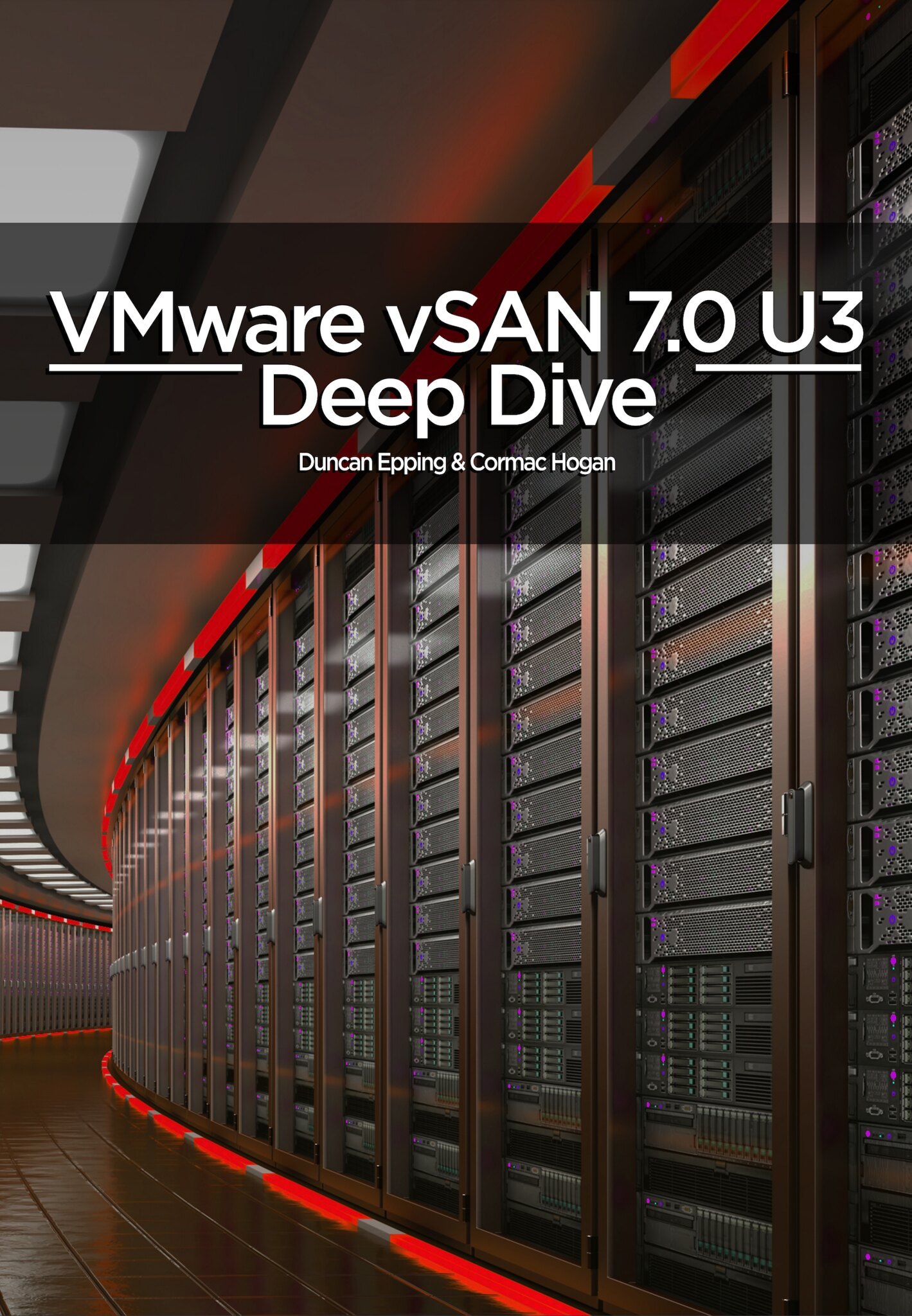
New book: VMware vSAN 7.0 U3 Deep Dive
Yes, we’ve mentioned it a few times already on Twitter that we were working on it, but today Cormac and I are proud to announce that the VMware vSAN 7.0 U3 Deep Dive is available via Amazon on both ebook as well as paper! We had the pleasure of working with Pete Koehler again as a technical editor, the foreword was written by John Gilmartin (SVP and GM for Cloud Storage and Data), the cover was created by my son (Aaron Epping), and it is once again fully self-published! We changed the format (physical dimension) of the book to be able to increase the size of the screenshots, as we realize that most of us are middle-aged by now, we feel it really made a huge difference in readability.
VMware’s vSAN has rapidly proven itself in environments ranging from hospitals to oil rigs to e-commerce platforms and is the top player in the hyperconverged space. Along the way, it has matured to offer unsurpassed features for data integrity, availability, space efficiency, stretched clustering, and cloud-native storage services. vSAN 7.0 U3 has radically simplified IT operations and supports the transition to hyperconverged infrastructures (HCI). The authors of the vSAN Deep Dive have thoroughly updated their definitive guide to this transformative technology. Writing for vSphere administrators, architects, and consultants, Cormac Hogan, and Duncan Epping explain what vSAN is, how it has evolved, what it now offers, and how to gain maximum value from it. The book offers expert insight into preparation, installation, configuration, policies, provisioning, clusters, architecture, and more. You’ll also find practical guidance for using all data services, stretched clusters, two-node configurations, and cloud-native storage services.
Although we pressed publish, sometimes it takes a while before the book is available in all Amazon stores, but it should just trickle in the upcoming 24-48 hours. The book is priced at 9.99 USD (ebook) and 29.99 USD (paper) and is sold through Amazon only. Get it while it is hot, and we would appreciate it if you would use our referral links and leave a review when you finish it. Thanks, and we hope you will enjoy it!
Of course, we also have the links to other major Amazon stores:
- United Kingdom – Kindle – Paper
- Germany – Kindle – Paper
- Netherlands – Kindle – Paper
- Canada – Kindle – Paper
- France – Kindle – Paper
- Spain – Kindle – Paper
- India – Kindle
- Japan – Kindle – Paper
- Italy – Kindle – Paper
- Mexico – Kindle
- Australia – Kindle – Paper
- Or just do a search!
Unexplored Territory #013 – Exploring VMware Cloud on AWS with Adrian Roberts!
In episode 013 we talk to Adrian Roberts, Head of EMEA Solution Architecture for VMware Cloud on AWS at AWS. Adrian discusses the various reasons customers are looking to utilize VMware Cloud on AWS, discusses some of the challenges, and of course the opportunities that arise when you have your VMware workloads close to native AWS services. Listen to the full episode via Spotify (spoti.fi/3DDCoJX) or Apple (apple.co/3r1qAvV)
Unexplored Territory #012: Discussing VMware Cloud offerings with ITQ’s CTO Jeffrey Kusters!
Episode 12 is out, this week we have Jeffrey Kusters to discuss VMware Cloud! Jeffrey discusses the use cases and the different offerings ranging from AWS to Google! Listen now: Spotify (https://spoti.fi/3tsSm6p), Apple (https://apple.co/3ioaQyp).
Stretched cluster witness failure resilience in vSAN 7.0
Cormac and I have been busy the past couple of weeks updating the vSAN Deep Dive to 7.0 U3. Yes, there is a lot to update and add, but we are actually going through it at a surprisingly rapid pace. I guess it helps that we had already written dozens of blog posts on the various topics we need to update or add. One of those topics is “witness failure resilience” which was introduced in vSAN 7.0 U3. I have discussed it before on this blog (here and here) but I wanted to share some of the findings with you folks as well before the book is published. (No, I do not know when the book will be available on Amazon just yet!)
In the scenario below, we failed the secondary site of our stretched cluster completely. We can examine the impact of this failure through RVC on vCenter Server. This will provide us with a better understanding of the situation and how the witness failure resilience mechanism actually works. Note that the below output has been truncated for readability reasons. Let’s take a look at the output of RVC (vsan.vm_object_info) for our VM directly after the failure.
VM R1-R1:
Disk backing:
[vsanDatastore] 0b013262-0c30-a8c4-a043-005056968de9/R1-R1.vmx
RAID_1
RAID_1
Component: 0b013262-c2da-84c5-1eee-005056968de9 , host: 10.202.25.221
votes: 1, usage: 0.1 GB, proxy component: false)
Component: 0b013262-3acf-88c5-a7ff-005056968de9 , host: 10.202.25.201
votes: 1, usage: 0.1 GB, proxy component: false)
RAID_1
Component: 0b013262-a687-8bc5-7d63-005056968de9 , host: 10.202.25.238
votes: 1, usage: 0.1 GB, proxy component: true)
Component: 0b013262-3cef-8dc5-9cc1-005056968de9 , host: 10.202.25.236
votes: 1, usage: 0.1 GB, proxy component: true)
Witness: 0b013262-4aa2-90c5-9504-005056968de9 , host: 10.202.25.231
votes: 3, usage: 0.0 GB, proxy component: false)
Witness: 47123362-c8ae-5aa4-dd53-005056962c93 , host: 10.202.25.214
votes: 1, usage: 0.0 GB, proxy component: false)
Witness: 0b013262-5616-95c5-8b52-005056968de9 , host: 10.202.25.228
votes: 1, usage: 0.0 GB, proxy component: false)
As can be seen, the witness component holds 3 votes, the components on the failed site (secondary) hold 2 votes, and the components on the surviving data site (preferred) hold 2 votes. After the full site failure has been detected, the votes are recalculated to ensure that a witness host failure does not impact the availability of the VMs. Below shows the output of RVC once again.
VM R1-R1:
Disk backing:
[vsanDatastore] 0b013262-0c30-a8c4-a043-005056968de9/R1-R1.vmx
RAID_1
RAID_1
Component: 0b013262-c2da-84c5-1eee-005056968de9 , host: 10.202.25.221
votes: 3, usage: 0.1 GB, proxy component: false)
Component: 0b013262-3acf-88c5-a7ff-005056968de9 , host: 10.202.25.201
votes: 3, usage: 0.1 GB, proxy component: false)
RAID_1
Component: 0b013262-a687-8bc5-7d63-005056968de9 , host: 10.202.25.238
votes: 1, usage: 0.1 GB, proxy component: false)
Component: 0b013262-3cef-8dc5-9cc1-005056968de9 , host: 10.202.25.236
votes: 1, usage: 0.1 GB, proxy component: false)
Witness: 0b013262-4aa2-90c5-9504-005056968de9 , host: 10.202.25.231
votes: 1, usage: 0.0 GB, proxy component: false)
Witness: 47123362-c8ae-5aa4-dd53-005056962c93 , host: 10.202.25.214
votes: 3, usage: 0.0 GB, proxy component: false)
As can be seen, the votes for the various components have changed, the data site now has 3 votes per component instead of 1, the witness on the witness host went from 3 votes to 1, and on top of that, the witness that is stored in the surviving fault domain now also has 3 votes instead of 1 vote. This now results in a situation where quorum would not be lost even if the witness component on the witness host is impacted by a failure. A very useful enhancement to vSAN 7.0 Update 3 for stretched cluster configurations if you ask me.