• Skip to primary navigation
  • Skip to main content
  • Skip to primary sidebar

Yellow Bricks

by Duncan Epping

  • Home
  • Unexplored Territory Podcast
  • HA Deepdive
  • ESXTOP
  • Stickers/Shirts
  • Privacy Policy
  • About
  • Show Search
Hide Search

Server

vSphere Availability Survey, please help out!

Duncan Epping · Feb 17, 2014 ·

Just received the below from the vSphere Availability team. It takes a couple of minutes to fill out and it helps the vSphere Availability team to set priorities correctly for upcoming releases, yes indeed based on your answers!

— copy / paste —

The Availability team (that brings to you products such as vSphere HA, FT etc.) would like to get your input on how you use our products today and your projected needs. The survey has mainly multiple choice questions, and will take 10-15 minutes to complete. Your feedback is invaluable in helping us tailor our development efforts towards valuable enhancements. So, thank you!

Here’s the link to the survey: http://tinyurl.com/vmwavailability
Startup News Flash part 13

Duncan Epping · Feb 13, 2014 ·

Edition 13 of the Startup News Flash already. This week is VMware Partner Exchange 2014 so I expected some announcements to be made. There were a couple of announcements the last week(s) which I felt were worth highlighting. There is one that is not really a startup, but I figured should at least be included in the article and that is the fact that Scale.IO and SuperMicro / LSI / Mellanox / VMware showed an appliance at PEX that was optimized for View deployments. I found it an interesting move, and appealing solution. Chris Mellor wrote an article about it here for the Register.

DataGravity announced their Partner Early Access Program this week. They haven’t revealed what they are building, but judging by the quotes in the announcement publication they are aiming to bring a simple cost-effictive solution to enable analysis of unstructured data. Definitely interesting, and something I will look more closer in to at some point in time.

Atlantis ILIO USX was announced this week. I already mentioned it in my VSAN update. Atlantis ILIO USX is an in-memory storage solution. They added the ability to pool and optimize any class of storage including SAN, NAS, RAM or any type of DAS (SSD, Flash, SAS, SATA) to create a hybrid solution. A change of direction for Atlantis as there primary focus was caching so far, but it makes a lot of sense to me especially as they already have many of the data services for their caching platform.

PernixData announced their Beta program for FVP 1.5. They added support for vSphere 5.5, the vSphere Web Client and also in this version allow you to use a different VMkernel interface other than the vMotion interface which their product uses by default. If you want to know more, Chris Wahl wrote a nice article on his experience with FVP 1.5.

Tintri announced it has closed a $75 million Series E funding round led by Insight Venture Partners, with participation from existing investors Lightspeed Venture, Menlo Ventures and NEA. Good to see Tintri getting another boost, and will be interesting to see how they move forward. I have been following them from the very start and have always been impressed with the ease of the solution they have built.

Operational simplicity through Flash

Duncan Epping · Feb 11, 2014 ·

A couple of weeks back I had to honor to be one of the panel members at the opening of the Pure Storage office in the Benelux. The topic of course was flash, and the primary discussion around the benefits. The next day I tweeted a quote of one of the answers I gave during the session which was picked up by Frank Denneman in one of his articles, this is the quote:

https://twitter.com/DuncanYB/status/425920926325411840

David Owen responded to my tweet saying that many performance acceleration platforms introduce an additional layer of complexity, and Frank followed up on that in his article. However this is not what my quote was referring to. First of all, I don’t agree with David that many performance acceleration solutions increase operational complexity. However, I do agree that they don’t always make life a whole lot easier either.

I guess it is fair to say that performance acceleration solutions (hyper-visor based SSD caching) are not designed to replace your storage architecture or to simplify it. They are designed to enhance it, to boost the performance. During the Pure Storage panel sessions I was talking about how flash changed the world of storage, or better said is changing the world of storage. When you purchased a storage array in the two decades it would come with days worth of consultancy. Two days typically being the minimum and in some cases a week or even more. (Depending on the size, and the different functionality used etc.) And that was just the install / configure part. It also required the administrators to be trained, in some cases (not uncommon) multiple five-day courses. This says something about the complexity of these systems.

The complexity however was not introduced by storage vendors just because they wanted to sell extra consultancy hours. It was simply the result of how the systems were architected. This by itself being the result of a major big constraint: magnetic disks. But the world is changing, primarily because a new type of storage was introduced; Flash!

Flash allowed storage companies to re-think their architecture, probably fair to state that the this was kickstarted by the startups out there who took flash and saw this as their opportunity to innovate. Innovationg by removing complixity. Removing (front-end) complexity by flattening their architecture.

Complex constructs to improve performance are no longer required as (depending on which type you use) a single flash disk delivers more than a 1000 magnetic disks typically do. Even when it comes to resiliency, most new storage systems introduced different types of solutions to mitigate (disk) failures. No longer is a 5-day training course required to manage your storage systems. No longer do you need weeks of consultancy just to install/configure your storage environment. In essence, flash removed a lot of the burden that was placed on customers. That is the huge benefit of flash, and that is what I was referring to with my tweet.

One thing left to say: Go Flash!

Virtual SAN Compatibility Guide updated!

Duncan Epping · Feb 2, 2014 ·

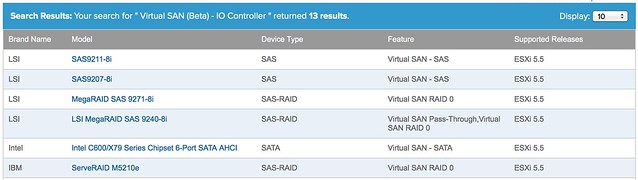
For those looking to start configuring hardware for VSAN / Virtual SAN infrastructures, the VMware Compatibility Guide just got updated!

VMware VSAN Beta HCL updated: http://t.co/oCop26WrDs#vsan @PunchingClouds @wholmes

— Kiran Madnani (@kmadnani) February 2, 2014

Personally I find the new section on disk controllers very useful as it shows whether the controller is supported in SAS / SATA / RAID-0 or Pass-through. I can’t wait for the first VSAN Ready Nodes to pop-up. Note that VSAN is not GA yet, so I expect the HCL to be expanded even further over time. Just like to say: Nice work Dell, it looks you folks are really making an effort getting your hardware certified.

Awesome VSAN contest results

Duncan Epping · Jan 24, 2014 ·

Every once in a while I have someone asking me how about VSAN scale? Typically the question is triggered by a conversation had with another storage vendor and either a misunderstanding or pure FUD that was spread. It is nice to see some of our beta testers showing the possibilities with VSAN. How about the result of the Miami VMUG? These guys managed to get their hands on 3 awesome Dell R720xd hosts and found someone willing to host them. Then they started building, and it didn’t take them long to figure out what the limit was on a 3 node cluster… They managed to run 2250 virtual machines on 3 hosts. Yes, that is indeed more than two thousand virtual machines.

Thanks Miami VMUG for going all out.

  • « Go to Previous Page
  • Page 1
  • Interim pages omitted …
  • Page 110
  • Page 111
  • Page 112
  • Page 113
  • Page 114
  • Interim pages omitted …
  • Page 336
  • Go to Next Page »

Primary Sidebar

About the Author

Duncan Epping is a Chief Technologist and Distinguished Engineering Architect at Broadcom. Besides writing on Yellow-Bricks, Duncan is the co-author of the vSAN Deep Dive and the vSphere Clustering Deep Dive book series. Duncan is also the host of the Unexplored Territory Podcast.

Follow Us

  • X
  • Spotify
  • RSS Feed
  • LinkedIn

Recommended Book(s)

Also visit!

For the Dutch-speaking audience, make sure to visit RunNerd.nl to follow my running adventure, read shoe/gear/race reviews, and more!

Do you like Hardcore-Punk music? Follow my Spotify Playlist!

Do you like 80s music? I got you covered!

Copyright Yellow-Bricks.com © 2026 · Log in