• Skip to primary navigation
  • Skip to main content
  • Skip to primary sidebar

Yellow Bricks

by Duncan Epping

  • Home
  • Unexplored Territory Podcast
  • HA Deepdive
  • ESXTOP
  • Stickers/Shirts
  • Privacy Policy
  • About
  • Show Search
Hide Search

Storage

vSAN 7.0 U2 Durability Components?

Duncan Epping · Mar 22, 2021 ·

Last week I published a new demo on my youtube channel (at the bottom of this post) and it discussed an enhanced feature called Durability Components. Some may know these as “delta components” as well. These durability components were introduced in vSAN 7.0 Update 1 and provided a mechanism to maintain the required availability for VMs while doing maintenance. That meaning that when you would place a host into maintenance mode new “durability components” would be created for the components which were stored on that host. This would then allow all the new VM I/O to be committed to the existing component, as well as the durability component.

Now, starting with vSAN 7.0 Update 2, vSAN also uses these durability components in situations where a host failure has occurred. So if a host has failed, durability components will be created to ensure we still maintain the specified availability level specified within the policy as shown in the diagram above. The great thing is that if a second host fails in an FTT=1 scenario and you are able to recover the first failed host, we can still merge the data with the first failed host with the durability component! So not only are these durability components great for improving the resync times, but they also provide a higher level of availability to vSAN! To summarize:

  1. Host fails
  2. Durability components are created for all impacted objects
  3. New writes are committed to existing components and the new durability components
  4. Host recovers
  5. Durability components are merged with the previously failed components
  6. Durability components are deleted when resync has completed

I hope that help providing a better understanding of how these durability components help improving availability/resiliency in your environment with vSAN 7.0 Update 2.

I can understand that some of you may not want to test durability components in their own environment, this is why I recorded a quick demo and published it on my youtube channel. Check out the video below, as it also shows you how durability components are represented in the UI.

vSAN 7.0 U2 Skyline Health History

Duncan Epping · Mar 15, 2021 ·

I have already discussed this briefly during my 7.0 U2 video presentation, which can be found here, but I also wanted to share the demo I recorded with you, and provide some additional details. Over the past years, one of the most requested features for Skyline Health, or Health Check as it used to be called, was the ability to go back in time to see what has happened between certain dates. This functionality was demonstrated at VMworld, and a few VMUGs the past year, and now finally made it into the release with vSAN 7.0 U2.

The “health history” feature simply provides a toggle that enables you to go back in time. When you tick the toggle, you can specify a date range. Note that the range can be anywhere between the current date, and 30 days back. The health check data is stored, for 30 days, in the vCenter Server database. This is important to know because if you feel that there’s no need to store the data, you can disable the feature under vSAN Services in the Configuration tab. When you disable the feature the data is deleted from the vCenter Server database. Now if you flip the toggle, set a date range, and look at the different checks you should see green checks. If a check is not green, but rather red or orange you can click the check.

When clicking on the red square, you will see which check failed, and when exactly it failed. The number in the square or circle refers to the number of checks that were run and resulted in the same state. In other words, 37 red, 45 green, 54 red checks etc. When you click on it, you will see the below.

Hopefully, this will then allow you, during troubleshooting, to correlate particular failures or configuration changes, to the issue that bubbled up in the health check. I feel that having the date/time is already very useful, as it will allow you to focus on a more specific date/time range while reading logs or going through the events section.

Anyway, if you would like to see the feature in action, check out the demo below.

VMs which are not stretched in a stretched cluster, which policy to use?

Duncan Epping · Dec 14, 2020 ·

I’ve seen this question popping up regularly. Which policy setting (“site disaster tolerance” and “failures to tolerate”) should I use when I do not want to stretch my VMs? Well, that is actually pretty straight forward, in my opinion, you really only have two options you should ever use:

  • None – Keep data on preferred (stretched cluster)
  • None – Keep data on non-preferred (stretched cluster)

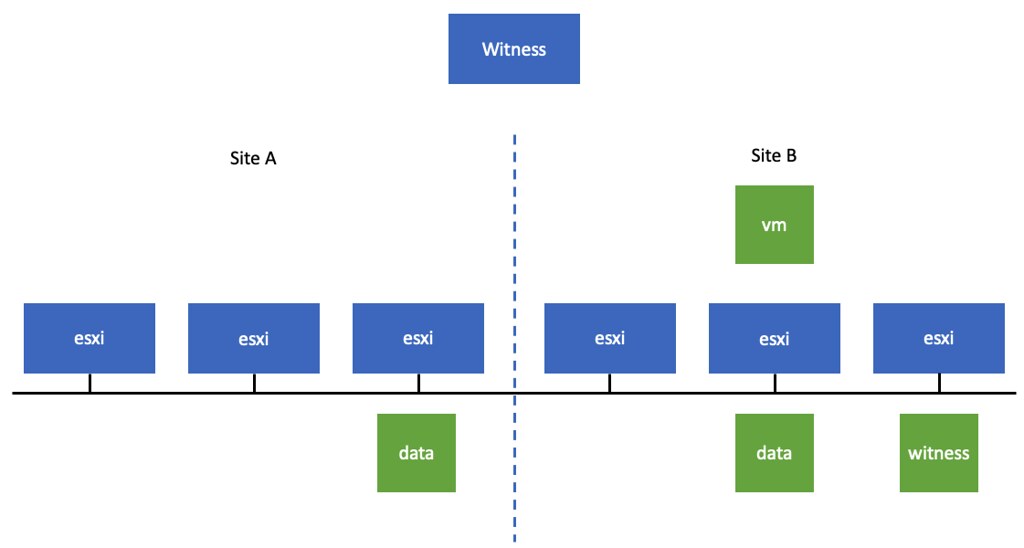
Yes, there is another option. This option is called “None – Stretched Cluster” and then there’s also “None – Standard Cluster”. Why should you not use these? Well, let’s start with “None – Stretched Cluster”. In the case of “None – Stretched Cluster”, vSAN will per object decide where to place it. As you hopefully know, a VM consists of multiple objects. As you can imagine, this is not optimal from a performance point of view, as you could end up having a VMDK being placed in Site A and a VMDK being placed in Site B. Which means it would read and write from both locations from a storage point of view, while the VM would be sitting in a single location from a compute point of view. It is also not very optimal from an availability stance, as it would mean that when the intersite link is unavailable, some objects of the VM would also become inaccessible. Not a great situation. What would it look like? Well, potentially something like the below diagram!

Then there’s “None – Standard Cluster”, what happens in this case? When you use “None – Standard Cluster” with “RAID-1”, what is going to happen is that the VM is configured with FTT=1 and RAID-1, but in a stretched cluster “FTT” does not exist, and FTT automatically will become PFTT. This means that the VM is going to be mirrored across locations, and you will have SFTT=0, which means no resiliency locally. It is the same as “Dual Site Mirroring”+”No Data Redundancy”!

In summary, if you ask me, “none – standard cluster” and “none – stretched cluster” should not be used in a stretched cluster.

vSphere HA configuration for HCI Mesh!

Duncan Epping · Oct 29, 2020 ·

I wrote a vSAN HCI Mesh Considerations blog post a few weeks ago. Based on that post I received some questions, and one of the questions was around vSphere HA configurations. Interestingly I also had some internal discussions around how vSAN HCI Mesh and HA were integrated. Based on the discussions I did some testing just to validate my understanding of the implementation.

Now when it comes to vSphere HA and vSAN the majority of you will be following the vSAN Design Guide and understand that having HA enabled is crucial for vSAN. Also when it comes to vSAN configuring the Isolation Response is crucial, and of course setting the correct Isolation Address. However, so far there’s been an HA feature which you did not have to configure for vSAN and HA to function correctly, and that feature is VM Component Protection aka APD / PDL responses.

Now, this changes with HCI Mesh. Specifically for HCI Mesh the HA and vSAN team have worked together to detect APD (all paths down) down scenarios! When would this happen? Well if you look at the below diagram you can see that we have “Client Clusters” and a “Server Cluster”. The “Client Cluster” consumes storage from the “Server Cluster”. If for whatever reason a host in the “Client Cluster” loses access to the “Server Cluster”, it results in the VMs on that host consuming storage on the “Server Cluster” to lose access to the datastore. This is essentially an APD (all paths down) scenario.

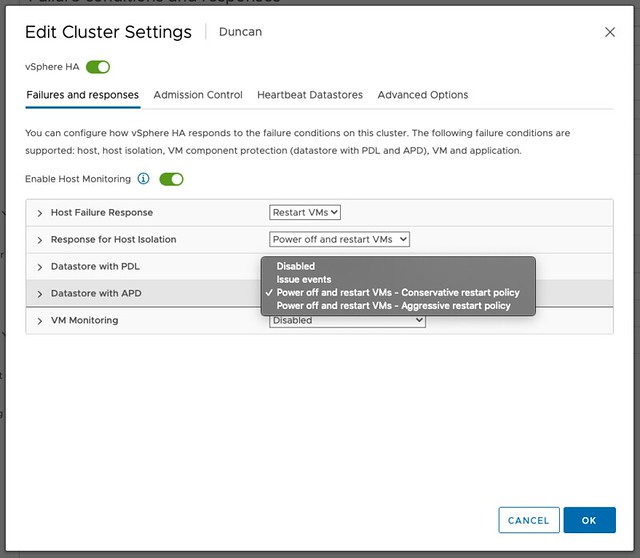
Now, to ensure the VMs are protected by HA for this situation you only need to enable the APD response. This is very straight-forward. You simply go to the HA cluster settings and set the “Datastore with APD” setting to either “Power off and restart VMs – Conservative” or “Power off and restart VMs – Aggressive”. The difference between conservative and aggressive is that with conservative HA will only kill the VMs when it knows for sure the VMs can be restarted, wherewith aggressive it will also kill the VMs on a host impacted by an APD while it isn’t sure it can restart the VMs. Most customers will use the “Conservative Restart Policy” by the way.

As I also mentioned in the HCI Mesh Considerations blog, one thing I would like to call out is the timing for the APD scenario: The APD is declared after 60 seconds, after which the APD response (restart) is triggered automatically after 180 seconds. Mind that this is different than with an APD response with traditional storage, as with traditional storage it will take 140 seconds before the APD is declared. You can, of course, in the log file see that an APD is detected, declared and VMs are killed as a result. Note that the “fdm.log” is quite verbose, so I copied only the relevant lines from my tests.

APD detected for remote vSAN Datastore /vmfs/volumes/vsan:52eba6db0ade8dd9-c04b1d8866d14ce5
Go to terminate state for VM /vmfs/volumes/vsan:52eba6db0ade8dd9-c04b1d8866d14ce5/a57d9a5f-a222-786a-19c8-0c42a162f9d0/YellowBricks.vmx due to APD timeout (CheckCapacity:false)
Failover operation in progress on 1 Vms: 1 VMs being restarted, 0 VMs waiting for a retry, 0 VMs waiting for resources, 0 inaccessible vSAN VMs.

Now for those wondering if it actually works, of course, I tested it a few times and recorded a demo, which can be watched on youtube (easier to follow in full screen), or click play below. (Make sure to subscribe to the channel for the latest videos!)

I hope this helps!

vSAN 7.0 U1 File Services with SMB and NFS support demo

Duncan Epping · Sep 21, 2020 ·

I created this quick demo last week, and I figured I would share it here. It shows vSAN 7.0 U1 File Services with SMB and NFS support. I wrote about vSAN File Services and what is new in this post here, make sure to read that as well, and of course, it also details all the other introduced changes for vSAN 7.0 U1.

  • « Go to Previous Page
  • Page 1
  • Interim pages omitted …
  • Page 9
  • Page 10
  • Page 11
  • Page 12
  • Page 13
  • Interim pages omitted …
  • Page 101
  • Go to Next Page »

Primary Sidebar

About the Author

Duncan Epping is a Chief Technologist and Distinguished Engineering Architect at Broadcom. Besides writing on Yellow-Bricks, Duncan is the co-author of the vSAN Deep Dive and the vSphere Clustering Deep Dive book series. Duncan is also the host of the Unexplored Territory Podcast.

Follow Us

  • X
  • Spotify
  • RSS Feed
  • LinkedIn

Recommended Book(s)

Also visit!

For the Dutch-speaking audience, make sure to visit RunNerd.nl to follow my running adventure, read shoe/gear/race reviews, and more!

Do you like Hardcore-Punk music? Follow my Spotify Playlist!

Do you like 80s music? I got you covered!

Copyright Yellow-Bricks.com © 2026 ยท Log in