• Skip to primary navigation
  • Skip to main content
  • Skip to primary sidebar

Yellow Bricks

by Duncan Epping

  • Home
  • Unexplored Territory Podcast
  • HA Deepdive
  • ESXTOP
  • Stickers/Shirts
  • Privacy Policy
  • About
  • Show Search
Hide Search

Software Defined

Startup News Flash part 3

Duncan Epping · Aug 20, 2013 ·

Who knew so quickly after part 1 and part 2 there would be a part 3, I guess not strange considering VMworld is coming up soon and there was a Flash Memory Summit last week. It seems that there is a battle going on in the land of the AFA’s (all flash arrays), it isn’t about features / data services as one would expect. No they are battling over capacity density aka how many TBs can I cram in to a single U, not sure how relevant this is going to be over time, yes it is nice to have dense configurations, yes it is awesome to have a billion IOps in 1U but most of all I am worried about availability and integrity of my data.  So instead of going all out on density, how about going all out on data services? Not that I am saying density isn’t useful, it is just… Anyway, I digress…

One of the companies which presented at Flash Memory Summit was Skyera. Skyera announced an interesting new product called skyEagle. Another all-flash array is what I can hear many of you thinking, and yes I thought exactly the same… but skyEagle is special compared to others. This 1u box manages to provide 500TB of flash capacity, now that is 500TB of raw capacity. So just imagine what that could end up being after Skyera’s hardware-accelerated data compression and data de-duplication has done its magic. Pricing wise? Skyera has set a list price for the read-optimized half petabyte (500 TB) skyEagle storage system of $1.99 per GB, or $.49 per GB with data reduction technologies. More specs can be found here. Also, I enjoyed reading this article on The Register which broke the news…

David Flynn (Former Fusion-io CEO) and Rick White (Fusion-io founder) started a new company called Primary Data. The WallStreet Journal reported on this and more or less revealed what they will be working on:”that essentially connects all those pools of data together, offering what Flynn calls a “unified file directory namespace” visible to all servers in company computer rooms–as well as those “in the cloud” that might be operatd by external service companies.” This kind of reminds me of Aetherstore, or at least the description aligns with what Aetherstore is doing. Definitely a company worth tracking if you ask me.

One of the companies I did an introduction post on is Simplivity. I liked their approach to converged as it not only combines just compute and storage, but they also included backup, replication, snapshots, dedupe and cloud integration. They announced this week an update on their Omnicube CN-3000 platform and introduced two new platforms Omnicube CN-2000 and the Omnicube CN-5000. So what are these two new Omnicubes? Basically the CN-5000 is the big brother of the CN-3000 and the CN-2000 is its kid brother. I can understand why they introduced these as it will help expanding the target audience, “one size fits all” doesn’t work when the cost for “all” is the same and so the TCO/ROI changes based on your actual requirements, but in a negative way. One of the features that made SimpliVity unique that has had a major update is the OmniStack Accelerator, this is a custom designed PCIe card that does inline dedupe and compression. Basically an offload mechanism for dedupe and compression where others are leveraging the server CPU. Another nice thing SimpliVity added is support for VAAI. If you are interested in getting to know more, two white papers were released which are interesting to read: a deep dive by Hans de Leenheer and Stephen Foskett and one with a focus on “data management” by Howard Marks.

A bit older announcement, but as I spoke with these folks this week and they demoed their GA product I figured I would add them to the list. Ravello Systems developed a cloud hypervisor which abstracts your virtualization layer and allows you to move virtual machines / vApps between clouds (private and public) without the need to rebuild your virtual machines or guest OS’s. What I am saying is that they can move your vApps from vSphere to AWS to Rackspace without painful conversions every time. Pretty neat right? On top of that, Ravello is your single point of contact meaning that they are also a cloud broker. You pay Ravello and they will take care of AWS / RackSpace etc. of course they allow you to do stuff like snapshotting, cloning and create complex network configurations if needed. They managed to impress me during the short call we had, and if you want to know more I recommend reading this excellent article by William Lam or visit their booth during VMworld!

That is it for part 3, I bet I will have another part next week during or right after VMworld as press releases are coming in every hour at this point. Thanks for reading,
Startup News Flash part 2

Duncan Epping · Aug 13, 2013 ·

First part of the Startup News Flash was published a couple of weeks ago, and as many things have happened I figured I would publish another. At times I guess I will miss out on a news fact or a new company, if that happens don’t hesitate to leave a comment with your findings/opinion or just a link to what you feel is newsworthy! As mentioned in part 1 the primary focus of this article is Startup news / Flash related news. As you can see most flash related except for one.

Nimbus Data launched two brand new arrays: Gemini F400 / F600 arrays. These are all flash arrays, and bring something unique to the table for sure… and that is costs: price per useable gigabyte is $0.78. Yes, that is low indeed. How do they bring it down? Well of course by very efficient deduplication and compression. On top of that, by leveraging standard hardware and getting all smarts from software the price can be kept low. According to the press release these new arrays will be able to provide between 3TB and 48TB of capacity (I almost said disk space there…) and will be shipping end of this year! Although Nimbus declared Hybrid Storage officially dead, mainly because of the cost of Nimbus all flash solution (the F400 starts under US$60,000, the F600 starts under US$80,000.), I still think there is a lot of room for growth in that space and many customer will be interested in those solutions. My question yesterday on twitter was to Nimbus which configuration they did the math with to declare hybrid dead, because cost per gigabyte is one thing, the upfront investment to reach that price point is another. It will be interesting to see how they will do the upcoming 12-18 months, but it is needless to say that they will be going after their competition aggressively. Talking about competition….

Last year at VMworld I briefly stopped at the Tegile booth, besides the occasional tweet I kind of lost track until recent as Tegile just announced series C funding… Not pocket money I would say but a serious round, $35 million, led by Meritech Capital Partners and original stakeholder August Capital and strategic partners Western Digital and SanDisk.  For those who don’t know, Tegile is a storage company who sells both a hybrid and an “all-flash” solution and they have done this in an interesting modular fashion (all-flash placed in front of spinning disks = modular hybrid). Of course they also offer functionality like dedupe/compression and replication. Although I haven’t heard too much from them lately it is a booth I will surely stop by at VMworld. Again, there is a lot of competition in this space and it would be interesting to see an “All-flash / Hybrid Storage bake off”. Tegile vs Nimbus, Nimble vs Tintri, Pure Storage vs Violin…

Violin Memory just announced the 6264 flash Memory Array. This new all flash storage system can provide a capacity of 64 TiB/70.3 TB with a footprint of just 3U, and that is impressive if you ask me. On top of that, it can provide up to 1 million IOps and at a ultra low latency! Who doesn’t want to have 1 million IOps to its disposal right? (More specs to be found here.) To me though what was more exciting in this press release was the announcement of a management tool called Symphony. Symphony provides a single pane of glass for all your Violin devices (read more details here.) It provides a smart management interface that allows you to create custom dashboard, comprehensive reporting, tagging and filtering and of course they provide a RESTful API for you admins out there who love to automate things. Nice announcement from Violin Memory, and those already running Violin hardware I would definitely recommend evaluating Symphony as the video looks promising.

CloudPhysics just announced the Card Store is GA as of today (13th August 2013) and a new round of funding ($ 10 million) led by Kleiner Perkins Caufield & Byers. Previous investors the Mayfield Fund, Mark Leslie, Peter Wagner, Carl Waldspurger, Nigel Stokes, Matt Ocko and VMware co-founders also participated in this round. I would say an exciting day for CloudPhysics. Many have asked over the last year why have I always been enthusiastic about what they do? I think John Blumenthal (CEO) explains it best:

Our servers receive a daily stream of 80+ billion samples of configuration, performance, failure and event data from our global user base with a total of 20+ trillion data points to date. This ‘collective intelligence,’ combined with CloudPhysics’ patent-pending datacenter simulation and unique resource management techniques, empowers enterprise IT to drive Google-like operations excellence using actionable analytics from a large, relevant, continually refreshed data set.

If you are interested in testing their solution, sign up for a free trial  at cloudphysics.com. Pricing starts at $49/month per physical server, more details here. For those wondering what CloudPhysics has to do with flash, well they’ve got a card for that!

That was it for Part 2, hope you found it a useful round-up and I will expect to be able to publish another startup news flash within 2 weeks!


Startup News Flash part 1

Duncan Epping · Aug 8, 2013 ·

I am on PTO this week so have tried to avoid spending time behind my mac/iPhone/iPad, well tried I guess… It is difficult as most of you probably know and have realized. While on vacation a couple of interesting things happened, hence this Startup New Flash blog post. The primary focus of this article is Startup news / Flash-related news. Preferably in the storage/flash space. This can be flash caching, flash arrays, hybrid arrays, flash drives… you name it! I guess “new technologies from old companies” would even fit. Will try to make this a regular thing… Or at least use the same title when there is something flashy announced or worth calling out.

For those who have been living under a rock the last week, besides introducing a brand new logo, PernixData announced general availability of FVP 1.0. On Monday my RSS reader was filled with Pernix related articles, and I was almost at the point of muting “Pernix” on twitter. So why the excitement, what did they announce? Hopefully, most of you have read my article on Pernix, or have been following Frank’s series of articles. I guess everyone is aware that Pernix offers a hypervisor-based flash virtualization platform. Meaning that their solution is installed as a “vib” within ESXi, indeed not an appliance-based approach. But others are doing this as well, so what is so unique about it? Write-back caching… Clustered write-back caching that is, so guaranteeing consistency of your IO. In other words, when within FVP you enable “write-back” caching, you can select how many relicas of the IO you want. (Currently, it ranges from 0 to 2.) Pricing for the enterprise solution was also announced, $ 7500,- per host. The announcement mentions there will be a different SKU for SMB, so looking forward to hear the details on that. One thing which I didn’t know is that Pernix also has optimization for View environments, it contains a form of “dedupe” for the base images… Frank revealed this on the APAC podcast (episode 77) he was on, hosted by Mike Laverick. (Recommend listening to it.) All in all an exciting and unique 1.0 release… I guess you might wonder where I think they should focus on, for me that would be NFS support and potentially support for other hypervisors, but if I recall correctly Satyam or Frank mentioned that those are being worked on.

Diablo announced Memory Channel Storage (MCS). The next logical step if you ask me when it comes to reducing latency and increasing bandwidth. MCS basically brings flash closer to your CPU by leveraging the memory bus instead of PCIe/SAS/SATA. Interesting concept, something worth exploring. Especially considering you can present it as either normal memory (how about TBs of memory for a fraction of the price?) or as a block device. This means that you could potentially use Diablo as a target for a flash caching solution. One of the benefits many people listed is that this solution would be very useful in blade environments or hyperconverged due to the fact that it eliminates the need for a PCIe slot or a disk slot… I guess that is somewhat true, in many of those cases the number of memory slots will also be limited so it doesn’t really solve those types of constraints immediately. Nevertheless, an interesting solution which is worth exploring and definitely offers new opportunities.

Another interesting announcement came from a startup called Crossbar. Crossbar came out of stealthmode this week, and is working on RRAM. With 20x faster write performance at 20x lower power consumption and much higher capacity density compared to best-of-breed flash solutions you can understand why people are excited about Crossbar. The market opportunity is huge here, and various companies have been working on it… So far not many have been able to execute on it at scale, so congrats to Crossbar, and definitely a company and a solution to keep your eye on. I know I will, I have already added them to my twitter startup watch list.

Different tiers of storage in a single Storage DRS datastore cluster?

Duncan Epping · Aug 6, 2013 ·

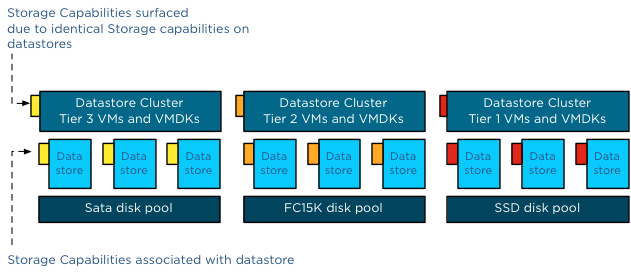
This question around adding different tiers of storage in a single Storage DRS datastore cluster keeps popping up every once in a while. I can understand where it is coming from as one would think that VM Storage Profiles combined with Storage DRS would allow you to have all types of tiers in one cluster, but then balance within that “tier” within that pool.

Truth is that that does not work with vSphere 5.1 and lower unfortunately. Storage DRS and VM Storage Profiles (Profile Driven Storage) are not tightly integrated. Meaning that when you provision a virtual machine in to a datastore cluster and Storage DRS needs to rebalance the cluster at one point, it will consider ANY datastore within that datastore cluster as a possible placement destination. Yes I agree, it is not what you hoped for… it is – what it is. (feature request filed) Frank visualized this nicely in his article a while back:

So when you architect your datastore clusters, there are a couple of things you will need to keep in mind. These are the design rules at a minimum, that is if you ask me:

  • LUNs of the same storage tier
    • See above
  • More LUNs = more balancing options
    • Do note size matters, a single LUN will need to be able to fit your largest VM!
  • Preferably LUNs of the same array (so VAAI offload works properly)
    • VAAI XCOPY (used by SvMotion for instance) doesn’t work when going from Array-A to Array-B
  • When replication is used, LUNs that are part of the same consistency group
    • You will want to make sure that VMs that need to be consistent from a replication perspective are not moved to a LUN that is outside of the consistency group
  • Similar availability characteristics and performance characteristics
    • You don’t want potential performance or availability to degrade when a VM is moved

Hope this helps,

Startup intro: SolidFire

Duncan Epping · Jun 27, 2013 ·

This seems to becoming a true series, introducing startups… Now in the case of SolidFire I am not really sure if I should use the word startup as they have been around since 2010. But then again, it is not a consumer solution that they’ve created and enterprise storage platforms do typically take a lot longer to develop and mature. SolidFire was founded in 2010 by Dave Wright who discovered a gap in the current storage market when he was working for Rackspace. The opportunity Dave saw was in the Quality of Service area. Not many storage solutions out there could provide a predictable performance in almost every scenario, and were designed for multi-tenancy and offered a rich API. Back then the term Software Defined Storage wasn’t coined yet, but I guess it is fair to say that is how we would describe it today. This actually how I got in touch with SolidFire. I wrote various articles on the topic of Software Defined Storage, and tweeted about this topic many times, and SolidFire was one of the companies who consistently joined the conversation. So what is SolidFire about?

SolidFire is a storage company, they sell a storage systems and today they offer two models namely the SF3010 and the SF6010. What is the difference between these two? Cache and capacity! With the SF3010 you get 72Gb of cache per node and it uses 300GB SSD’s where the SF6010 gives you 144GB of cache per node and uses 600GB SSD’s. Interesting? Well to a certain point I would say, SolidFire isn’t really about the hardware if you ask me. It is about what is inside the box, or boxes I should say as the starting point is always 5 nodes. So what is inside?

Architecture

SolidFire’s architecture is based on a scale-out model and of course flash, in the form of SSD. You start out with 5 nodes and you can go up to 100 nodes, all connected to your hosts via iSCSI. Those 100 nodes would be able to provide you 5 million IOps and about 2.1 Petabyte of capacity. Each node that is added linearly scales performance and of course adds capacity. Of course SolidFire offers deduplication, compression and thin provisioning. Considering it is a scale-out model it is probably not needed to point this out, but dedupe and compression are cluster wide. Now the nice thing about the SolidFire architecture is that they don’t use a traditional RAID, this means that the long rebuild times when a disk fails or a node fails do not apply to SolidFire. Rather SolidFire evenly distributes data across all disk and nodes, so when a single disk fails or even a node fails rebuild time is not constraint due to a limited amount of resources but many components can help in parallel to get back to a normal state. What I liked most about their architecture is that it already closely aligns with VMware’s Virtual Volume (VVOL) concept, SolidFire is prepared for VVOLs when it is released.

Quality of Service

I already has briefly mentioned this, but Quality of Service (QoS) is one of the key drivers of the SolidFire solution. It revolves around having the ability to provide an X amount of capacity with an X amount of performance (IOps). What does this mean? SolidFire allows you to specify a minimum and maximum number of IOps for a volume, and also a burst space. Lets quote the SolidFire website as I think they explain it in a clear way:

  • Min IOPS – The minimum number of I/O operations per-second that are always available to the volume, ensuring a guaranteed level of performance even in failure conditions.
  • Max IOPS – The maximum number of sustained I/O operations per-second that a volume can process over an extended period of time.
  • Burst IOPS – The maximum number of I/O operations per-second that a volume will be allowed to process during a spike in demand, particularly effective for data migration, large file transfers, database checkpoints, and other uneven latency sensitive workloads.

Now I do want to point out here that SolidFire storage systems have no “form of admission control” when it comes to QoS. Although it is mentioned that there is a guaranteed level of performance this is up to the administrator, you as the admin will need to do the math and not overprovision from a performance point of view if you truly want to guarantee a specific performance level. If you do, you will need to take failure scenarios in to account!

One thing that my automation friends William Lam and Alan Renouf will like is that you can manage all these settings using their REST-based API.

(VMware) Integration

Ofcourse during the conversation integration came up. SolidFire is all about enabling their customers to automate as much as they possibly can and have implemented a REST-based API. They are heavily investing in for instance integration with Openstack but also with VMware. They offer full support for the vSphere Storage APIs – Storage Awareness (VASA) and are also working towards full support for vSphere Storage APIs – Array Integration (VAAI). Currently not all VAAI primitives are supported but they promised me that this is a matter of time. (They support: Block Zero’ing, Space Reclamation, Thin Provisioning. See HCL for more details.) On top of that they are also looking at the future and going full steam ahead when it comes to Virtual Volumes. Obvious question from my side: what about replication / SRM? This is being worked on, hopefully more news about this soon!

Now with all this integration did they forget about what is sitting in between their storage system and the compute resources? In other words what are they doing with the network?

Software Defined Networking?

I can be short, no they did not forget about the network. SolidFire is partnering with Plexxi and Arista to provide a great end-to-end experience when it comes to building a storage environment. Where with Arista currently the focus is more on monitoring the the different layers Plexxi seems to focus more on the configuration and optimization for performance aspect. No end-to-end QoS yet, but a great step forward if you ask me! I can see this being expanded in the future

Wrapping up

I had already briefly looked at SolidFire after the various tweets we exchanged but this proper introduction has really opened my eyes. I am impressed by what SolidFire has achieved in a relatively short amount of time. Their solution is all about customer experience, that could be performance related or the ability to automate the full storage provisioning process… their architecture / concept caters for this. I have definitely added them to my list of storage vendors to visit at VMworld, and I am hoping that those who are looking in to Software Defined Storage solutions will do the same as SolidFire belongs on that list.

  • « Go to Previous Page
  • Page 1
  • Interim pages omitted …
  • Page 65
  • Page 66
  • Page 67
  • Page 68
  • Page 69
  • Interim pages omitted …
  • Page 71
  • Go to Next Page »

Primary Sidebar

About the Author

Duncan Epping is a Chief Technologist and Distinguished Engineering Architect at Broadcom. Besides writing on Yellow-Bricks, Duncan is the co-author of the vSAN Deep Dive and the vSphere Clustering Deep Dive book series. Duncan is also the host of the Unexplored Territory Podcast.

Follow Us

  • X
  • Spotify
  • RSS Feed
  • LinkedIn

Recommended Book(s)

Also visit!

For the Dutch-speaking audience, make sure to visit RunNerd.nl to follow my running adventure, read shoe/gear/race reviews, and more!

Do you like Hardcore-Punk music? Follow my Spotify Playlist!

Do you like 80s music? I got you covered!

Copyright Yellow-Bricks.com © 2026 · Log in