• Skip to primary navigation
  • Skip to main content
  • Skip to primary sidebar

Yellow Bricks

by Duncan Epping

  • Home
  • Unexplored Territory Podcast
  • HA Deepdive
  • ESXTOP
  • Stickers/Shirts
  • Privacy Policy
  • About
  • Show Search
Hide Search

BC-DR

SMP-FT and (any type of) stretched storage support

Duncan Epping · Jan 19, 2016 ·

I had a question today around support for SMP-FT in an EMC VPLEX environment. It is well known that SMP-FT isn’t supported in a stretched VSAN environment, but what about other types of stretched storage? Is that a VSAN specific constraint? (Legacy) FT appears to be supported for VPLEX and other types of stretched storage?

SMP-FT is not supported in a vSphere Metro Storage Cluster environment either! This has not been qualified yet, I’ve requested the FT team to at least put it up on the roadmap and document max latency tolerated for these types of environments for SMP-FT just in case someone would want to use it in a campus situations for instance, despite the high bandwidth requirements for SMP-FT. Note that “legacy FT” can be used with vMSC environment, but not with VSAN. In order to use legacy FT (single vCPU) you will need to use an advanced VM setting: vm.uselegacyft. Make sure to set this setting when using FT in a stretched environment!

Disable VSAN site locality in low latency stretched cluster

Duncan Epping · Jan 15, 2016 ·

This week I was talking to a customer in Germany who had deployed a VSAN stretched cluster within a building. As it was all within a building (extremely low latency) and they preferred to have a very simple operational model they decided not to implement any type of VM/Host rules. By default when a stretched cluster is deployed in VSAN (and ROBO uses this workflow as well) then “site locality” is implemented for caching. This means that a VM will have its read cache on the host which holds the components in the site where it is located.

This is great of course and avoids incurring latency hit for reads. Now in some cases you may not desire this behaviour. For instance in the situation above where there is an extremely low latency connection between the different rooms in the same building. In this case as well because there are no VM/Host rules implemented a VM can freely roam around the cluster. Now when a VM moves between VSAN Fault Domains in this scenario the cache will need to be rewarmed as it only reads locally. Fortunately you can disable this behaviour easily through the advanced setting called DOMOwnerForceWarmCache:

[root@esxi-01:~] esxcfg-advcfg -g /VSAN/DOMOwnerForceWarmCache
Value of DOMOwnerForceWarmCache is 0
[root@esxi-01:~] esxcfg-advcfg -s 1 /VSAN/DOMOwnerForceWarmCache
Value of DOMOwnerForceWarmCache is 1

In a stretched environment you will see that this setting is set to 0 set it to 1 to disable this behaviour. In a ROBO environment VM migrations are uncommon, but if they do happen on a regular basis you may also want to look in to setting this setting.

Where do I run my VASA Vendor Provider for vVols?

Duncan Epping · Jan 6, 2016 ·

I was talking to someone before the start of the holiday season about running the Vendor Provider (VP) for vVols as a VM and what the best practices are around that. I was thinking about the implication of the VP not being available and came to the conclusion that when the VP is unavailable a bunch of things stop working out of which “bind” is probably most important.

The “bind” operation is what allows vSphere to access a given Virtual Volume (vVol), and this operation is issued during a power-on of a VM. This is how the vVols FAQ describes it:

When a vVol is created, it is not immediately accessible for IO. To Access vVol, vSphere needs to issue a “Bind” operation to a VASA Provider (VP), which creates IO access point for a vVol on a Protocol Endpoint (PE) chosen by a VP. A single PE can be the IO access point for multiple vVolss. “Unbind” Operation will remove this IO access point for a given vVol.

This means that when the VP is unavailable, you can’t power-on VMs at that particular time. For many storage systems that problem is mitigated by having the VP as part of their storage system itself, and of course there is the option to have multiple VPs as part of your solution, either in active/active or in active/standby configuration. In the case of VSAN for instance, each host has a VASA provider out of which one is active and others are standby, if the active fails the standby will take over automatically. So to be clear, it is up to the vendor to decide what type of availability to provide for the VP, some have decided to go for a single instance and rely on vSphere HA to restart the appliance, others have created active/standby etc.

But back to vVols, what if you own a storage system that requires an external VASA VP as a VM?

  • Run your VP VMs in a management cluster, if the hosts in the “production” cluster are impacted and VMs are restarted then at least the VP VMs should be up and running in your management cluster
  • Use multiple VP VMs if and when possible, if active/active or active / standby is supported make sure to run your VPs in that configuration
  • Do not use vVols for the VP itself, you don’t want to have any (circular) dependency between the availability of the VP and being able to power-on the VP itself
  • If there is no availability story for the VP, depending on the configuration of the appliance vSphere FT should be considered.

One more thing, if you are considering buying new storage, I think one question you definitely need to ask your vendor is what their story is around the VP. Is it a VM or is it part of the storage system itself? Is there an availability story for the VP, and if so is this “active/active” or “active/standby”? If not, what do they have on their roadmap around this? You are probably also asking yourself what VMware has planned to solve this problem, well there are a couple of things cooking and I can’t say too much about it. One important effort though is the inclusion of bind/unbind in the T10 SCSI standard, but as you can imagine, those things take time. (Which would allow us to power-on new VMs even when the VP is unavailable as it would be a SCSI command.) Until then, when you design a vVol environment, take the above into account when it comes to your Vendor Provider aka VP!

Removing stretched VSAN configuration?

Duncan Epping · Dec 15, 2015 ·

I had a question today around how to safely remove a stretched VSAN configuration without putting any of the workloads in danger. This is fairly straight forward to be honest, there are 1 or 2 things though which are important. (For those wondering why you would want to do this, some customers played with this option and started loading workloads on top of VSAN and then realized it was still running in stretched mode.) Here are the steps required:

  1. Click on your VSAN cluster and go to Manage and disable the stretched configuration
    • This will remove the witness host, but will leave 2 fault domains in tact
  2. Remove the two remaining fault domains
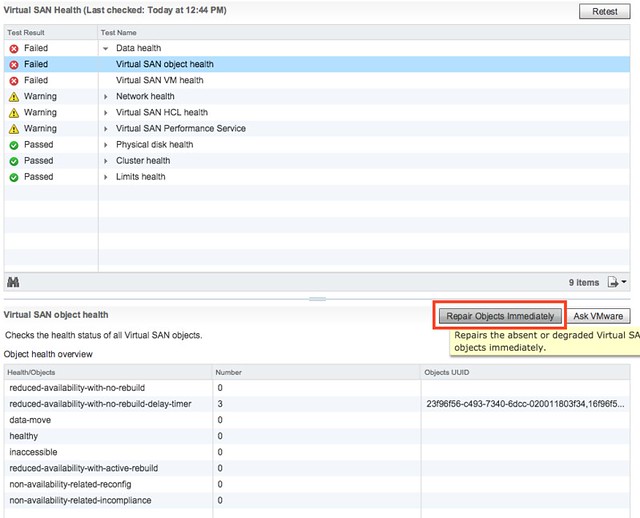
  3. Go to the Monitor section and click on Health and check the “virtual san object health”. Most likely it will be “red” as the “witness components” have gone missing. VSAN will repair this automatically by default in 60 minutes. We prefer to take step 4 though asap after removing the failure domains!
  4. Click “repair object immediately”, now witness components will be recreated and the VSAN cluster will be healthy again.
  5. Click “retest” after a couple of minutes

By the way, that “repair object immediately” feature can also be used in the case of a regular host failure where “components” have gone absent. Very useful feature, especially if you don’t expect a host to return any time soon (hardware failure for instance) and have the spare capacity.

data copy management / converged data management / secondary storage

Duncan Epping · Dec 3, 2015 ·

At the Italian VMUG I was part of the “Expert panel” at the end of the event. One of the questions was around innovation in the world of IT, what should be next. I knew immediately what I was going to answer: backup/recovery >> data copy management. My key reason for it being is that we haven’t seen much innovation in this space.

And yes before some of my community friends will go nuts and point at Veeam and some of the great stuff they have introduced over the last 10 years, I am talking more broadly here. Many of my customers are still using the same backup solution they used 10-15 years ago, yes it is a different version probably, but all the same concepts apply. Well maybe tapes have been replaced by virtual tape libraries stored on a disk system somewhere, but that is about it. The world of backup/recovery hasn’t evolved really.

Over the last years though we’ve been seeing a shift in the industry. This shift started with companies like Veeam and then continued with companies like Actifio, and this is now accelerated by companies like Cohesity and Rubrik. What is different from what these guys offer versus the more traditional backup solution… well the difference is that all of these are more than backup solutions, they don’t focus on a single use case. They “simply” took a step back and looked at what kind of solutions are using your data today, who is using it, how and of course what for. On top of that, where the data is stored is also a critical part of it of the puzzle.

In my mind Rubrik and Cohesity are leading the pack when it comes to this new wave of, they’ve developed a solution which is a convergence of different products (Backup / Scale-out storage / Analytics / etc). I used “convergence” on purpose, as this is what it is to me “converged data (copy) management”. Although not all use cases may have reached the full potential yet, the vision is pretty clear, and multiple layers have already converged, even if we would just consider backup and scale-out storage. I said pretty clear as the various startups have taken different messaging approaches. This is something that became obvious during the last Storage Field Day where Cohesity presented. Different story than for instance Rubrik had during Virtualization Field Day. Just as an example, Rubrik typical;y leads with data protection and management, where Cohesity’s messaging appears to be more around being a “secondary storage platform”. This in the case of Cohesity lead to discussions (during SFD) around what secondary storage is, how you get data on the platform and finally then what you can do with it.

To me, and the folks at these startups may have completely different ideas around this, there are a couple of use cases which stand out for a converged data management platform, use cases which I would expect to be the first target and I will explain why in a second.

  1. Backup and Recovery (long retention capabilities)
  2. Disaster Recovery using point in time snapshots/replication (relatively short retention capabilities and low RPO)

Why are these the two use cases to go after first? Well it is the easiest way to suck data in to your system and make your system sticky. It is also the market where innovation is needed, on top of that you need to have the data in your system first before you can do anything with it. Before some of the other use cases start to make sense like “data analytics”, or creating clones for “test / dev” purposes, or spinning up DR instances whether that is in your remote site or somewhere in the cloud.

The first use case (backup and recovery) is something which all of them are targeting, the second one not so much at this point. In my opinion a shame, as it could definitely be very compelling for customers to have these two data availability concepts combined. Especially when some form of integration with an orchestration layer can be included (think Site Recovery Manager here) and protection of workloads is enabled through policy. Policy in this case allowing you to specify SLA for data recovery in the form of recovery point, recovery time and retention. And then when needed, you as a customer have the choice of how you want to make your data available again: VM fail-over, VM recovery, live/instant recovery, file granular or application/database object level recovery and so on and so forth. Not just that, from that point on you should be capable of using your data for other use cases, the use cases I mentioned earlier like analytics, test/dev copies etc.

We aren’t there yet, better said we are far from there, but I do feel this is where we are headed towards… and some are closing in faster than others. I can’t wait for all of this to materialize and we start making those next steps and see what kind of new use cases can be made possible on converged data management platforms.

  • « Go to Previous Page
  • Page 1
  • Interim pages omitted …
  • Page 16
  • Page 17
  • Page 18
  • Page 19
  • Page 20
  • Interim pages omitted …
  • Page 63
  • Go to Next Page »

Primary Sidebar

About the Author

Duncan Epping is a Chief Technologist and Distinguished Engineering Architect at Broadcom. Besides writing on Yellow-Bricks, Duncan is the co-author of the vSAN Deep Dive and the vSphere Clustering Deep Dive book series. Duncan is also the host of the Unexplored Territory Podcast.

Follow Us

  • X
  • Spotify
  • RSS Feed
  • LinkedIn

Recommended Book(s)

Also visit!

For the Dutch-speaking audience, make sure to visit RunNerd.nl to follow my running adventure, read shoe/gear/race reviews, and more!

Do you like Hardcore-Punk music? Follow my Spotify Playlist!

Do you like 80s music? I got you covered!

Copyright Yellow-Bricks.com © 2026 · Log in