• Skip to primary navigation
  • Skip to main content
  • Skip to primary sidebar

Yellow Bricks

by Duncan Epping

  • Home
  • Unexplored Territory Podcast
  • HA Deepdive
  • ESXTOP
  • Stickers/Shirts
  • Privacy Policy
  • About
  • Show Search
Hide Search

VMware

DQLEN changes, what is going on?

Duncan Epping · Mar 5, 2019 ·

I had a question this week on twitter, it was about the fact that DQLEN changes to values well below it was expected to be (30) in esxtop for a host. There was latency seen and experienced seen for VMs so the question was why is this happening and wouldn’t a lower DQLEN make things worse?
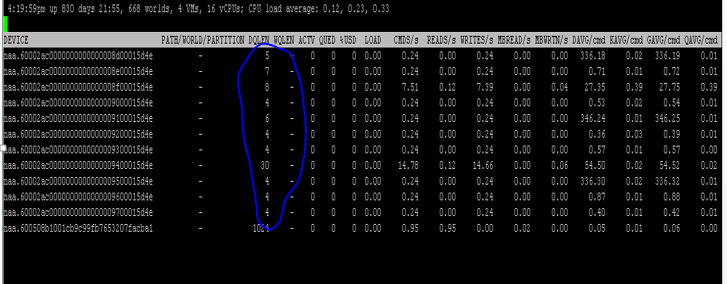
My first question: Do you have SIOC enabled? The answer was “yes”, and this is (most likely) what is causing the DQLEN changes. (What else could it be? Adaptive Queueing for instance.) When SIOC is enabled it will automatically change DQLEN when the configured latency threshold is exceeded based on the number of VMs per host and the number of shares. DQLEN will be changed to ensure a noisy neighbor VM is not claiming all I/O resources. I described how that works in this post in 2010 on Storage IO Fairness.

How do you solve this problem? Well, first of all, try to identify the source of the problems, this could be a single (or multiple) VMs, but it could also be that in general, the storage array is running at its peak constantly or backend services like replication is causing a slowdown. Typically it is a few (or one) VMs causing the load, try to find out which VMs are pushing the storage system and look for alternatives. Of course, that is easier said than done, as you may not have any expansion possibilities in the current solution. Offloading some of the I/O to a caching solution could also be an option (Infinio for instance), or replace the current solution with a more capable system is another one.
Device X is not listed on the vSAN Compatability Guide, can I still use it?

Duncan Epping · Jan 8, 2019 ·

I get this question almost daily, and I am pretty sure I have said this various times, but just in case it wasn’t clear I figured I would share the answer to the question whether a device should be used in a vSAN cluster when it is not listed on the vSAN Compatibility Guide? if you have not looked at the components variant of the VCG for vSAN please take a look here: http://vmwa.re/vsanhclc. Of course, we also have an easier route, which is the ReadyNode VCG. But some may want to tweak based on performance, cost etc. I get that, and so does VMware, that is why we have listed all supported and tested components. Can you use a device which is not listed? Sure you can. Will VMware support the environment? Maybe they will, maybe they won’t! Should you use a device which is not listed if the previous answer is maybe? No!

So let’s be clear and let’s answer the two most asked questions:

  • Device X is not listed on the vSAN Compatability Guide, can I still use it?
    • No, you should not. If any problem arises chances are you will not get the support you need as a result of an unsupported configuration. Sure, usually VMware Support will do their best to help, but if it appears the unsupported device is causing the problem then it becomes difficult. Please do not use devices which are not listed
  • Device X is listed with Firmware version Y, but the OEM says I should use Z, what to do?
    • Ask the OEM why the version is not listed on VMware’s VCG website. Vendors are responsible for certifying components and the software (drivers / firmware) associated with it. If it is not listed then it has either not been submitted yet, it has not been tested, or it has not passed the test. Please only use tested and listed versions, the only exception is when both VMware GSS and the OEM points you to a new version.

Hope that helps,

New book: VMware vSAN 6.7 U1 Deep Dive

Duncan Epping · Dec 12, 2018 ·

Cormac Hogan and I have been working late nights and weekends over the past months to update our vSAN book material. Thanks Cormac, it was once again a pleasure working with you on this project! As you may know, we released two versions of a vSAN based book through VMware Press. The book was titled vSAN Essentials. As mentioned before, after restructuring and rewriting a lot of the content we felt that the title of the book didn’t match the content, so we decided to rebrand it to vSAN 6.7 U1 Deep Dive. After receiving very thorough reviews by Frank Denneman and Pete Koehler (Thanks guys!) we managed to complete it this week after we added a great foreword by our business unit’s SVP and General Manager, Yanbing Li.

Cormac and I decided to take the self-publishing route for this book, which allows us to set a great price for the ebook and enable the Amazon matchbook option, giving everyone who buys the paper version through Amazon the option to buy the e-book with a nice discount! As prices will vary based on location I am only going to list the USD prices. Please check your local Amazon website for localized prices. Oh, and before I forget, I would like to recommend buying the ebook flavor! Why? Well:

“On average, each printed book releases 8.85 pounds of carbon dioxide into the environment. Together, the newspaper and book-printing industries cut down 125 million trees per year and emit 44 million tons of CO2.”

We appreciate all support, but we prefer the cleanest option from an environmental stance, this is also the reason we priced the ebook a lot cheaper than the paper version. Anyway, here are the links to the US store, we hope you enjoy the content, and of course as always an Amazon review would be appreciated! Interestingly, it seems we already reached number 1 in the category Virtualization and the category Storage before this announcement, thanks everyone, we really appreciate it! (Please note, as an Amazon Associate I earn from below qualifying purchases.)

  • Paper version – 39.95 USD
  • Ebook version – 9.99 USD
  • Match book price – 2.99 USD for the ebook!
    (you need to buy the paper edition first before you see this discount, and this may not be available in all regions, unfortunately.)


UPDATE:

It appears that some Amazon stores take a bit longer to index the content, so listing all the different versions below for the different stores that sell it:

  • Germany – Paper
  • Germany – ebook
  • UK – Paper
  • UK – ebook
  • FR – Paper
  • FR – ebook
  • ES – Paper
  • ES – ebook
  • IT – Paper
  • IT – ebook
  • JP – Paper
  • JP – ebook
  • NL – ebook
  • BR – ebook
  • CA – ebook
  • MX – ebook
  • AU – ebook
  • IN – ebook

CTO3509BU: Embracing the Edge: Automation, Analytics, and Real-Time Business

Duncan Epping · Sep 7, 2018 ·

This is the last post in this VMworld Sessions series. Although the title lists “CTO3509BU: Embracing the Edge: Automation, Analytics, and Real-Time Business” which is by Chris Wolf and Daniel Beveridge, I would also highly recommend watching Daniel’s other session titled “CTO2161BU Smart Placement of Workloads in Tomorrow’s Distributed Cloud“. Both sessions discuss a similar topic and this Edge vs Cloud and where workloads and data should be placed. Both very interesting topics if you ask me, and definitely topics I am starting to explore more.

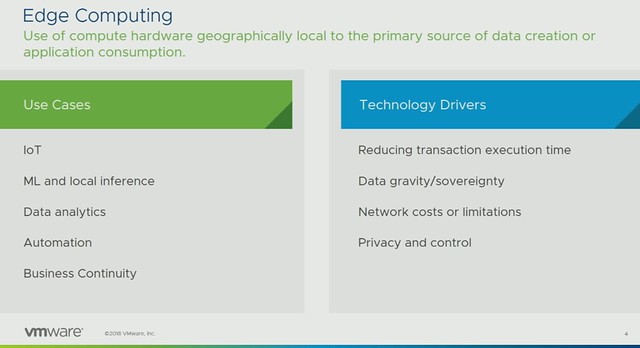
Chris discussed the various use cases around Edge Computing and the Technology Drivers, some of these very obvious but some of them not so much. What often is skipped is the business continuity aspect of edge but also things like network costs, limitations, and even data gravity. It is good to see that Chris addressed these. Some people still seem to be under the impression that every workload can run in the cloud, but in many cases it simply isn’t possible to send data to the cloud. Could be that the volume is too high, could be that the time it takes to transfer and analyze is too long (transaction execution time), or maybe it is physically impossible. It could also be that the application is mission-critical, meaning that the service can’t rely on a connection to the internet.

As a company, VMware is aiming to provide a solution for Edge and IoT, yet work closely with the very rich partner ecosystem and the main focus is providing a “native experience” for developers. Which provides customers choice as it avoids lock-in. Now I don’t want to start a lock-in discussion here as one could claim that it is difficult to migrate between platforms, and this is always the case, if not only because of the operational aspects (tooling/processes). A diagram which explains the different initiatives was then presented, and I like this diagram a lot as it differentiates between “device edge” and “compute edge”, on top of that it shows a differentiation between the device edge focussed on things vs people (big difference).

Next discussed is IoT management, Chris explains how Pulse 2.0 will be capable of managing up to 500 million managed objects. Pulse provides central management across different IoT device manufacturers. Instead of having a point solution for each manufacturer we introduced an abstraction layer and automate things like updates etc. (Sounds familiar?) Then ESXi for ARM is briefly touched upon, as Christ mentioned this is not for general purpose intended. VMware is looking for very specific use cases, if you are one of those partners/customers that has a use case for ESXi on ARM then please reach out to us and let’s discuss the use case and opportunity!

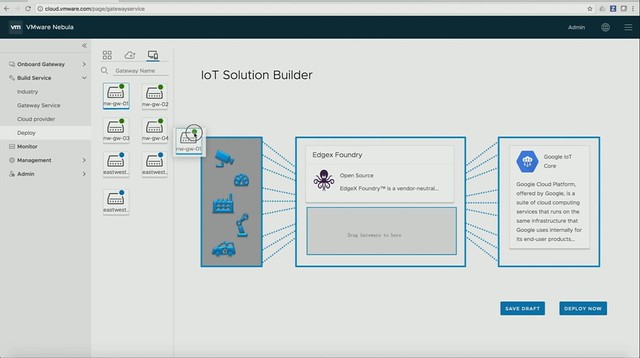
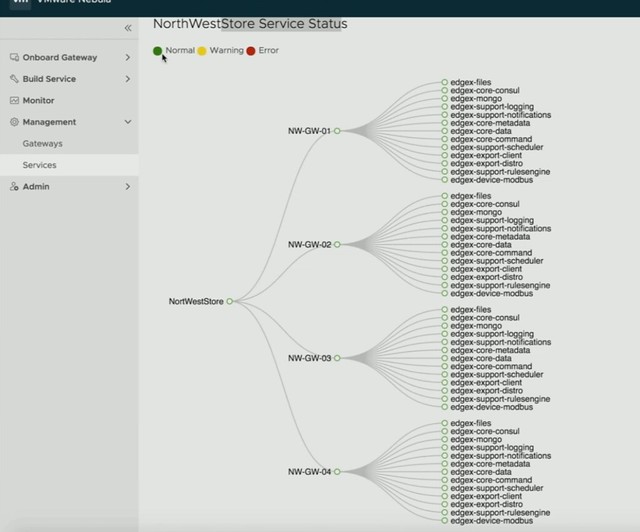
First, a new project is introduced by Daniel, it is called Project Nebula. Nebula brings an IoT marketplace, in this marketplace you can select various IoT services (which come in the form of containers), which are then sent to the IoT gateways. It looks pretty cool, as Daniel shows how he simply pushed various IoT services down to capable IoT gateways. So there’s a validation there if the edge services can run on the specific devices. On top of that, a connection to specific cloud services can also be provided so that certain metrics can be send up and analyzed when needed. Pretty smooth, I also like the fact that it provides monitoring, even down to the sensor and individual service as shown in the second screenshot below.

Next, it is briefly discussed why vSphere/VMware is the right platform, and then they jump into the momentum there is around cloud services and edge computing today. A brief overview of Amazon RDS on VMware is given and more importantly why this is a valuable solution, especially the replication of instances from on-premises to cloud and across regions. Of course, AWS Greengrass is mentioned, VMware also has a story in this space. You can run Greengrass on-premises in a highly available manner and it is dead simple to implement. For those who have not seen the announcements around that, read up here. Next Chris and Daniel go over various use cases, I guess Daniel likes wine as he explains how a Winery leverages AWS Lamba and Greengrass to analyze data coming from sensors which then drives control systems. On top of that, based on customer (and sommelier) ratings of wine, leveraging the data provided by sensors and matching that with customer behavior the winery can predict which barrels will score higher and most likely sell better etc. Very interesting story.

Compute edge is discussed next, this is where project dimension comes in to play, however first Chris defines the difference between the different option people have for consuming certain services. When does Cloud, Compute or Device Edge make sense? It is all about “time” or “latency”, how fast do you or the process need a response from the system? Transaction time window within 500ms and latency lower than 5ms? Well then you need to process at “device edge layer”, if a transaction time of below 1s is acceptable and latency of around 20ms then the “compute edge would work. Is a transaction time of larger than 1s okay and latency of higher than 20ms, then the cloud may be an option. As I said, it all revolves around how long you can wait.

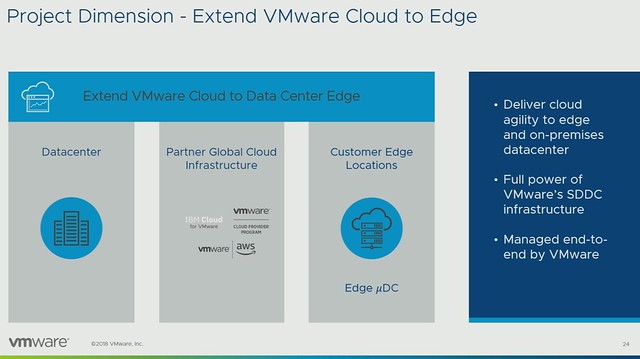
Project Dimension delivers a compute edge solution which runs on-premises but is managed by VMware and delivered as a service. What I also liked is that the “micro” and “nano” data center is discussed, meaning that there potentially will be an option in the future to buy small form factor solutions which allow you to run a handful of VMs. More importantly, these solutions will consume less power and require less cooling. These things can make a big difference, especially as many Edge locations don’t have a data center room. Again ESXi for ARM is mentioned, this sounds very interesting, would be interesting to see if there are plans to mix this with Project Dimension over time, but that is just me thinking out loud.

From a networking perspective of course VeloCloud is discussed, and some very cool projects where cloud networks can be utilized and per traffic type certain routes can be used based on availability and performance (I probably should say QoS).

That was it for now as I don’t want to type out the whole session verbatim, for more specifics please watch the two sessions, worth your time, TO3509BU: Embracing the Edge: Automation, Analytics, and Real-Time Business” and/or “CTO2161BU Smart Placement of Workloads in Tomorrow’s Distributed Cloud“.

HCI2164BU – HCI Management, current and futures

Duncan Epping · Sep 5, 2018 ·

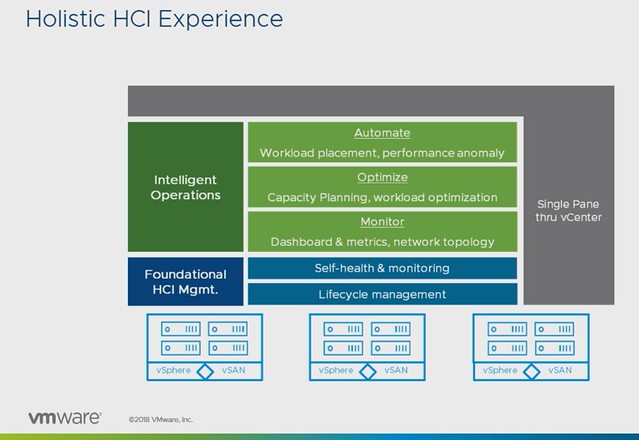
This session by Christian Dickmann and Junchi Zhang is usually one of my favorites in the HCI track, mainly because they show a lot of demos and in many cases show you what ends up being part of the product in 6-12 months. The session revolved all around management, or as they called it in the session “providing a holistic HCI experience”.

After a short intro Christian showed a demo around what we currently have around the installation of the vCenter Server Appliance and how we can deploy that to a vSAN Datastore, followed by the Quickstart functionality. I posted a demo of Quickstart earlier this week, let me post it here as well so you have an idea of what it is/does.

In the next demo, Christian showed how you can upgrade the firmware of a disk controller using Update Manager. Pretty cool, but afaik still limited to a single disk controller, hopefully, more will follow soon. But more importantly, after that demo ended he started talking about “Guided SDDC Update & Patching”, and this is where it got extremely interesting. We all know that it isn’t easy to upgrade a full stack, and what Christian was describing would be doing exactly that. Do you have Horizon? Sure, we will upgrade that as well when we do vCenter / ESXi / vSAN etc. Do you have NSX as part of your infra? Sure, that is also something we will take into account and upgrade it when required. This would also include firmware upgrades for NICs, disk controllers etc.

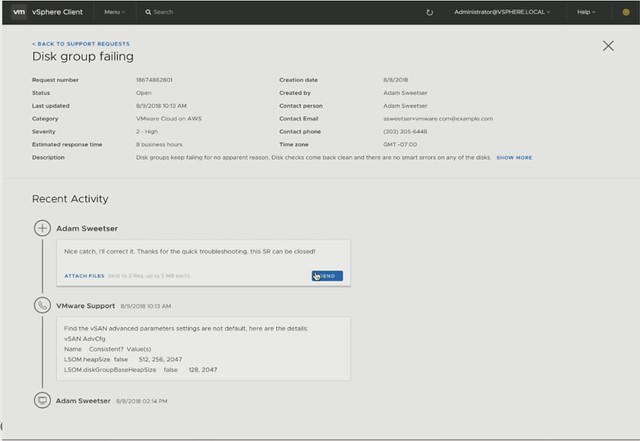
Next Christian showed the Support Insight feature, which is enabled through the Customer Experience Improvement Program. His demo then showed how to create a support request right from the H5 Client. The process shows that the solution understands the situation and files the ticket. Then it shows what the support team sees. It allows the support team to quickly analyze the environment, and more importantly inform the customer about the solution. No need to upload log bundles or anything like that, that all happens automatically. That’s not where it stop, you will be informed in the H5 client about the solution as well. Cool right?

Next Junchi was up and he discussed Capacity Management first. As he mentioned it appears to be difficult for people to understand the capacity graphs provided by vSAN. Junchi proposes a new model where it is clear instantly what the usable space is and by what current capacity is being consumed. Not just on a cluster level, but also at a VM level. This should also include what-if scenarios for usage projection. Junchi then quickly demoed the tools available that help with sizing and scaling.

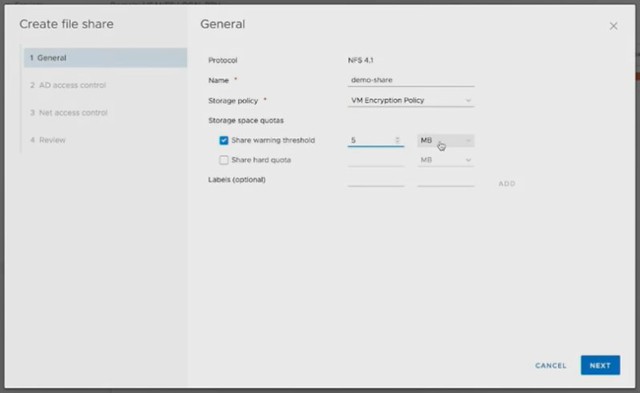
Next Native File Services was briefly discussed, Data Protection and Cloud Native Storage. What does the management of these services look like? The file services demo that Junchi showed was really slick. Fill out IP details and Domain details and have File Services running in a minute or two natively on vSAN. Only thing you would need to do is create file shares and give folks access to the file shares. Also, monitoring will go through the familiar screens like the health check etc.

Last but not least Junchi discusses the integration with vRealize Automation on-premises and SaaS-based, a very cool demo showing how Cloud Assembly (but also vRA) will be able to leverage storage policies and new applications are provided using blueprints which have these policies associated with them.

That was it, if you like to know more, watch the session online, or attend it in EMEA!

  • « Go to Previous Page
  • Page 1
  • Interim pages omitted …
  • Page 28
  • Page 29
  • Page 30
  • Page 31
  • Page 32
  • Interim pages omitted …
  • Page 124
  • Go to Next Page »

Primary Sidebar

About the Author

Duncan Epping is a Chief Technologist and Distinguished Engineering Architect at Broadcom. Besides writing on Yellow-Bricks, Duncan is the co-author of the vSAN Deep Dive and the vSphere Clustering Deep Dive book series. Duncan is also the host of the Unexplored Territory Podcast.

Follow Us

  • X
  • Spotify
  • RSS Feed
  • LinkedIn

Recommended Book(s)

Also visit!

For the Dutch-speaking audience, make sure to visit RunNerd.nl to follow my running adventure, read shoe/gear/race reviews, and more!

Do you like Hardcore-Punk music? Follow my Spotify Playlist!

Do you like 80s music? I got you covered!

Copyright Yellow-Bricks.com © 2026 · Log in