I had a comment on one of my 2-node vSAN cluster articles that there was an issue with HA when disabling the Isolation Response. The isolation response is not required for 2-node as it is impossible to properly detect an isolation event and vSAN has a mechanism to do exactly what the Isolation Response does: kill the VMs when they are useless. The error witnessed was “This host has no isolation addresses defined as required by vSphere HA” as shown also in the screenshot below.
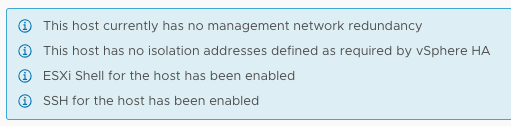
So now what? Well first of all, as mentioned in the comments section as well, vSphere always checks if an isolation address is specified, that could be the default gateway of the management network or it could be the isolation address that you specified through advanced setting das.isolationaddress. When you use das.isolationaddress it often goes hand in hand with das.usedefaultisolationaddress set to false. That last setting, das.usedefaultisolationaddress, is what causes the error above to be triggered. What you should do in a 2-node configuration is the following:
- Do not configure the isolation response, explanation to be found in the above-mentioned article
- Do not configure das.usedefaultisolationaddress, if it is configured set it to true
- Make sure you have a gateway on the management vmkernel, if that is not the case you could set das.isolationaddress and simply set it to 127.0.0.1 to prevent the error from popping up.
Hope this helps those hitting this error message.

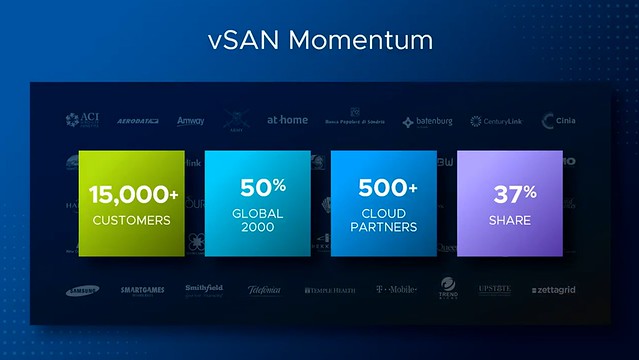
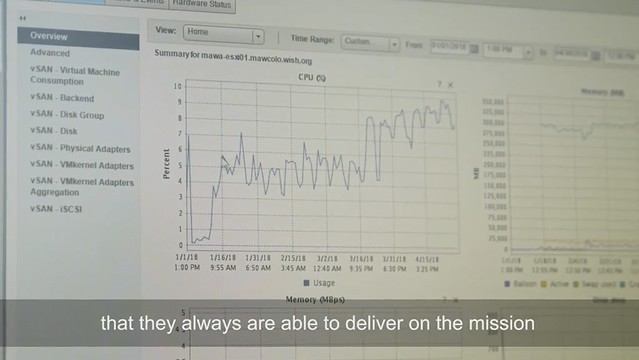
 Another amazing story was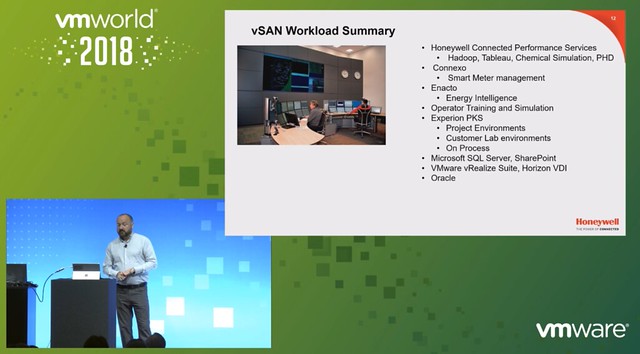

 Norwegian Cruise Line mentioned that they also still use traditional storage, same for ConAgra. It is great that you can do this with vSAN, keep your “old investment”, while building out the new solution. Over time most applications will move over though. One thing that they feel is missing with hyper-converged is the ability to run large memory configurations or large storage capacity configurations. (Duncan: Not sure I entirely agree, limits are very close to non-HCI servers, but I can see what they are referring to.) One thing to note as well from an operational aspect is that certain types of failures are completely different, and handled completely different in an HCI world, that is definitely something to get familiar with. Another thing mentioned was the opportunity of HCI in the Edge, nice small form factor should be possible and should allow running 10-15 VMs. It removes the need for “converged infra” in those locations or traditional storage in general in those environments. Especially now that compute/processing and storage requirements go up at the edge due to IoT and data analytics that happens “locally”.