• Skip to primary navigation
  • Skip to main content
  • Skip to primary sidebar

Yellow Bricks

by Duncan Epping

  • Home
  • Unexplored Territory Podcast
  • HA Deepdive
  • ESXTOP
  • Stickers/Shirts
  • Privacy Policy
  • About
  • Show Search
Hide Search

VMUG Advantage Homelab Group Buy Discount offer!

Duncan Epping · Apr 28, 2021 ·

Some of you may have seen the blog that William Lam posted last year titled the “VMUG Advantage Homelab Group Buy Discount”. Some of you may have not seen this. Basically, William worked with the VMUG on a discount for the VMUG Advantage Program. Why am I posting this? Well, I am pleased to announce that I have teamed up with William Lam and the VMUG to bring the VMUG Advantage Group Buy to the VMware Community. The great thing about this group buy is that the higher the number of people signing up, the higher the discount will be! But why should you sign up?

I get questions about career development a lot. How do I become an expert in vSAN or NSX for instance? How do I get to the next level? Well, there’s no shortcut, unfortunately. You have got to put in the work! What better way than building a lab, testing and playing with the products, taking training courses etc? That is where VMUG Advantage comes into play as it can provide access to all of those things, and/or at least lower the cost for these things. What is included?

  • 365-day Evaluation Licenses
    • Including vSphere, vCloud Foundation, vSAN, NSX, vRealize, Workstation, Horizon, and more!
  • VMworld Discounts
  • 20-35% discount on training
  • Access to “test drive“

The VMUG Advantage Program comes at a cost of 200 USD. Last year the discount was 15%, which means the price ended up being 170 USD for a full year. If you have just one training course planned per year, the VMUG Advantage Program will have already paid for itself (20% discount on a 3000+ USD training course). Yes, I have been talking about USD so far, but of course, this offer is available to all our community members globally (Europe, APJ, Africa, Middle East, etc). Now, again, the discount percentage you get, will depend on the number of people signing up for this years promotion. The ranges look as follows:

Quantity Discount Cost
1-199 12% $176
200-299 14% $172
300+ 15% $170

If more than 1000 people sign up, VMUG HQ will also do a raffle and give away some cool VMUG Advantage “swag”.Can’t wait? Sign up for the discount code here, join the program!

Now before I forget, personally I think that the VMUG Advantage Program is a great program, and I feel that it is a great investment in your career. However, I also do realize that not everyone may be in a position where they can afford to invest 170-176 USD. I would highly encourage people to have a conversation with their employer, in many cases, employers are happy for employees to join these programs, if only because it allows them to benefit from the discounts on training courses, exams, and of course VMworld. Sign up for the discount code here, join the program!

<UPDATE: We have reached 250, so right now we are at 15% discount!>
HCI Mesh error: Failed to run the remote datastore mount pre-checks

Duncan Epping · Apr 21, 2021 ·

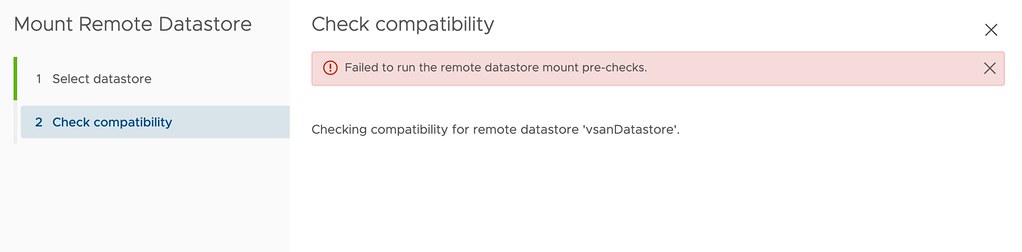
I had two comments on my HCI Mesh compute only blogpost where both were reporting the same error when trying to mount a remote datastore. The error that popped up was the following:

Failed to run the remote datastore mount pre-checks.

I tried to reproduce it in my lab, as both had upgraded from 7.0 to U2 I did the same, that didn’t result in the same error though. The error doesn’t provide any details around why the pre-check fails, as shown below in the screenshot. After some digging I found out that the solution is simple though, you need to make sure IPv6 is enabled on your hosts. Yes, even when you are not using IPv6, it still needs to be enabled to pass the pre-checks. Thanks, Jiří and Reza for raising the issue!

HCI Mesh error: Failed to run the remote datastore mount pre-checks

Can 2-node or Stretched be used as client or server cluster with vSAN HCI Mesh?

Duncan Epping · Apr 20, 2021 ·

I had this question today, probably sparked by my post earlier where a showed a single-node cluster being able to leverage HCI Mesh to mount a remote vSAN Datastore. The question was if this also works with 2-node vSAN or with a vSAN Stretched Cluster. Unfortunately, the answer is no, a 2-node cluster or a vSAN Stretched Cluster is not supported with HCI Mesh today. Yes, this is a hard limit today, meaning that the “health check”, which is done before mounting the datastore, will actually report the issue and not allow it to progress. You can imagine that this is the result of the latency and bandwidth/throughput requirements there are in place for vSAN HCI Mesh today. This may, or may not, change over time.

Does vSAN Enhanced Durability work when you have a limited number of hosts?

Duncan Epping · Apr 19, 2021 ·

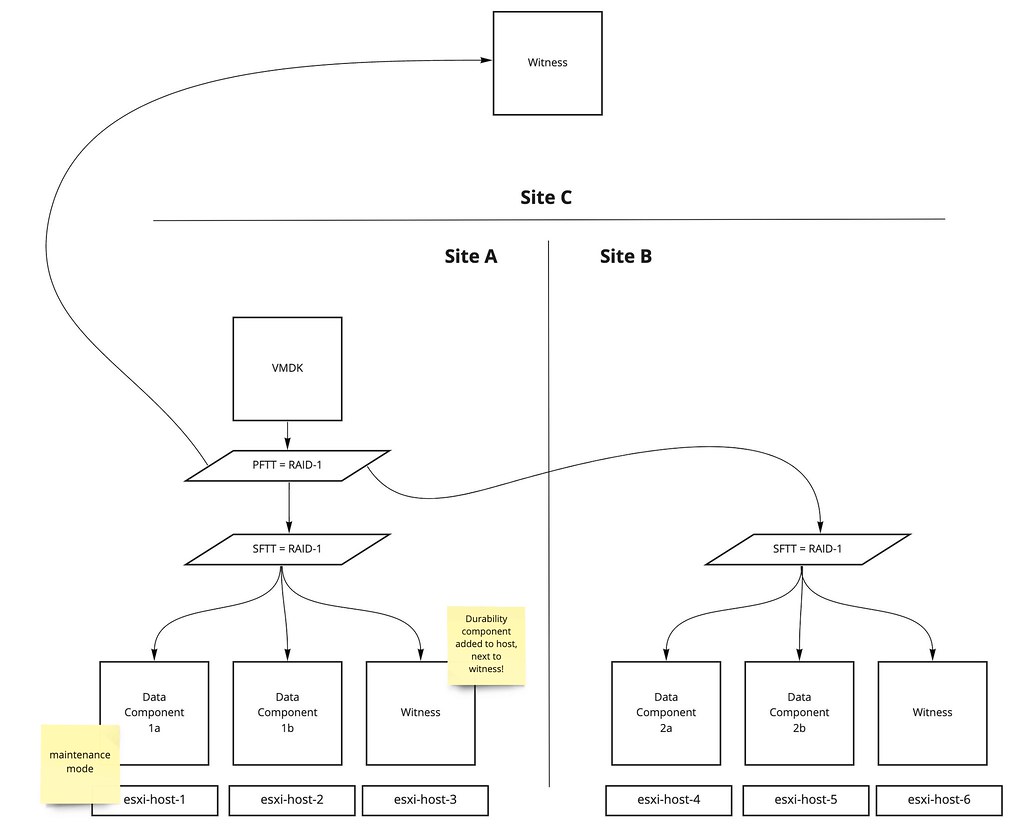
Last week I had a question about how vSAN Enhanced Durability works when you have a limited number of hosts. In this case, the customer had a 3+3+1 stretched cluster configuration, and they wondered what would happen when they would place a host into maintenance mode. Although I was pretty sure I knew what would happen, I figured I would test it in the lab anyway. Let’s start with a high-level diagram of what the environment looks like. Note I use a single VM as an example, just to keep the scenario easy to follow.

In the diagram, we see a virtual disk that is configured to be stretched across locations, and protected by RAID-1 within each location. As a result, you will have two RAID-1 trees each with two components and a witness, and of course, you would have a witness component in the witness location. Now the question is, what happens when you place esxi-host-1 into maintenance mode? In this scenario, vSAN Enhanced Durability will want to create a “durability component”. This durability component is used to commit all new write IO to. This will allow vSAN to resync fast after maintenance mode, and enhances durability as we would still have 2 copies of the (new) data.

However, in the scenario above we only have 3 hosts per location. The question then is, where is this delta component created then? As normally with maintenance mode you would need a 4th host to move data to. Well, it is simple, in this case, what vSAN does is it creates a “durability component” on the host where the witness resides, within the location of course. Let me show you in a diagram, as that makes it clear instantly.

By adding the Durability component next to the witness on esxi-host-3, vSAN enhances durability even in this stretched cluster situation, as it provides a local additional copy of new writes. Now, of course I tested this in my lab. So for those who prefer to see a demo, check out the youtube video below.

Using HCI Mesh with a stand-alone vSphere host?

Duncan Epping · Apr 13, 2021 ·

Last week at the French VMUG we received a great question. The question was whether you can use HCI Mesh (datastore sharing) with a stand-alone vSphere Host. The answer is simple, no you cannot. VMware does not support enabling vSAN, and HCI Mesh, on a single stand-alone host. However, if you still want to mount a vSAN Datastore from a single vSphere host, there is a way around this limitation.

First, let’s list the requirements:

  1. The host needs to be managed by the same vCenter Server as the vSAN Cluster
  2. The host needs to be under the same virtual datacenter as the vSAN Cluster
  3. Low latency, high bandwidth connection between the host and the vSAN Cluster

If you meet these requirements, then what you can do to mount the vSAN Datastore to a single host is the following:

  1. Create a cluster without any services enabled
  2. Add the stand-alone host to the cluster
  3. Enable vSAN, select “vSAN HCI Mesh Compute Cluster”
  4. Mount the datastore

Note, when you create a cluster and add a host, vCenter/EAM will try to provision the vCLS VM. Of course this VM is not really needed as HA and DRS are not useful with a single host cluster. So what you can do is enable “retreat mode”. For those who don’t know how to do this, or those who want to know more about vCLS, read this article.

As I had to test the above in my lab, I also created a short video demonstrating the workflow, watch it below.

  • « Go to Previous Page
  • Page 1
  • Interim pages omitted …
  • Page 42
  • Page 43
  • Page 44
  • Page 45
  • Page 46
  • Interim pages omitted …
  • Page 502
  • Go to Next Page »

Primary Sidebar

About the Author

Duncan Epping is a Chief Technologist and Distinguished Engineering Architect at Broadcom. Besides writing on Yellow-Bricks, Duncan is the co-author of the vSAN Deep Dive and the vSphere Clustering Deep Dive book series. Duncan is also the host of the Unexplored Territory Podcast.

Follow Us

  • X
  • Spotify
  • RSS Feed
  • LinkedIn

Recommended Book(s)

Also visit!

For the Dutch-speaking audience, make sure to visit RunNerd.nl to follow my running adventure, read shoe/gear/race reviews, and more!

Do you like Hardcore-Punk music? Follow my Spotify Playlist!

Do you like 80s music? I got you covered!

Copyright Yellow-Bricks.com © 2026 · Log in