• Skip to primary navigation
  • Skip to main content
  • Skip to primary sidebar

Yellow Bricks

by Duncan Epping

  • Home
  • Unexplored Territory Podcast
  • HA Deepdive
  • ESXTOP
  • Stickers/Shirts
  • Privacy Policy
  • About
  • Show Search
Hide Search

Virtual SAN (related) PEX Updates

Duncan Epping · Feb 12, 2014 ·

I am at VMware Partner Exchange this week and there and figured I would share some of the Virtual SAN related updates.

  • 6th of March their is an online Virtual SAN event with Pat Gelsinger, Ben Fathi and John Gilmartin… Make sure to register for it!
  • Ben Fathi (VMware CTO) stated that VSAN will be GA in Q1, more news in the upcoming weeks
  • Maximum cluster size has been increased from 8 (beta) to 16 according to Ben Fathi, VMware VSAN engineering team is ahead of schedule!
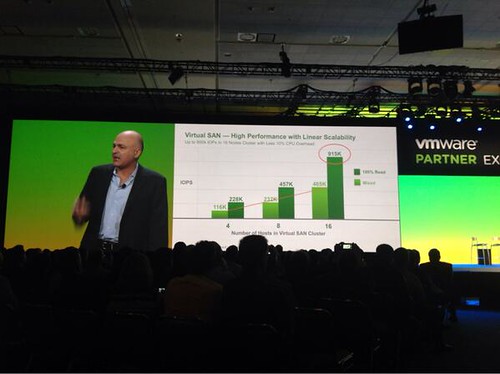
  • VSAN has linear scalability, close to a million IOPS with 16 hosts in a cluster (100% read, 4K blocks). Mixed IOPS close to half a million. All of this with less than 10% CPU/Memory overhead. That is impressive if you ask me. Yeah yeah I know, numbers like these are just a part of the overall story… still it is nice to see that this kind of performance numbers can be achieved with VSAN.
  • I noticed a tweet Chetan Venkatesh and it looks like Atlantis ILIO USX (in memory storage solution) has been tested on top of VSAN and they were capable of hitting 120K IOPS using 3 hosts, WOW. There is a white paper on this topic to be found here, interesting read.
  • It was also reinstated that customers who sign up and download the beta will get a 20% discount on the first purchase of 10 VSAN licenses or more!
  • Several hardware vendors announced support for VSAN, a nice short summary by Alberto to be found here.
Operational simplicity through Flash

Duncan Epping · Feb 11, 2014 ·

A couple of weeks back I had to honor to be one of the panel members at the opening of the Pure Storage office in the Benelux. The topic of course was flash, and the primary discussion around the benefits. The next day I tweeted a quote of one of the answers I gave during the session which was picked up by Frank Denneman in one of his articles, this is the quote:

https://twitter.com/DuncanYB/status/425920926325411840

David Owen responded to my tweet saying that many performance acceleration platforms introduce an additional layer of complexity, and Frank followed up on that in his article. However this is not what my quote was referring to. First of all, I don’t agree with David that many performance acceleration solutions increase operational complexity. However, I do agree that they don’t always make life a whole lot easier either.

I guess it is fair to say that performance acceleration solutions (hyper-visor based SSD caching) are not designed to replace your storage architecture or to simplify it. They are designed to enhance it, to boost the performance. During the Pure Storage panel sessions I was talking about how flash changed the world of storage, or better said is changing the world of storage. When you purchased a storage array in the two decades it would come with days worth of consultancy. Two days typically being the minimum and in some cases a week or even more. (Depending on the size, and the different functionality used etc.) And that was just the install / configure part. It also required the administrators to be trained, in some cases (not uncommon) multiple five-day courses. This says something about the complexity of these systems.

The complexity however was not introduced by storage vendors just because they wanted to sell extra consultancy hours. It was simply the result of how the systems were architected. This by itself being the result of a major big constraint: magnetic disks. But the world is changing, primarily because a new type of storage was introduced; Flash!

Flash allowed storage companies to re-think their architecture, probably fair to state that the this was kickstarted by the startups out there who took flash and saw this as their opportunity to innovate. Innovationg by removing complixity. Removing (front-end) complexity by flattening their architecture.

Complex constructs to improve performance are no longer required as (depending on which type you use) a single flash disk delivers more than a 1000 magnetic disks typically do. Even when it comes to resiliency, most new storage systems introduced different types of solutions to mitigate (disk) failures. No longer is a 5-day training course required to manage your storage systems. No longer do you need weeks of consultancy just to install/configure your storage environment. In essence, flash removed a lot of the burden that was placed on customers. That is the huge benefit of flash, and that is what I was referring to with my tweet.

One thing left to say: Go Flash!

vSphere HA and VMs per Datastore limit!

Duncan Epping · Feb 5, 2014 ·

I felt I would need to get this out there, as it is not something many seem to be aware off . More and more people are starting to use storage solutions which offer 1 large shared datastore, examples are solutions like Virtual SAN, Tintri and Nutanix. I have seen various folks saying: unlimited number of VMs per datastore, but of course there are limits to everything! If you are planning to build a big cluster (HA enabled), keep in mind that per cluster your limit for a datastore is 2048 powered-on virtual machines! Say what? Yes that is right, per cluster you are limited to 2048 powered-on VMs on a single datastore. This is documented in the Max Config Guide of both vSphere 5.5 and vSphere 5.1. Please note it says datastore and not VMFS or NFS explicitly, this applies to both!

The reason for this today is the vSphere HA poweron list. I described that list in this article, in short: this list keeps track of the power-state of your virtual machines If you need more VMs in your cluster than 2048 you will need to create multiple datastores for now. (More details in the blog post) Do note that this is a known limitation and I have been told that the engineering team is researching a solution to this problem. Hopefully it will be in one of the upcoming releases.

Virtual SAN Compatibility Guide updated!

Duncan Epping · Feb 2, 2014 ·

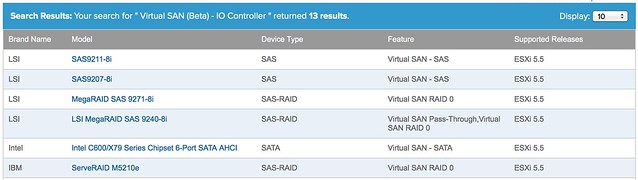
For those looking to start configuring hardware for VSAN / Virtual SAN infrastructures, the VMware Compatibility Guide just got updated!

VMware VSAN Beta HCL updated: http://t.co/oCop26WrDs#vsan @PunchingClouds @wholmes

— Kiran Madnani (@kmadnani) February 2, 2014

Personally I find the new section on disk controllers very useful as it shows whether the controller is supported in SAS / SATA / RAID-0 or Pass-through. I can’t wait for the first VSAN Ready Nodes to pop-up. Note that VSAN is not GA yet, so I expect the HCL to be expanded even further over time. Just like to say: Nice work Dell, it looks you folks are really making an effort getting your hardware certified.

Awesome VSAN contest results

Duncan Epping · Jan 24, 2014 ·

Every once in a while I have someone asking me how about VSAN scale? Typically the question is triggered by a conversation had with another storage vendor and either a misunderstanding or pure FUD that was spread. It is nice to see some of our beta testers showing the possibilities with VSAN. How about the result of the Miami VMUG? These guys managed to get their hands on 3 awesome Dell R720xd hosts and found someone willing to host them. Then they started building, and it didn’t take them long to figure out what the limit was on a 3 node cluster… They managed to run 2250 virtual machines on 3 hosts. Yes, that is indeed more than two thousand virtual machines.

Thanks Miami VMUG for going all out.

  • « Go to Previous Page
  • Page 1
  • Interim pages omitted …
  • Page 163
  • Page 164
  • Page 165
  • Page 166
  • Page 167
  • Interim pages omitted …
  • Page 497
  • Go to Next Page »

Primary Sidebar

About the Author

Duncan Epping is a Chief Technologist and Distinguished Engineering Architect at Broadcom. Besides writing on Yellow-Bricks, Duncan is the co-author of the vSAN Deep Dive and the vSphere Clustering Deep Dive book series. Duncan is also the host of the Unexplored Territory Podcast.

Follow Us

  • X
  • Spotify
  • RSS Feed
  • LinkedIn

Recommended Book(s)

Also visit!

For the Dutch-speaking audience, make sure to visit RunNerd.nl to follow my running adventure, read shoe/gear/race reviews, and more!

Do you like Hardcore-Punk music? Follow my Spotify Playlist!

Do you like 80s music? I got you covered!

Copyright Yellow-Bricks.com © 2026 · Log in