• Skip to primary navigation
  • Skip to main content
  • Skip to primary sidebar

Yellow Bricks

by Duncan Epping

  • Home
  • Unexplored Territory Podcast
  • HA Deepdive
  • ESXTOP
  • Stickers/Shirts
  • Privacy Policy
  • About
  • Show Search
Hide Search

vSAN

Taking VSAN to the next level, join the VSAN beta!

Duncan Epping · Sep 5, 2016 ·

In 2013 VSAN saw the day of light, the beta was released. Now 3 years later you have the opportunity to once again sign up and help improve our product. Over the last couple of years we have seen many new features introduced, so you may wonder what is left. There will be various enhancements in this release, but we are in particular looking for feedback on the following 3 features:

  • Software data-at-rest encryption
  • Local Protection for Stretched Clusters, for two-layer protection of stretched clusters: across sites and locally
  • New operational management enhancements (Health checks from vCenter, monitoring networking stats, and more)

I think most of these speak for itself, with regards to the Local Protection for Stretched Clusters, it basically allows you to protect your data within a site and across sites at the same time in a stretched cluster. In other words: RAID-1 across site and then RAID-1, 5 or 6 within a site. Something I am very excited about personally.

I don’t know how many people will be accepted for the beta, but if I find out I will report back. Sign up now: vmware.com/go/virtual-san-beta. PS: remember, these capabilities are still under development, are subject to change without notice and there is no guarantee of future availability.
An Industry Roadmap: From storage to data management #STO7903 by @xtosk

Duncan Epping · Sep 1, 2016 ·

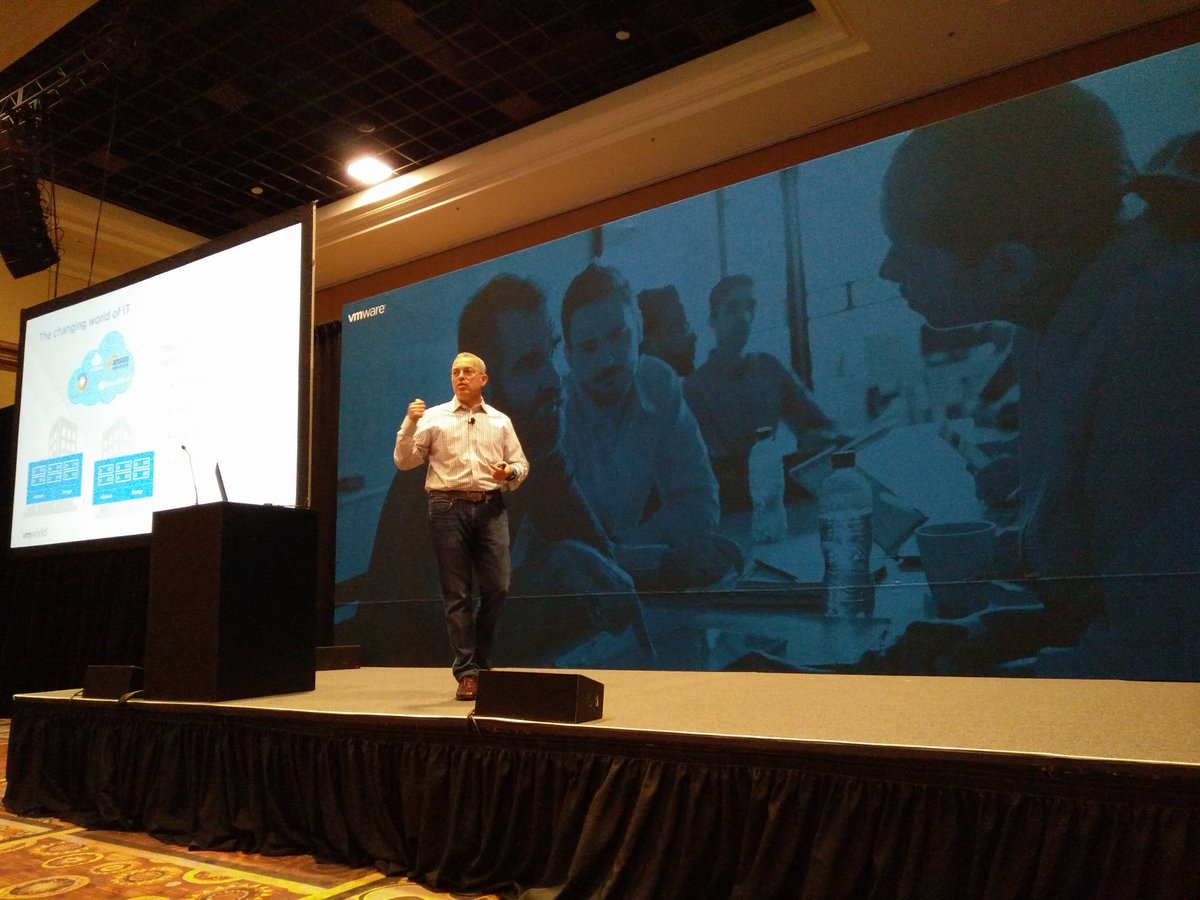
This is the session I have been waiting for, I had it very high on my “must see” list together with the session presented by Christian Dickmann earlier today. Not because it happened to be presented by our Storage an Availability CTO Christos Karamanolis (@XtosK on twitter), but because of the insights I expect to be provided in this session. The title I think says it all: An Industry Roadmap: From storage to data management.

** Keep that in mind when reading the rest of article. Also, this session literally just finished a second ago, I wanted to publish it asap so if there are any typos, my apologies. **

Christos starts with explaining the current problem. There is a huge information growth, 2x growth every 2 years. And that is on the conservative side. Where does the data go? According to analyst it is not expected that this will go to traditional storage, actually the growth of traditional storage is slowing down, actually there is a negative growth seen. Two new types of storage have emerged and are growing fast, Hyper-scale Server SAN Storage and Enterprise Server SAN Storage aka Hyper-converged systems.

With new types of applications changing the world of IT, data management is more important than ever before. Todays storage product do not meet the requirements of this rapidly changing IT world and does not provide the agility your business owners demand. Many of the infrastructure problems can be solved by Hyper-Converged Software, this is all enabled by the hardware evolution we’ve witness over the last years: flash, RDMA, NVMe, 10Gbe etc. These changes from a hardware point of view allowed us to simplify storage architectures and deliver it as software. But it is not just about storage, it is also about operational simplicity. How do we enable our customers to manage more applications and VMs with less. Storage Policy Based Management has enabled this for both Virtual SAN (hyper-converged) and Virtual Volumes in more traditional environments.

Data Lifecycle Management however is still challenging. Snapshots, Clones, Replication, Dedupe, Checksums, Encryption. How do I enable these on a per VM level? How do we decouple all of these data services from the underlying infrastructure? VMware has been doing that for years, best example is vSphere Replication where VMs and Virtual Disks can be replicated on a case by case basis between different types of storage systems. It is even possible to leverage an orchestration solution like Site Recovery Manager to manage your DR strategy end to end from a single interface from private cloud to private cloud, but also from private to public. And from private to public is enabled by vCloud Availability suite, and here you can pay as you g(r)o(w). All of this again driven by policy and through the interface you use on a daily basis, the vSphere Web Client.

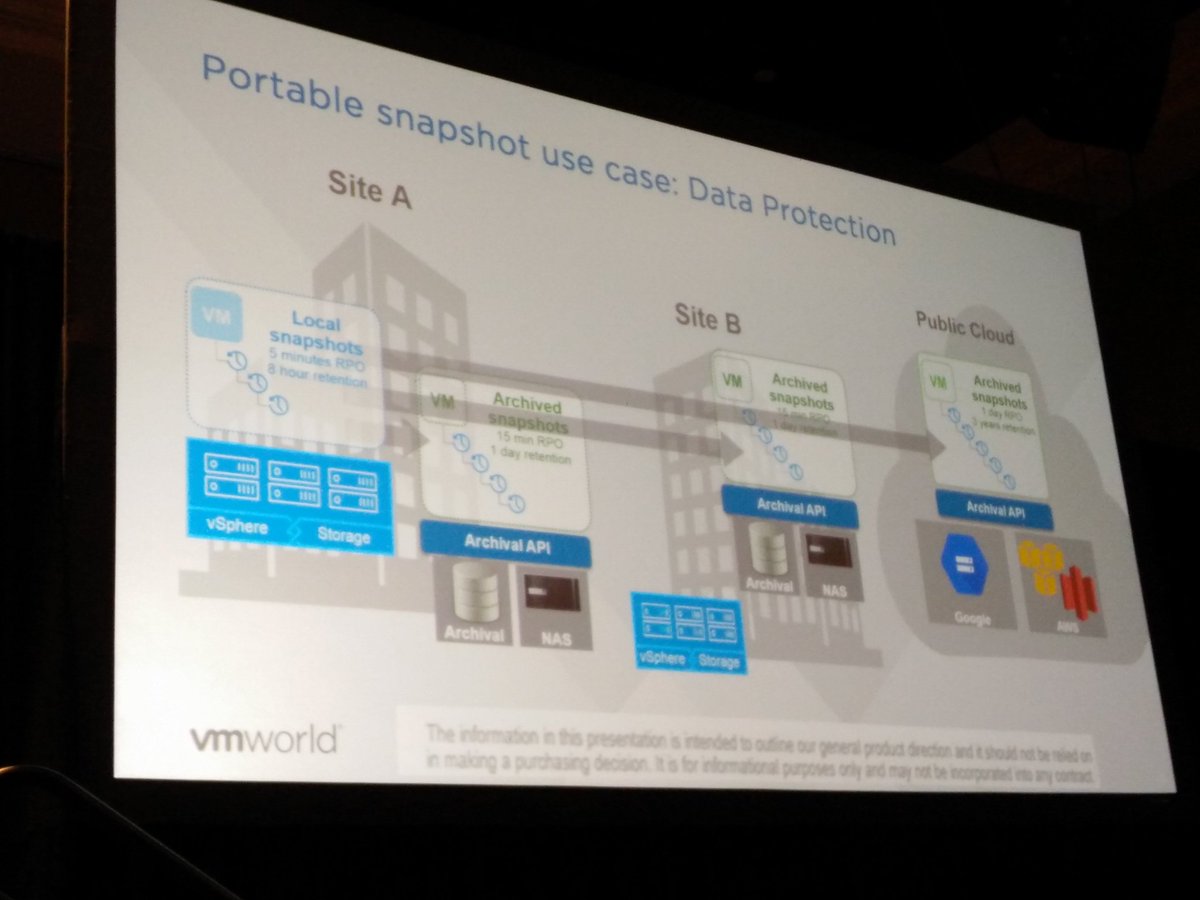
How can we improve the world of DR? Just imagine there was a portable snapshot. A snapshot that was decoupled from storage, can be moved between environments, can be stored in public or private clouds and maybe even both at the same time. This is something we as VMware are working on. A portable snapshot that can be used for Data Protection purposes. Local copies, archived copies in remote datacenters with a different SLA/retention.

How does this scale however when you have 10000s of VMs? Especially when there are 10s of snapshots per VM, or even hundreds. This should all be driven by policy. If I can move the data to different locations, can I use this data as well for other purposes? How about leveraging this for test&dev or analytics? Portable snapshots providing application mobility.

Christos next demoed what the above may look like in the future, the demo shows a VM being replicated from vSphere to AWS, but vSphere to vSphere or vSphere to Azure were also available as an option. The normal settings are configured (destination datastore and network) and literally within seconds the replication starts. The UI looks very crisp and seems to be similar to what was shown in the keynote on day 1 (Cross Cloud Services). But how does this work in the new world of IT, what if I have many new gen applications, containers / microservices?

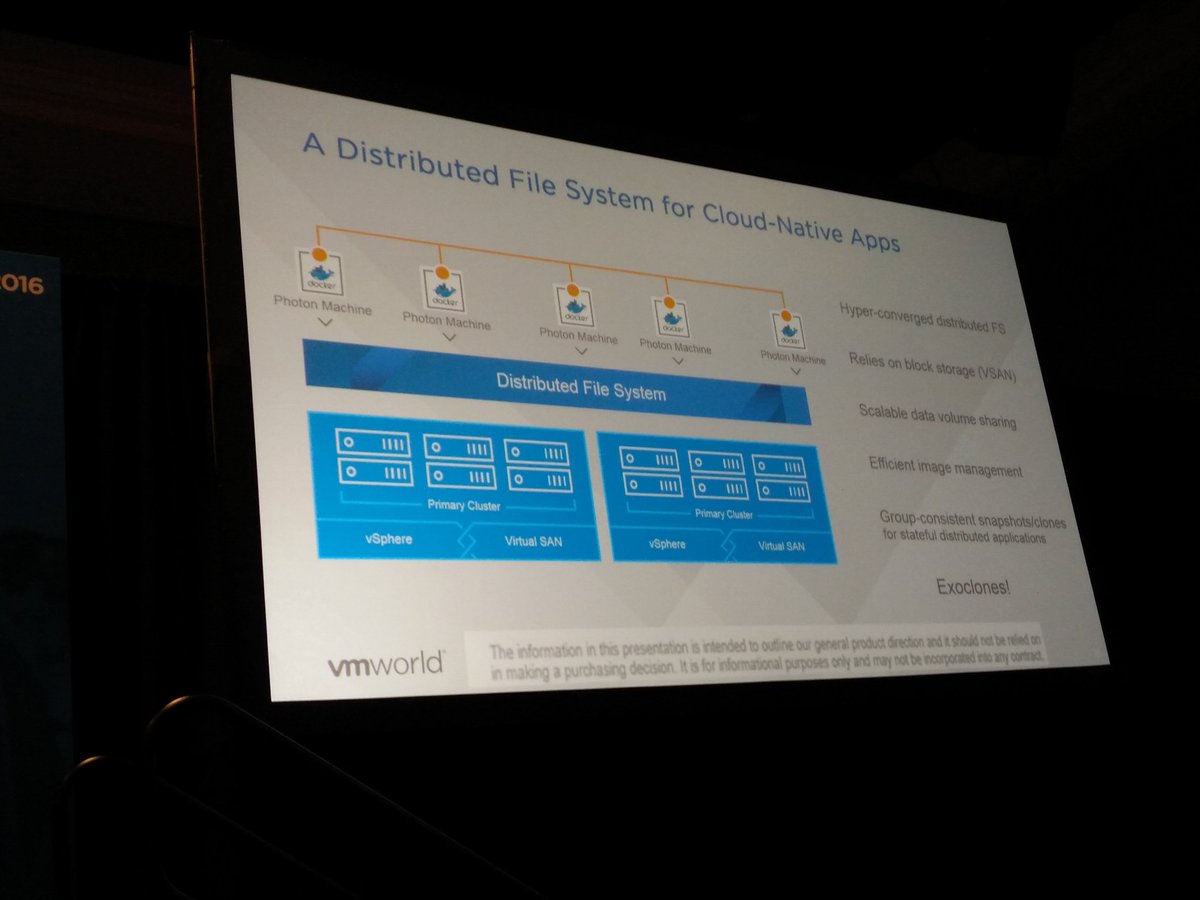
A Distributed File System for Cloud Native apps is now introduced. It appears to be a solution which sits on top of Virtual SAN and provides a file system that can scale to 1000s of hosts with functionality like highly scalable and performing snapshots and clones. These snapshots provided by this Distributed File System are also portable, this concept being developed is called exoclones. It is not something that is just living in the heads of the engineering team, Christos actually showed a demo of an exoclone being exported and imported to another environment.

If VMware does provide that level of data portability, how do you track and control all that data? Data governance is key in most environments, how do we enforce compliance, integrity and availability.  This will be the next big challenge for the industry. There are some products which can provide this today, but nothing that can do this cross-cloud and for both current and new application architectures and infrastructures.

Although for years we seem to have been under the impression that the infrastructure was the center of the universe. Reality is that it serves a clear purpose: host applications and provide users access to data. Your companies data is what is most important. We as VMware realize that and are working to ensure we can help you move forward on your next big journey. In short, it is our goal that you can focus on data management and no longer need to focus on the infrastructure.

Great talk,

#STO7904 VSAN Management Current and Futures by @cdickmann

Duncan Epping · Aug 31, 2016 ·

Christian Dickmann (VSAN Development Architect) talking about VSAN Management futures in this session, first of all a big fat disclaimer, all of these features may or may not ever make it in to a release and no promises of timelines were made. This session all revolved around VSAN’s mission: Providing Radically Simple HCI with Choice. Keep that in mind when reading the rest of article. Also, this session literally just finished a second ago, I wanted to publish it asap so if there are any typos, my apologies.

First Christian went over the current VSAN Management Experience, discussing the creation of a VSAN Cluster, health monitoring and performance monitoring. VSAN is already dead simple from a storage point of view, but there is room for improvement from an operational point of view, and mostly in the vSphere space. Install / Update / Upgrades of drivers, firmware, ESXi, vCenter etc.

1st demo: HCI Installer

In this demo a deployment of the vCenter Server Appliance is shown. We connect to an ESXi server fist. Then you provide all the normal vCenter Server details like password. Where do you want to deploy the appliance? How about on VSAN? Well you can actually create the VSAN Datastore during the deployment of the VCSA. You specify VSAN details and go ahead. During the install/configuration process VSAN will simply be configured using a single host cluster. When vCenter is installed and configured you simply add the rest of the hosts to the cluster. Very cool if you ask me!

2nd demo: Simple VMkernel interface creation

In this demo the creation of VMkernel interfaces is shown. Creation of the interfaces is dead simple as you can simply specify the IP ranges and it does this for every host using the specified details. Literally 4 hosts and interfaces were creates in seconds.

3rd demo: Firmware Upgrade

In this demo in the VSAN Healthcheck it is shown that the firmware of the disk controller is out of date. When you say update, vendor specific tools are downloaded and installed first. When this is completed you can remediate your cluster and install drivers and firmware for all nodes in your cluster, all done through the UI (webclient) and literally in minutes in a rolling fashion. I wish I had this when I had to upgrade my lab in the past.

4th demo: VUM Integration

80% of vSphere customers use VUM so integrating VSAN upgrades and updates with VUM makes a lot of sense. During the upgrade process VUM will validate which version of vSphere/VSAN is supported for your environment. If for whatever reason the latest version is not supported for your configuration it will make a recommendation to use a different version. When you remediate VSAN provides the image needed and there is no need even to create baselines etc. All of this manual work is done by VSAN for you. Upgrades literally become 1 or 2 clicks, and all risks are mitigated by validation of hardware/software against the compatibility matrix.

5th demo: Automation

In this demo Christian showed how to automate the deployment of 10 ROBO clusters end to end using PowerCLI. One by one all the different locations are being created. Every single aspect is fully automated, including even the deployment of the witness appliance. The second demo was the upgrade of the VSAN on-disk format using python. In a fully automated fashion all clusters are upgraded in a rolling fashing. No magic here, all using public APIs.

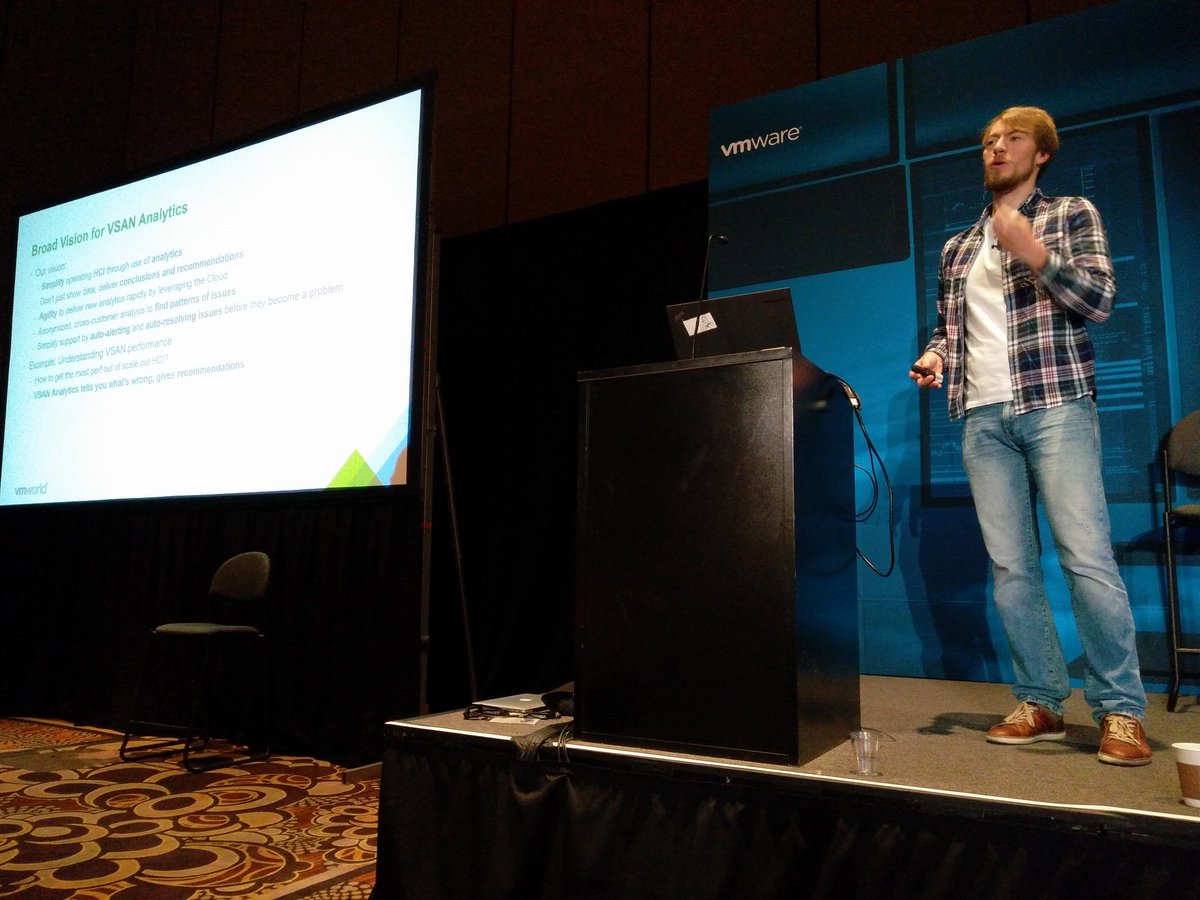
6th demo: VSAN Analytics

Apparently with the 6.2 Christian found out that Admin’s don’t read all KB articles VMware releases, based on the issue experienced with a disk controller he decided to solve this problem. Can we pro-actively inform you about this problem? Yes we can, using a “cloud connected” VSAN Healthcheck we know what you are using and we can inform you about KBs and potential issues and recommendations that may apply to you. And that is what was shown in this demo, a known issue is bubbled up through the healthcheck and the KB details are provided. Mitigating is simply a matter of applying the recommendation. This is still a manual step, and probably will stay as Christian emphasized as you as the administrator need to have control and should make the decision whether you want to apply the steps/patches or not.

Concluding, in literally 40 minutes Christian showed how the VSAN team is planning on simplifying your life. Not just from a storage perspective, but for your complete vSphere infrastructure. I am hoping I can share the demos at some point in the future as they are worth watching. Thanks Christian for sharing, great job!

Virtually Speaking Podcast – VMworld preview

Duncan Epping · Aug 23, 2016 ·

This week I had the pleasure to join Pete and John again on the Virtually Speaking podcast, together with Ken Werneburg. We spoke about the upcoming VMworld event in Las Vegas. Throughout the show there are tips around sessions and vendors to look out for on the show floor. I think it was an interesting conversation…

VSAN Healthcheck: Read Cache Reservations test failed

Duncan Epping · Jul 26, 2016 ·

** Please note: this has been solved in vSAN/vSphere 6.5GA and 6.0 p04 **

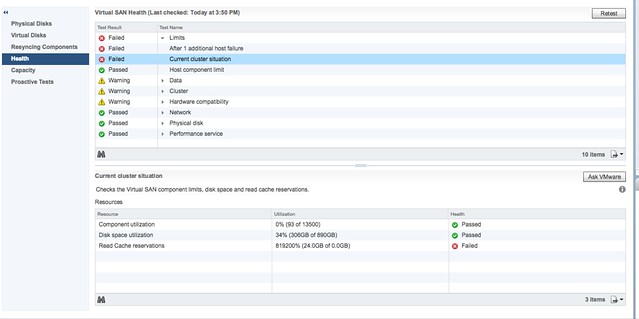
I’ve seen this popping up a bunch of times now, and it seems that the problem and solution is not easy to find for people so I thought I would give it a try as well. When running VSAN all-flash and Horizon View it can happen that you see a failed test for Read Cache Reservations in the VSAN Healthcheck. The reason for this failed test is simple: you are using read cache reservations but All-Flash has no read cache. So this is why the read cache reservations test failed. You can see the error below.

The solution is even easier, you change the policy that you are using on those objects. Change the policy to state 0% read cache and apply this policy to all objects! When applied you click “retest” on the Healthcheck and the error should go away. If you want to know more about Horizon View and policies make sure to read Cormac’s post here. There is also a KB on this topic, which can be found here.

  • « Go to Previous Page
  • Page 1
  • Interim pages omitted …
  • Page 39
  • Page 40
  • Page 41
  • Page 42
  • Page 43
  • Interim pages omitted …
  • Page 71
  • Go to Next Page »

Primary Sidebar

About the Author

Duncan Epping is a Chief Technologist and Distinguished Engineering Architect at Broadcom. Besides writing on Yellow-Bricks, Duncan is the co-author of the vSAN Deep Dive and the vSphere Clustering Deep Dive book series. Duncan is also the host of the Unexplored Territory Podcast.

Follow Us

  • X
  • Spotify
  • RSS Feed
  • LinkedIn

Recommended Book(s)

Also visit!

For the Dutch-speaking audience, make sure to visit RunNerd.nl to follow my running adventure, read shoe/gear/race reviews, and more!

Do you like Hardcore-Punk music? Follow my Spotify Playlist!

Do you like 80s music? I got you covered!

Copyright Yellow-Bricks.com © 2026 · Log in