• Skip to primary navigation
  • Skip to main content
  • Skip to primary sidebar

Yellow Bricks

by Duncan Epping

  • Home
  • Unexplored Territory Podcast
  • HA Deepdive
  • ESXTOP
  • Stickers/Shirts
  • Privacy Policy
  • About
  • Show Search
Hide Search

sdrs

Storage IO Control, aka SIOC, deprecation notice with 8.0 U3!

Duncan Epping · Nov 25, 2024 · 1 Comment

Recently it was announced that SIOC was going to be deprecated and that SDRS IO Load Balancing as a result would also be deprecated. The following was mentioned in the release notes of 8.0 Update 3:

Deprecation of Storage DRS Load Balancer and Storage I/O Control (SIOC): The Storage DRS (SDRS) I/O Load Balancer, SDRS I/O Reservations-based load balancer, and vSphere Storage I/O Control Components will be deprecated in a future vSphere release. Existing 8.x and 7.x releases will continue to support this functionality. The deprecation affects I/O latency-based load balancing and I/O reservations-based load balancing among datastores within a Storage DRS datastore cluster. In addition, enabling of SIOC on a datastore and setting of Reservations and Shares by using SPBM Storage policies are also being deprecated. Storage DRS Initial placement and load balancing based on space constraints and SPBM Storage Policy settings for limits are not affected by the deprecation.

So why do I bring this up if this was announced a while back? Well, apparently, not everyone had seen that announcement, and not everyone fully understands the impact. For Storage DRS (SDRS), this means that essentially, ‘capacity balancing’ remains available, but anything related to performance will not be available in a next major release. Also, noisy neighbor handling through SIOC with shares and, for instance, IO reservations will no longer be available.

Some of you may also have noticed already that in the UI on a per VM level the ability to specify the IOPS limit had also disappeared. So what does this mean for IOPS Limits in general? Well, that functionality will remain available through Policy Based Management (SPBM) as it is today. So, if you set IOPS limits on a per VM basis in vSphere 7, if you upgrade to vSphere 8 you will need to use the SPBM policy option! This IOPS Limit option in SPBM will remain available, even though in the UI it shows up under “SIOC” it is actually applied through the disk scheduler on a per-host basis.
Death to false myths: Storage IO Control = Storage DRS IO load balancing

Duncan Epping · Dec 17, 2012 ·

I often hear people making comments around Storage IO Control and Storage DRS IO Load Balancing being one and the same thing. It has been one of those myths that has been floating around for a long time now, and with this article I am going to try to stop it.

I guess where this myth comes from is that when you create a Datastore Cluster and you enable Storage DRS IO Load Balancing then it configures Storage IO Control for you automatically on all datastores which are part of that particular Datastore Cluster. This seems to give people the impression that they are the same thing.

I have heard people making these claims especially around interoperability discussions. For example, one of the common made mistakes is that you should not enable Storage IO Control on a datastore which has auto-tiering (like EMC FAST for instance) enabled. Now the thing is that in the Storage DRS Interop white paper it is listed that when using an auto-tiering array you should disable IO Load Balancing when using Storage DRS. However, let is be clear Storage IO Control and Storage DRS Load Balancing are not one and the same thing and Storage IO Control is supported in those scenarios!

Storage DRS uses Storage IO Control to retrieve the IO metrics required to create load balancing recommendations. So lets repeat that, Storage DRS leverages Storage IO Control. Storage IO Control works perfectly fine without Storage DRS. Storage IO Control is all about handling queues and limiting the impact of short IO spikes. Storage DRS is about sustained latency and moving virtual machines around to balance out the environment.

I guess I can summarize this article in just one sentence:
Storage IO Control != Storage DRS IO Load Balancing


Setting the default affinity rule for Storage DRS

Duncan Epping · Feb 7, 2012 ·

On my blog article for yesterday “Rob M” commented that the default affinity rule for Storage DRS (SDRS), keep VM files together, did not make sense to him. One of the reasons this affinity rule is set is because customers indicated that from an operational perspective it would be easier if all files of a given VM (vmx / vmdk’s) would reside in the same folder. Especially troubleshooting was one of the main reasons, as this lowers complexity. I have to say that I fully agree with this, I’ve been in the situation where I needed to recover virtual machines and having them spread across multiple datastore really complicates things.

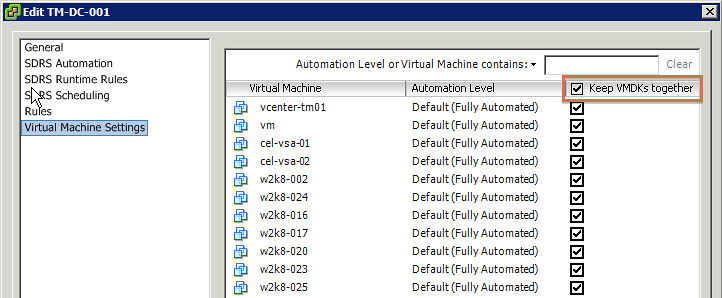
But, just like Rob, you might not agree with this and rather have SDRS handling balancing on a file per file basis. That is possible and we documented this procedure in our book. I was under the impression that I blogged this, but just noticed that somehow I never did. Here is how you change the affinity rule for the current provisioned VMs in a datastore cluster:

  1. Go to Datastores and Datastore Clusters
  2. Right click a datastore cluster and select “edit settings”
  3. Click “Virtual machine settings”
  4. Deselect “Keep VMDKs together”
    1. For virtual machines that need to stick together you can override the default by ticking the tick box next to the VM


Also check out this article by Frank about DRS/SDRS affinity rules, useful to know!

How cool and useful is Storage DRS?!

Duncan Epping · Feb 6, 2012 ·

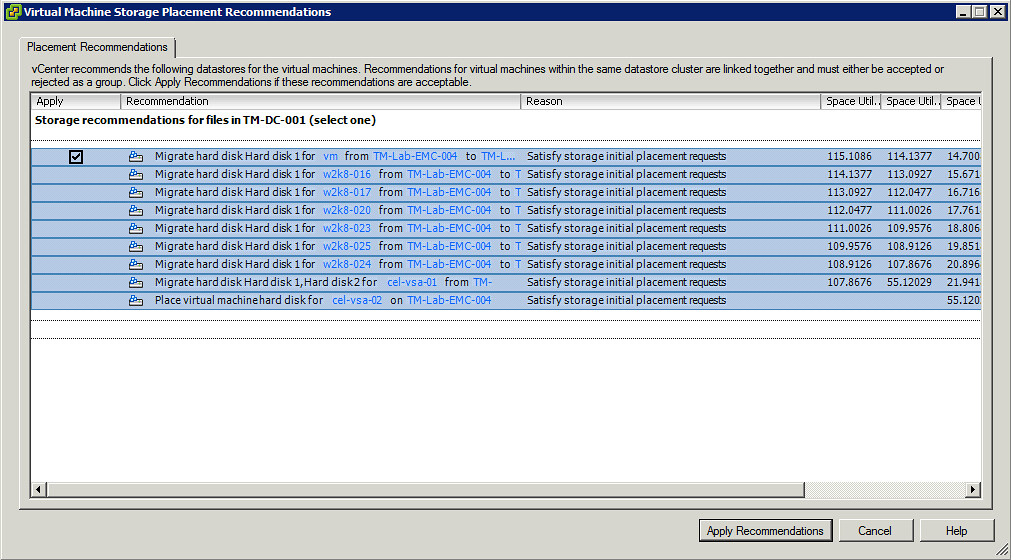
I was just playing around in my lab and created a whole bunch of VMs when I needed to deploy to large virtual machines. Both of them had 500GB disks. The first one deployed without a hassle, but the second one was impossible to deploy, well not impossible for Storage DRS. Just imagine you had to figure this out yourself! Frank wrote a great article about the logic behind this and there is no reason for me to repeat this, just head over to Frank’s blog if you want to know more..

And the actually migrations being spawned:

Yes, this is the true value of Storage DRS… initial placement recommendations!

Does SRM support Storage DRS? No it does not!

Duncan Epping · Sep 7, 2011 ·

During VMworld I received multiple questions around support for vSphere Storage DRS with vSphere Site Recovery Manager (SRM), we even had this question during our session and my answer was “Yes it does”. During some of the other sessions presenters stated that it was unsupported. Scott Lowe also mentions recalling the fact that it was mentioned somewhere down the line to be unsupported. Now although the Resource Management Guide for vSphere 5.0 on page 91 currently says it is supported it is not supported. Yes I know I stated it was supported but unfortunately the document is incorrect and the information provided to me was outdated. Although I verified the facts, I was not informed about this change. Hopefully this will not happen again and my apologies for that.

Now lets give the raw facts first, SRM does not support Storage vMotion and SRM does not support Storage DRS. The reason that SRM does not support Storage vMotion (and subsequently Storage DRS) is because it changes the location of the virtual machine without SRM being aware of it. After the location of the virtual machine has changed the VM that was originally protected by SRM will not be protected anymore which can have an impact on your RTO. These are the raw facts. I have requested the SRM team to document this in a KB to make sure everyone understands the reason and the impact.

The question of course is… will it work? My colleague Cormac has tested it and you can read his observations here.

This statement is documented in the SRM releasenotes: http://www.vmware.com/support/srm/srm_releasenotes_5_0_0.html

Interoperability with Storage vMotion and Storage DRS:
Due to some specific and limited cases where recoverability can be compromised during storage movement, Site Recovery Manager 5.0 is not supported for use with Storage vMotion (SVmotion) and is not supported for use with the Storage Distributed Resource Scheduler (SDRS) including the use of datastore clusters.

** update: I followed the documentation which apparently was incorrect. Documentation bug has been filed, should be update in the near future. **
** update: Link to SRM releasenotes with statement added. **

  • Page 1
  • Page 2
  • Go to Next Page »

Primary Sidebar

About the Author

Duncan Epping is a Chief Technologist and Distinguished Engineering Architect at Broadcom. Besides writing on Yellow-Bricks, Duncan is the co-author of the vSAN Deep Dive and the vSphere Clustering Deep Dive book series. Duncan is also the host of the Unexplored Territory Podcast.

Follow Us

  • X
  • Spotify
  • RSS Feed
  • LinkedIn

Recommended Book(s)

Also visit!

For the Dutch-speaking audience, make sure to visit RunNerd.nl to follow my running adventure, read shoe/gear/race reviews, and more!

Do you like Hardcore-Punk music? Follow my Spotify Playlist!

Do you like 80s music? I got you covered!

Copyright Yellow-Bricks.com © 2026 · Log in