• Skip to primary navigation
  • Skip to main content
  • Skip to primary sidebar

Yellow Bricks

by Duncan Epping

  • Home
  • Unexplored Territory Podcast
  • HA Deepdive
  • ESXTOP
  • Stickers/Shirts
  • Privacy Policy
  • About
  • Show Search
Hide Search

ft

Host placement for the secondary FT VM with Fault Domains?

Duncan Epping · Sep 23, 2026 · Leave a Comment

On Reddit there was a question about how to specify on which group of hosts the secondary VM of an FT-enabled VM would land on. Now this is a problem that has been around for a while, and for the longest time we actually did not have a solution for it, but now we do. I did a quick search, and somehow I couldn’t find an article where I describe how this works, so I figured I would write one. Having said that, I would not be surprised if there’s already and article out there, but somehow didn’t pop up.

When it comes to vSphere Fault Tolerance, when you enable it on a VM, what you will see happening is that the VM you enabled it on will get “(primary)” behind the name. This VM is, as you would expect, the primary and is paired with a “secondary”. This “secondary” VM runs in lockstep with the primary, so that it can take over instantly if the primary would fail for any reason. Now, that secondary VM is kind of a strange VM. Although you can find the VM in your inventory on a host level, you cannot find it on a cluster level or in the VM view. It is like a shadow copy, it is there, but yet it isn’t really.

As a result, making VM-Host rules for it is rather difficult. Although you can do it, this shadow / secondary VM can also be reinstantiated and as a result that VM-Host rule would unfortunately break. Why? Well, the newly instantiated VM is literally that… a newly instantiated VM, so the old rules do not apply. So although the VM-Host rules with tags can work through the Compute Policy option, it not ideal. Probably should also mention, traditional VM-Host groups and rules do not even work with the secondary VM, as you simply cannot select the secondary VM to begin with.

So what does work? Well, there’s a new option called Enable Metro Cluster Fault Tolerance. What this does is that when you select a Host Group for the primary, the secondary VM automatically ends up on a host outside of the selected group. The Host Group can simply be defined via the VM-Host group option under your cluster’s Configure tab as shown in the screenshots below.

Hopefully this helps those who are planning on leveraging FT and want to ensure the primary and secondary are placed on different fault domains.

Host placement for the secondary FT VM with Fault Domains?


vSphere FT and vVols/SPBM an unsupported config? Why?

Duncan Epping · Aug 20, 2020 ·

I was pointed out by a customer (thanks Johan), that vSphere FT is not supported when using SPBM on non-vSAN based storage systems. You may wonder why this is, at least I did wonder. I figured it would be a testing constraint of some sort, but after emailing product management, engineering, and our quality engineering team I now understand why it is. Now before I explain it, the constraint is documented here, let me quote the section for you:

Virtual Volume datastores.
Storage-based policy management. Storage policies are supported for vSAN storage.

So why is this and why would vSAN be supported as that also uses SPBM? Well the difference is in the implementation. For vVols there’s a dependency on vCenter Server to be available when creating new VMs. This is essentially what happens when an FT instance needs to be restarted. We will need to associate an SPBM policy with it and we can only retrieve it via vCenter Server. With vSAN, FT/HA can also retrieve the needed info via the ESXi host. This is why FT and vSAN are a supported configuration, and vVols and FT, unfortunately, is not at the moment. Hopefully, though, this will change in the future. (Yes, I filed a feature request before anyone asks.)

Changing advanced vSphere FT related settings, is that supported?

Duncan Epping · Feb 1, 2018 ·

This week I received a question around changing the values for vSphere FT related advanced settings. This customer is working on an environment where uptime is key. Of course the application layer is one side, but they also want to have additional availability from an infrastructure perspective. Which means vSphere HA and vSphere FT are key.

They have various VMs they need to enable FT on, these are vSMP VMs (meaning in this case dual CPU). Right now each host is limited to 4 FT VMs and at most 8 vCPUs, this is being controlled by two advanced settings called “das.maxftvmsperhost” and “das.maxFtVCpusPerHost”. The values for these are, obviously, 4 and 8. The question was: can I edit these and still have a supported configuration? Also, why 4 and 8?

I spoke to the product team about this and the answer is: yes, you can safely edit these. These values were set based on typical bandwidth and resource constraints customers have. An FT VM easily consumes between 1-3Gbps of bandwidth, meaning that if you dedicate a 10Gbps link to it you will fit roughly 4 VMs. I say roughly as of course the workload matters: CPU, Memory and IO pattern.

If you have a 40Gbps NIC, and you have plenty of cores and memory you could increase those max numbers for FT VMs per host and FT vCPUs. However, it must be noted that if you run in to problems VMware GSS may request you to revert back to the default just to ensure the issues that occur aren’t due to this change as VMware tests with the default values.

UPDATE to this content can be found here: https://www.yellow-bricks.com/2022/11/18/can-you-exceed-the-number-of-ft-enabled-vcpus-per-host-or-number-of-ft-enabled-vcpus-per-vm/

SMP-FT support for Virtual SAN ROBO configurations

Duncan Epping · Oct 12, 2015 ·

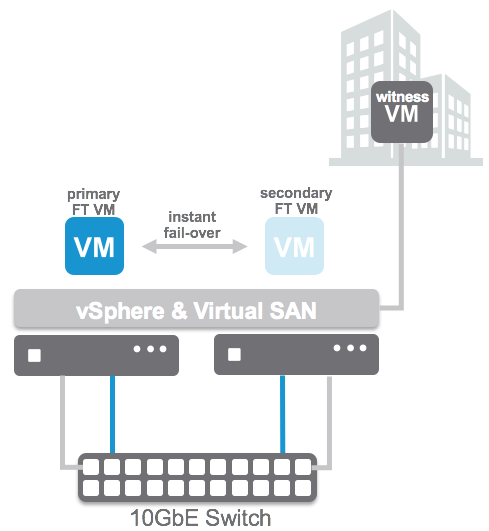
When we announced Virtual SAN 2-node ROBO configurations at VMworld we received a lot of great feedback and responses. A lot of people asked if SMP-FT was supported in that configuration. Apparently many of the customers using ROBO still have legacy applications which can use some form of extra protection against a host failure etc. The Virtual SAN team had not anticipated this and had not tested this explicit scenario unfortunately so our response had to be: not supported today.

We took the feedback to the engineering and QA team and these guys managed to do full end-to-end tests for SMP-FT on 2-node Virtual SAN ROBO configurations. Proud to announce that as of today this is now fully supported with Virtual SAN 6.1! I want to point out that still all SMP-FT requirements do apply, which means 10GbE for SMPT-FT! Nevertheless, if you have the need to provide that extra level of availability for certain workloads, now you can!

vSphere Availability Survey, please help out!

Duncan Epping · Feb 17, 2014 ·

Just received the below from the vSphere Availability team. It takes a couple of minutes to fill out and it helps the vSphere Availability team to set priorities correctly for upcoming releases, yes indeed based on your answers!

— copy / paste —

The Availability team (that brings to you products such as vSphere HA, FT etc.) would like to get your input on how you use our products today and your projected needs. The survey has mainly multiple choice questions, and will take 10-15 minutes to complete. Your feedback is invaluable in helping us tailor our development efforts towards valuable enhancements. So, thank you!

Here’s the link to the survey: http://tinyurl.com/vmwavailability

  • Page 1
  • Page 2
  • Page 3
  • Go to Next Page »

Primary Sidebar

About the Author

Duncan Epping is a Chief Technologist and Distinguished Engineering Architect at Broadcom. Besides writing on Yellow-Bricks, Duncan is the co-author of the vSAN Deep Dive and the vSphere Clustering Deep Dive book series. Duncan is also the host of the Unexplored Territory Podcast.

Follow Us

  • X
  • Spotify
  • RSS Feed
  • LinkedIn

Recommended Book(s)

Also visit!

For the Dutch-speaking audience, make sure to visit RunNerd.nl to follow my running adventure, read shoe/gear/race reviews, and more!

Do you like Hardcore-Punk music? Follow my Spotify Playlist!

Do you like 80s music? I got you covered!

Copyright Yellow-Bricks.com © 2026 · Log in