• Skip to primary navigation
  • Skip to main content
  • Skip to primary sidebar

Yellow Bricks

by Duncan Epping

  • Home
  • Unexplored Territory Podcast
  • HA Deepdive
  • ESXTOP
  • Stickers/Shirts
  • Privacy Policy
  • About
  • Show Search
Hide Search

drs

HA without DRS?

Duncan Epping · Dec 8, 2010 ·

I had question on my HA Deepdive which I thought was worth answering in an article:

How does the active primary node decide where to restart failed VMs? Does it use a round-robin algorithm for selecting a host to start the VMs in restart priority order? What happens if the remaining nodes are imbalanced, especially without DRS enabled; are the nodes that have no spare capacity skipped? Or, does the active primary node restart VMs on the least busy host first, then the next busy host, etc?

Also, if VMs have no reservation for CPU or memory set, how does HA decide the number of VMs to restart on any one node? Is it possible that HA will restart too many VMs on one node so that performance is extremely poor until DRS move some VMs to other nodes?

In the past HA(pre 4.1) would consider the utilization of the Hosts and go through a check for every VM that needs to failover. It would fail the VM over the host with the most amount of available resources. Now from a “latency” perspective that is not the best approach as you can imagine. With latency meaning the time it takes to restart the VMs and the delay caused by hostd. Now type of delay can be cause by hostd? Well lets assume you have 1 host which is not doing a lot, this host would be the host that is selected for most failovers. Having 10 VMs (or more) starting in parallel will beat hostd severely.

So does HA use DRS to select which host to use for the restart? No it won’t, DRS happens on a vCenter level and HA happens on a host level…. But more things have changed. As of vSphere 4.1 virtual machines will be evenly distributed across hosts to lighten the load on the hostd service and to get quicker power-on results. HA then relies on DRS to redistribute the load later if required. This improvement results in faster restarts of the virtual machines and less stress on the ESX hosts.

So what if you are not using DRS? To put it bluntly, make sure you manual balance your environment to ensure HA doesn’t “overload” a single host… that is the only thing you can do for now. (by the way, all of this is included in the HA and DRS tech deepdive :-))
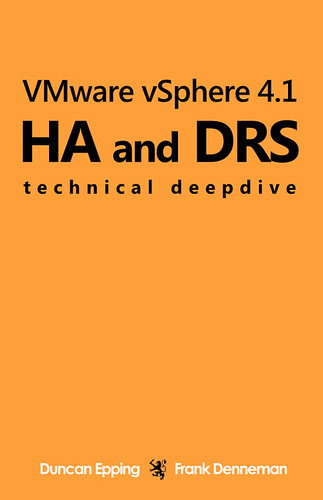
vSphere 4.1 HA and DRS Technical Deepdive, the book!

Duncan Epping · Dec 6, 2010 ·

In August we announced that we were working a secret project and let you guys in on it. The idea was to get it published through an official Publisher but due to several circumstances and a very tight deadline we decided to go the self-publishing route to make it available as soon as possible. So here it is, the moment both Frank Denneman and I have been waiting for…. it is finally available, the HA and DRS technical deepdive.

As of today “vSphere 4.1 HA and DRS Technical Deepdive” is available on paper via CreateSpace and Amazon. We are also working on getting a digital copy up for sale but that will more than likely be early 2011.

There is something I want to make very clear here as I have heard multiple people referring to this book as “Duncan’s Book”. This book was very much a joint effort. Frank has invested at least as much time in this project as I have, and probably even more. I want to thank Frank for his hard work and hope everyone realizes that it is our book and not my book!

We want to take the opportunity to thank our Technical Reviewers for their very valuable feedback and for keeping us honest; fellow VCDX Panel Member Craig Risinger (VMware PSO), Marc Sevigny (VMware HA Engineering), Anne Holler (VMware DRS Engineering) and Bouke Groenescheij (Jume.nl). A very special thanks to Scott Herold for writing the foreword!

For those who can’t wait, order it via CreateSpace or Amazon now. (Please be so kind to leave a review

This is the description of the book that is up on CreateSpace/Amazon:

About the authors:
Duncan Epping (VCDX 007) is a Consulting Architect working for VMware as part of the Cloud Practice. Duncan works primarily with Service Providers and large Enterprise customers. He is focussed on designing Public Cloud Infrastructures and specializes in bc-dr, vCloud Director and VMware HA. Duncan is the owner of Yellow-Bricks.com, the leading VMware blog.
Frank Denneman (VCDX 029) is a Consulting Architect working for VMware as part of the Professional Services Organization. Frank works primarily with large Enterprise customers and Service Providers. He specializes in Resource Management, DRS and storage. Frank is the owner of frankdenneman.nl which has recently been voted number 6 worldwide on vsphere-land.com

VMware vSphere 4.1 HA and DRS Technical Deepdive zooms in on two key components of every VMware based infrastructure and is by no means a “how to” guide. It covers the basic steps needed to create a VMware HA and DRS cluster, but even more important explains the concepts and mechanisms behind HA and DRS which will enable you to make well educated decisions. This book will take you in to the trenches of HA and DRS and will give you the tools to understand and implement e.g. HA admission control policies, DRS resource pools and resource allocation settings. On top of that each section contains basic design principles that can be used for designing, implementing or improving VMware infrastructures.
Coverage includes:

  • HA node types
  • HA isolation detection and response
  • HA admission control
  • VM Monitoring
  • HA and DRS integration
  • DRS imbalance algorithm
  • Resource Pools
  • Impact of reservations and limits
  • CPU Resource Scheduling
  • Memory Scheduler
  • DPM

We hope you will enjoy reading it as much as we did writing it. Thanks,

RE: Maximum Hosts Per Cluster (Scott Drummonds)

Duncan Epping · Nov 29, 2010 ·

I love blogging because of the discussions you some times get into. One of the bloggers I highly respect and closely follow is EMC’s vSpecialist Scott Drummonds (former VMware Performance Guru). Scott posted a question on his blog about what the size of a cluster should be. Scott discussed this with Dave Korsunksy and Dan Anderson, both VMware employee, and more or less came to the conclusion that 10 is probably a good number.

So, have I given a recommendation?  I am not sure.  If anything I feel that Dave, Dan and I believe that a minimum cluster size needs should be set to guarantee that the CPU utilization target, and not the HA failover capacity, is the defining the number of wasted resources.  This means a minimum cluster of something like four or five hosts.  While neither of us claims a specific problem that will occur with very large clusters, we cannot imagine the value of a 32-host cluster.  So, we think the right cluster size is somewhere shy of 10.

And of course they have a whole bunch of arguments for both Large( 12+) and small (8-) clusters… which I summarized below for your convenience

  • Pro Large: DRS efficiency.  This was my primary claim in favor of 32-host clusters.  My reasoning is simple: with more hosts in the cluster there are more CPU and memory resource holes into which DRS can place running virtual machines to optimize the cluster’s performance.  The more hosts, the more options to the scheduler.
  • Pro Small: DRS does not make scheduling decisions based on the performance characteristics of the server so a new, powerful server in a cluster is just as likely to receive a mission-critical virtual machine as older, slower host.  This would be unfortunate if a cluster contained servers with radically different–although EVC compatible–CPUs like the Intel Xeon 5400 and Xeon 5500 series.
  • Pro Small: By putting your mission-critical applications in a cluster of their own your “server huggers” will sleep better at night.  They will be able to keep one eye on the iron that can make or break their job.
  • Pro Small: Cumbersome nature of their change control.  Clusters have to be managed to a consistent state and the complexity of this process is dependent on the number of items being managed.  A very large cluster will present unique challenges when managing change.
  • Pro Small: To size a 4+1 cluster to 80% utilization after host failure, you will want to restrict CPU usage in the five hosts to 64%.  Going to a 5+1 cluster results in a pre-failure CPU utilization target of 66%.  The increases slowly approach 80% as the clusters get larger and larger.  But, you can see that the incremental resource utilization improvement is never more than 2%.  So, growing a cluster slightly provides very little value in terms of resource utilization.

It is probably an endless debate and all the arguments for both “Pro Large” and “Pro Small” are all very valid although I seriously disagree with their conclusion as in not seeing the value of a 32-host cluster. As always it fully depends. On what in this case you might say, why would you ever want a 32-host cluster? Well for instance when you are deploying vCloud Director. Clusters are currently your boundary for your vDC, and who wants to give his customer 6 vDCs instead of just 1 because you limited your cluster size to 6 hosts instead of leaving the option open to go to the max. This might just be an exception and nowhere near reality for some of you but I wanted to use this as an example to show that you will need to take many factors into account.
Now I am not saying you should, but at least leave the option open.

One of the arguments I do want to debate is the Change Control argument. Again, this used to be valid in a lot of Enterprise environments where ESX was used. Now I am deliberately using “ESX” and “Enterprise” here as reality is that many companies don’t even have a change control process in place. (I worked for a few large insurance companies which didn’t!) On top of that there is a large discrepancy when it comes to the amount of work associated with patching ESX vs ESXi. I have spent many weekends upgrading ESX but today literally spent minutes upgrading ESXi. The impact and risks associated with patching has most certainly decreased with ESXi in combination with VUM and the staging options. On top of that many organizations treat ESXi as an appliance, and with with stateless ESXi and the Auto-Deploy appliance being around the corner I guess that notion will only grow to become a best practice.

A couple of arguments that I have often seen being used to restrict the size of a cluster are the following:

  • HA limits (different max amount of VMs when cluster are > 8 hosts)
  • SCSI Reservation Conflicts
  • HA Primary nodes

Let me start with saying that for every new design you create, challenge your design considerations and best practices… are the still valid?

The first one is obvious as most of you know by now that there is no such a thing anymore as an 8 host boundary with HA. The second one needs some explanation. Around the VI3 time frame cluster sizes were often limited because of possible storage performance issues. These alleged issues were mainly blamed on SCSI Reservation Conflicts. The conflicts were caused by having many VMs on a single LUN in a large cluster. Whenever a metadata update was required the LUN would be locked by a host and this would/could increase overall latency. To avoid this, people would keep the amount of VMs per VMFS volume low (10/15) and keep the amount of VMFS volumes per cluster low…. Also resulting in a fairly low consolidation factor, but hey 10:1 beats physical.

Those arguments used to be valid, however things have changed. vSphere 4.1 brought us VAAI; which is a serious game changer in terms of SCSI Reservations. I understand that for many storage platforms VAAI is currently not supported… However, the original mechanism which is used for SCSI Reservations has also severely improved over time (Optimistic Locking) which in my opinion reduced the need to have many small LUNs, which eventually would limit you from a max amount of LUNs per host perspective. So with VAAI or Optimistic Locking, and of course NFS, the argument to have small clusters is not really valid anymore. (Yes there are exceptions)

The one design consideration, which is crucial, that is missing in my opinion though is HA node placement. Many have limited their cluster sizes because of hardware and HA primary node constraints. As hopefully known, if not be ashamed, HA has a maximum of 5 primary nodes in a cluster and a primary is required for restarts to take place. In large clusters the chances of losing all primaries also increase if and when the placement of the hosts is not taken into account. The general consensus usually is, keep your cluster limited to 8 and spread across two racks or chassis so that each rack always has at least a single primary node to restart VMs. But why would you limit yourself to 8? Why, if you just bought 48 new blades, would you create 6 clusters of 8 hosts instead of 3 clusters of 16 hosts? By simply layering your design you can mitigate all risks associated with primary nodes placements while benefiting from additional DRS placement options. (Do note that if you “only” have two chassis, your options are limited.) Which brings us to another thing I wanted to discuss…. Scott’s argument against increased DRS placement was that hundreds of VMs in an 8 host cluster already leads to many placement options. Indeed you will have many load balancing options in an 8 host cluster, but is it enough? In the field I also see a lot of DRS rules. DRS rules will restrict the DRS Load Balancing algorithm when looking for suitable options, as such more opportunities will more than likely result in a better balanced cluster. Heck, I have even seen cluster imbalances which could not be resolved due to DRS rules in a five host cluster with 70 VMs.

Don’t get me wrong,  I am not advocating to go big…. but neither am I advocating to have a limited cluster size for reasons that might not even apply to your environment. Write down the requirements of your customer or your environment and don’t limit yourself to design considerations around Compute alone. Think about storage, networking, update management, max config limits, DRS&DPM, HA, resource and operational overhead.

HA and DRS Question & Answer session at the Dutch VMUG

Duncan Epping · Nov 16, 2010 ·


As most of you know mini-VMworld, euuuh I mean the Dutch VMUG, is coming up pretty soon. I will be actively part of two sessions, one will be together with Willem van Engeland and we will be talking about vCloud Director. The other one is a Question and Answer session on VMware HA and VMware DRS together with Frank Denneman. The Q&A session is more or less an intro for our upcoming book I guess… Now, in order to make this session a success we need your (the attendees) help! We need questions on anything related to HA and DRS. Of course we will have an open microphone, but in order to ensure we have a flying start (yes the Dutch can be shy as well… hmmmm not really) we would like to have some questions up on a slide deck which we can discuss.

Now remember, we need your help. Think about HA and DRS… Did you always wanted to know what the impact is of Resource Pools? How the “host failures” admission control policy works? You name, we can discuss it. As most of the attendees will be Dutch, the following form is in Dutch as well…

Soon in a book store near you! HA and DRS Deepdive

Duncan Epping · Aug 25, 2010 ·

Over the last couple of months Frank Denneman and I have been working really hard on a secret project. Although we have spoken about it a couple of times on twitter the topic was never revealed.

Months ago I was thinking about what a good topic would be for my next book. As I already wrote a lot of articles on HA it made sense to combine these and do a full deepdive on HA. However a VMware Cluster is not just HA. When you configure a cluster there is something else that usually is enabled and that is DRS. As Frank is the Subject Matter Expert on Resource Management / DRS it made sense to ask Frank if he was up for it or not… Needless to say that Frank was excited about this opportunity and that was when our new project was born: VMware vSphere 4.1 – HA and DRS deepdive.

As both Frank and I are VMware employees we contacted our management to see what the options were for releasing this information to market. We are very excited that we have been given the opportunity to be the first official publication as part of a brand new VMware initiative, codenamed Rome. The idea behind Rome along with pertinent details will be announced later this year.

Our book is currently going through the final review/editing stages. For those wondering what to expect, a sample chapter can be found here. The primary audience for the book is anyone interested in high availability and clustering. There is no prerequisite knowledge needed to read the book however, the book will consist of roughly 220 pages with all the detail you want on HA and DRS. It will not be a “how to” guide, instead it will explain the concepts and mechanisms behind HA and DRS like Primary Nodes, Admission Control Policies, Host Affinity Rules and Resource Pools. On top of that, we will include basic design principles to support the decisions that will need to be made when configuring HA and DRS or when designing a vSphere infrastructure.

I guess it is unnecessary to say that both Frank and I are very excited about the book. We hope that you will enjoy reading it as much as we did writing it. Stay tuned for more info, the official book title and url to order the book. We hope to be able to give you an update soon.

Frank and Duncan

  • « Go to Previous Page
  • Page 1
  • Interim pages omitted …
  • Page 12
  • Page 13
  • Page 14
  • Page 15
  • Page 16
  • Interim pages omitted …
  • Page 19
  • Go to Next Page »

Primary Sidebar

About the Author

Duncan Epping is a Chief Technologist and Distinguished Engineering Architect at Broadcom. Besides writing on Yellow-Bricks, Duncan is the co-author of the vSAN Deep Dive and the vSphere Clustering Deep Dive book series. Duncan is also the host of the Unexplored Territory Podcast.

Follow Us

  • X
  • Spotify
  • RSS Feed
  • LinkedIn

Recommended Book(s)

Also visit!

For the Dutch-speaking audience, make sure to visit RunNerd.nl to follow my running adventure, read shoe/gear/race reviews, and more!

Do you like Hardcore-Punk music? Follow my Spotify Playlist!

Do you like 80s music? I got you covered!

Copyright Yellow-Bricks.com © 2026 · Log in