• Skip to primary navigation
  • Skip to main content
  • Skip to primary sidebar

Yellow Bricks

by Duncan Epping

  • Home
  • Unexplored Territory Podcast
  • HA Deepdive
  • ESXTOP
  • Stickers/Shirts
  • Privacy Policy
  • About
  • Show Search
Hide Search

drs

Host Admission Control: Powering on a VM…

Duncan Epping · Oct 22, 2011 ·

I was reading a whitepaper by VKernel and it mentioned the following “a failover host for these VMs requires sufficient idle resources“. In this whitepaper it is discussed how Monster VMs pose challenges for both HA and DRS. As I had a similar question last week at VMworld I figured I would post this. Also because it is fundamental to understand this with regards to HA. Now the thing is, I agree that there is no point in creating large VMs just because you can. Without a doubt do Monster VMs pose challenges with regards to managing resources. However I do want to point out that technically speaking the statement is incorrect.

To power-on a VM you need unreserved memory capacity! The unreserved memory capacity needs to be equal to the memory reservation of the VM and the memory overhead! In other words, if you set no memory reservation you can power-on multiple 96GB VMs on a 48GB host. Just because the memory overhead is much lower than 48GB of memory. Now this doesn’t mean it is a best practice, or this is something I would recommend, but it does mean that if you look at how HA handles a fail-overs it will accommodate the restart of these virtual machine. This also means that with regards to HA Admission Control, chances of not being able to power-on your virtual machine because of insufficient resources are fairly slim. I bet that if you over-commit to such an extent that a power-on operation is impossible you have a lot more challenges to begin with!

Frank Denneman wrote a nice article about this a while back, it explains perfectly what the impact is of a memory reservation.
Mandatory DRS Rules and HA

Duncan Epping · Aug 24, 2011 ·

On twitter Mike Laverick asked a question around DRS Affinity Rules and if HA would respect these. In this particular instance the question was around VM-Host affinity rules and I noticed multiple tweeps responding and figured it would not hurt to repeat this.

There are two different types of VM-Host affinity rules:

  1. Must aka mandatory
  2. Should aka preferential

The difference between these two with regards to HA is that HA will always respect a must rule. These are mandatory, even if that results in downtime for the VM. The should rule is also known as the preferential rule. In others words it would be nice if this rule can be respected, but if it can’t… no harm.

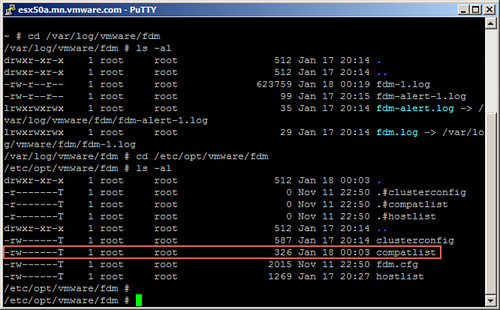
How does HA know which VM belongs to which host with regards to DRS rules? Well that is fairly straight forward. HA keeps track of which VM is compatible with which hosts. This “VM to Host compatibility list” is used for portgroups and datastores but also for DRS rules. Check the screenshot below for a hint…

Mandatory DRS Rules and HA

Please note, this is a very old article about HA, there are tons of new articles on this topic. Just do a search on my blog, or download my ebook freely available via Rubrik.

Thanks!!

Duncan Epping · Jul 13, 2011 ·

** Update: Available now: paperback full |paperback black & white **

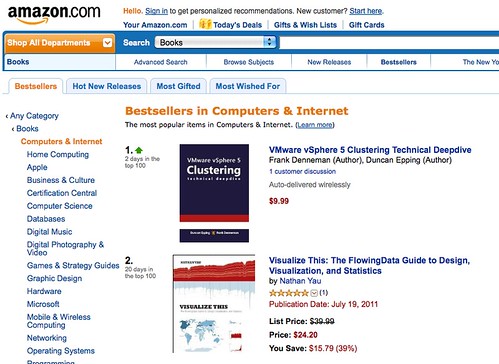
I’ve seen a lot of crazy things, but when I clicked the amazon link for our book yesterday I literally jumped up and started cheering… Number 1 in “Computers & Internet”. These are the kind of things that make it all worth it! PS: We asked amazon/createspace to get the printed copy up asap and they are looking in to it as it should have been ready by now.

Hot of the press: vSphere 5.0 Clustering Technical Deepdive

Duncan Epping · Jul 12, 2011 ·

** Update: Available now: paperback full |paperback black & white **

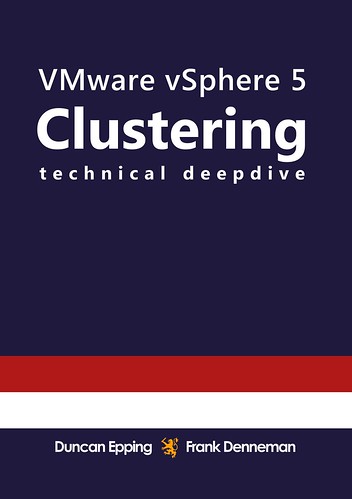
After months of hard work the moment is finally there, the release of our new book: vSphere 5.0 Clustering Technical Deepdive! When we started working, or better said, planning an update of the book we never realized the amount of work required. Be aware that this is not a minor update. This book covers HA (full rewrite as HA has been rewritten for 5.0), DRS (mostly rewritten to focus on resource management) and Storage DRS (new!). Besides these three major pillars we also decided to add what we call supporting deepdives. The supporting deepdives added are: vMotion, Storage vMotion, Storage I/O Control and EVC. This resulted in roughly 50% more content (totaling 348 pages) than the previous book, also worth noting that every single diagram has been recreated and are they cool or what?

Before I will give you the full details I want to thanks a couple of people who have helped us tremendously and without whom this publication would not have been possible. First of all I would like to thank my co-author Frank “Mr Visio” Denneman for all his hard work. Frank and I would also like to thank our VMware management team for supporting us on this project. Doug “VEEAM” Hazelman thanks for writing the foreword! A special thanks goes out to our technical reviewers and editors: Doug Baer, Keith Farkas and Elisha Ziskind (HA Engineering), Anne Holler, Irfan Ahmad and Rajesekar Shanmugam (DRS and SDRS Engineering), Puneet Zaroo (VMkernel scheduling), Ali Mashtizadeh and Gabriel Tarasuk-Levin (vMotion and Storage vMotion Engineering), Doug Fawley and Divya Ranganathan (EVC Engineering). Thanks for keeping us honest and contributing to this book.

As promised in the multiple discussions we had around our 4.1 HA/DRS book we wanted to make sure to offer multiple options straight away. While Frank finalized the printed copy I worked on formatting the ebook. Besides the black&white printed version we are also offering a full color version of the book and a Kindle version. The black&white sells for $ 29.95, the full color for $ 49.95 and the Kindle for an ultra cheap price: $ 9.95. Needless to say that we recommend the Kindle version. It is cheap, full color and portable or should we say virtual… who doesn’t love virtual? On a sidenote, we weren’t planning on doing a black and white release but due to the extremely high production costs of the full color print we decided to offer it as an extra service. Before I give the full description here are the direct links to where you can buy the book. (Please note that Amazon hasn’t listed our book yet, seems like an indexing issue, should be resolved soon hopefully For those who cannot wait to order the printed copy check-out Createspace or Comcol.

Amazon:
eBook (Kindle) – $ 9.99
(price might vary based on location as amazon charges extra for delivery)
Black & White Paper – $ 29.95
Full Color Paper – $ 49.95

Createspace:
Black & White Paper – 29.95
Full Color Paper – 49.95

For the EMEA folks comcol.nl offered to distribute it again, paper black & white can be found here, and full color here.

VMware vSphere 5.0 Clustering Technical Deepdive zooms in on three key components of every VMware based infrastructure and is by no means a “how to” guide. It covers the basic steps needed to create a vSphere HA and DRS cluster and to implement Storage DRS. Even more important, it explains the concepts and mechanisms behind HA, DRS and Storage DRS which will enable you to make well educated decisions. This book will take you in to the trenches of HA, DRS and Storage DRS and will give you the tools to understand and implement e.g. HA admission control policies, DRS resource pools, Datastore Clusters and resource allocation settings. On top of that each section contains basic design principles that can be used for designing, implementing or improving VMware infrastructures and fundamental supporting features like vMotion, Storage I/O Control and much more are described in detail for the very first time.

This book is also the ultimate guide to be prepared for any HA, DRS or Storage DRS related question or case study that might be presented during VMware VCDX, VCP and or VCAP exams.

Coverage includes:
– HA node types
– HA isolation detection and response
– HA admission control
– VM Monitoring
– HA and DRS integration
– DRS imbalance algorithm
– Resource Pools
– Impact of reservations and limits
– CPU Resource Scheduling
– Memory Scheduler
– DPM
– Datastore Clusters
– Storage DRS algorithm
– Influencing SDRS recommendations

Be prepared to dive deep!

Pick it up, leave a comment and of course feel free to make those great mugshots again and ping them over via Facebook or our Twitter accounts! For those looking to buy in bulk (> 20) contact clusteringdeepdive@gmail.com.

sneak peek of the upcoming vSphere Clustering book

Duncan Epping · Jun 10, 2011 ·

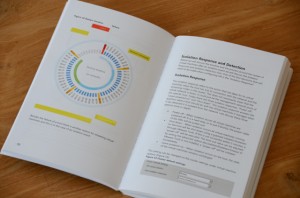
For those who are not following Frank’s blog, he just posted a sneak peek of the upcoming vSphere Clustering book. It looks really really slick in full color. I promise you won’t be disappointed. Go to Frank’s article for more details.

  • « Go to Previous Page
  • Page 1
  • Interim pages omitted …
  • Page 9
  • Page 10
  • Page 11
  • Page 12
  • Page 13
  • Interim pages omitted …
  • Page 19
  • Go to Next Page »

Primary Sidebar

About the Author

Duncan Epping is a Chief Technologist and Distinguished Engineering Architect at Broadcom. Besides writing on Yellow-Bricks, Duncan is the co-author of the vSAN Deep Dive and the vSphere Clustering Deep Dive book series. Duncan is also the host of the Unexplored Territory Podcast.

Follow Us

  • X
  • Spotify
  • RSS Feed
  • LinkedIn

Recommended Book(s)

Also visit!

For the Dutch-speaking audience, make sure to visit RunNerd.nl to follow my running adventure, read shoe/gear/race reviews, and more!

Do you like Hardcore-Punk music? Follow my Spotify Playlist!

Do you like 80s music? I got you covered!

Copyright Yellow-Bricks.com © 2026 ยท Log in