• Skip to primary navigation
  • Skip to main content
  • Skip to primary sidebar

Yellow Bricks

by Duncan Epping

  • Home
  • Unexplored Territory Podcast
  • HA Deepdive
  • ESXTOP
  • Stickers/Shirts
  • Privacy Policy
  • About
  • Show Search
Hide Search

4.1

Did you know? vCloud Director Reservation Pool allocation model fact

Duncan Epping · Dec 15, 2010 ·

I did not know about this, but someone pointed this out last week and I figured it was worth blogging about as this feature can potentially impact your design. (Think HA admission control policies and resource management)

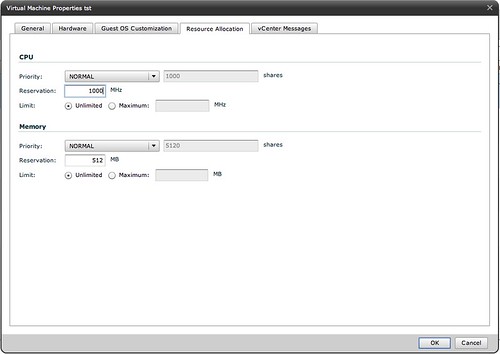
When you create a VM in an Org vDC which is defined as a Reservation Pool you can actually manually set the shares per type of resource (memory and CPU) and also set a reservation and even a limit if and when needed. Pretty cool, but as you can imagine also very complex at some point to figure out to what it should be set.
Shares set on Resource Pools

Duncan Epping · Dec 14, 2010 ·

During our session at the Dutch VMUG Frank was explaining Resource Pools and the impact of limits and reservations. As I had the feeling not everyone in the room was using resource pools I asked the following questions:

  1. How many people are using Resource Pools today?
    • Out of the roughly 300 people who attended our session 80 showed their hands. The follow-up question I asked was…
  2. How many people change the Shares setting from the default?
    • Out of those 80 hands roughly 20 people raised their hands and that lead me to the next question…
  3. How many people change the Shares value based on the amount of VMs running in that Resource Pool?
    • Now only a handful of people raised their hand.

That is what triggered this post as I believe it is an often made mistake. First of all when you create a Resource Pool there are a couple of things you can set a reservation, a limit and of course shares. For some reason shares are often overlooked. There are a couple of things I wanted to make sure everyone understands as judging by the numbers of hands that were raised I am certain there are a couple of common misunderstandings when it comes to Resource Pools:

  • If you create a Resource Pool a default Shares value is defined for the resource pool on both Memory and CPU
  • Shares specify the priority of the resource pool relative to other resource pools on the same level

This means that even if you don’t touch the shares values they will come into play whenever there is contention. This also means that the resource allocation on a VM level is dependent on the entitlement of the resource pool it belongs to.

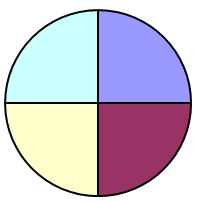
Now what is the impact of that? I guess I should quote from the “The Resource Pool Priority-Pie Paradox” blog post my colleague Craig Risinger wrote as it clearly demonstrates the issues that can be encountered when Resource Pools are used and Shares values are not based on the relative priority AND the amount of VMs per pool.

“Test” 1000 shares, 4 VMs => 250 units per VM (small pie, a few big slices):

“Production” 4000 shares, 50 VMs => 80 units per VM (bigger pie, many small slices):

I guess this makes it really obvious that shares might not always give you the results you expected it would.

Another issue that could arise is when Virtual Machines are created on the same level as the Resource Pools…. Believe me it doesn’t take a lot for a single VM to have higher priority than a Resource Pool in times of contention.

Again, whenever you create a Resource Pool it will “inherit” the default shares value, which equals a 4vCPU/16GB Virtual Machine, and whenever there is contention these will come into play. Keep this in mind when designing your virtual infrastructure as it could potentially lead to unwanted results.

VMware HA Deployment Best Practices

Duncan Epping · Dec 13, 2010 ·

Last week VMware officially released an official paper around Deployment Best Practices for HA. I was one of the authors of the document. Together with several people from the Technical Marketing Team we gathered all best practices that we could find, validated and simplified them to make it rock solid. I think it is a good read. It is short and sweet and I hope you will enjoy it.

Latest Revision:
Dec 9, 2010

Download:
http://www.vmware.com/files/pdf/techpaper/VMW-Server-WP-BestPractices.pdf

Description

This paper describes best practices and guidance for properly deploying VMware HA in VMware vSphere 4.1.  These include discussions on proper network and storage design, and recommendations on settings for host isolation response and admission control.

European distributor for the HA and DRS Technical Deepdive

Duncan Epping · Dec 10, 2010 ·

Frank published the following yesterday, but as many people have asked me about this I thought I would post it as well. For those who were looking for a European distributor of our book:

As of today, our book “vSphere 4.1 HA and DRS Technical Deepdive” can be ordered via ComputerCollectief. Computercollectief is a dutch computer book and software reseller and ships to most European countries. Using Computercollectief, we hope to evade the long shipping times and accompanying costs.

Go check it out. http://www.comcol.nl/detail/73133.htm

Comcol expects to be able to deliver at the end of this month.

HA without DRS?

Duncan Epping · Dec 8, 2010 ·

I had question on my HA Deepdive which I thought was worth answering in an article:

How does the active primary node decide where to restart failed VMs? Does it use a round-robin algorithm for selecting a host to start the VMs in restart priority order? What happens if the remaining nodes are imbalanced, especially without DRS enabled; are the nodes that have no spare capacity skipped? Or, does the active primary node restart VMs on the least busy host first, then the next busy host, etc?

Also, if VMs have no reservation for CPU or memory set, how does HA decide the number of VMs to restart on any one node? Is it possible that HA will restart too many VMs on one node so that performance is extremely poor until DRS move some VMs to other nodes?

In the past HA(pre 4.1) would consider the utilization of the Hosts and go through a check for every VM that needs to failover. It would fail the VM over the host with the most amount of available resources. Now from a “latency” perspective that is not the best approach as you can imagine. With latency meaning the time it takes to restart the VMs and the delay caused by hostd. Now type of delay can be cause by hostd? Well lets assume you have 1 host which is not doing a lot, this host would be the host that is selected for most failovers. Having 10 VMs (or more) starting in parallel will beat hostd severely.

So does HA use DRS to select which host to use for the restart? No it won’t, DRS happens on a vCenter level and HA happens on a host level…. But more things have changed. As of vSphere 4.1 virtual machines will be evenly distributed across hosts to lighten the load on the hostd service and to get quicker power-on results. HA then relies on DRS to redistribute the load later if required. This improvement results in faster restarts of the virtual machines and less stress on the ESX hosts.

So what if you are not using DRS? To put it bluntly, make sure you manual balance your environment to ensure HA doesn’t “overload” a single host… that is the only thing you can do for now. (by the way, all of this is included in the HA and DRS tech deepdive :-))

  • « Go to Previous Page
  • Page 1
  • Interim pages omitted …
  • Page 11
  • Page 12
  • Page 13
  • Page 14
  • Page 15
  • Interim pages omitted …
  • Page 20
  • Go to Next Page »

Primary Sidebar

About the Author

Duncan Epping is a Chief Technologist and Distinguished Engineering Architect at Broadcom. Besides writing on Yellow-Bricks, Duncan is the co-author of the vSAN Deep Dive and the vSphere Clustering Deep Dive book series. Duncan is also the host of the Unexplored Territory Podcast.

Follow Us

  • X
  • Spotify
  • RSS Feed
  • LinkedIn

Recommended Book(s)

Advertisements


Copyright Yellow-Bricks.com © 2025 · Log in