• Skip to primary navigation
  • Skip to main content
  • Skip to primary sidebar

Yellow Bricks

by Duncan Epping

  • Home
  • Unexplored Territory Podcast
  • HA Deepdive
  • ESXTOP
  • Stickers/Shirts
  • Privacy Policy
  • About
  • Show Search
Hide Search

Various

Startup News Flash part 3

Duncan Epping · Aug 20, 2013 ·

Who knew so quickly after part 1 and part 2 there would be a part 3, I guess not strange considering VMworld is coming up soon and there was a Flash Memory Summit last week. It seems that there is a battle going on in the land of the AFA’s (all flash arrays), it isn’t about features / data services as one would expect. No they are battling over capacity density aka how many TBs can I cram in to a single U, not sure how relevant this is going to be over time, yes it is nice to have dense configurations, yes it is awesome to have a billion IOps in 1U but most of all I am worried about availability and integrity of my data.  So instead of going all out on density, how about going all out on data services? Not that I am saying density isn’t useful, it is just… Anyway, I digress…

One of the companies which presented at Flash Memory Summit was Skyera. Skyera announced an interesting new product called skyEagle. Another all-flash array is what I can hear many of you thinking, and yes I thought exactly the same… but skyEagle is special compared to others. This 1u box manages to provide 500TB of flash capacity, now that is 500TB of raw capacity. So just imagine what that could end up being after Skyera’s hardware-accelerated data compression and data de-duplication has done its magic. Pricing wise? Skyera has set a list price for the read-optimized half petabyte (500 TB) skyEagle storage system of $1.99 per GB, or $.49 per GB with data reduction technologies. More specs can be found here. Also, I enjoyed reading this article on The Register which broke the news…

David Flynn (Former Fusion-io CEO) and Rick White (Fusion-io founder) started a new company called Primary Data. The WallStreet Journal reported on this and more or less revealed what they will be working on:”that essentially connects all those pools of data together, offering what Flynn calls a “unified file directory namespace” visible to all servers in company computer rooms–as well as those “in the cloud” that might be operatd by external service companies.” This kind of reminds me of Aetherstore, or at least the description aligns with what Aetherstore is doing. Definitely a company worth tracking if you ask me.

One of the companies I did an introduction post on is Simplivity. I liked their approach to converged as it not only combines just compute and storage, but they also included backup, replication, snapshots, dedupe and cloud integration. They announced this week an update on their Omnicube CN-3000 platform and introduced two new platforms Omnicube CN-2000 and the Omnicube CN-5000. So what are these two new Omnicubes? Basically the CN-5000 is the big brother of the CN-3000 and the CN-2000 is its kid brother. I can understand why they introduced these as it will help expanding the target audience, “one size fits all” doesn’t work when the cost for “all” is the same and so the TCO/ROI changes based on your actual requirements, but in a negative way. One of the features that made SimpliVity unique that has had a major update is the OmniStack Accelerator, this is a custom designed PCIe card that does inline dedupe and compression. Basically an offload mechanism for dedupe and compression where others are leveraging the server CPU. Another nice thing SimpliVity added is support for VAAI. If you are interested in getting to know more, two white papers were released which are interesting to read: a deep dive by Hans de Leenheer and Stephen Foskett and one with a focus on “data management” by Howard Marks.

A bit older announcement, but as I spoke with these folks this week and they demoed their GA product I figured I would add them to the list. Ravello Systems developed a cloud hypervisor which abstracts your virtualization layer and allows you to move virtual machines / vApps between clouds (private and public) without the need to rebuild your virtual machines or guest OS’s. What I am saying is that they can move your vApps from vSphere to AWS to Rackspace without painful conversions every time. Pretty neat right? On top of that, Ravello is your single point of contact meaning that they are also a cloud broker. You pay Ravello and they will take care of AWS / RackSpace etc. of course they allow you to do stuff like snapshotting, cloning and create complex network configurations if needed. They managed to impress me during the short call we had, and if you want to know more I recommend reading this excellent article by William Lam or visit their booth during VMworld!

That is it for part 3, I bet I will have another part next week during or right after VMworld as press releases are coming in every hour at this point. Thanks for reading,
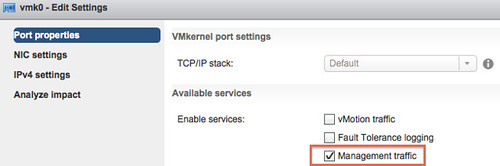
ESXi “Management traffic” tickbox, what does it do?

Duncan Epping · Aug 14, 2013 ·

I have seen this popping up various times over the last few years. That little tickbox on your VMkernel NIC that says “Management traffic” (aka management network) what is it for? What if I untick it, will SSH to that VMkernel still work? Will the HA heartbeat still work? Can I still ping the VMkernel NIC? Those are all questions I have had in the past, and I can understand why… I would say that the term “Management traffic” is really really poorly chosen, but why?

The feature described as “Management traffic” does nothing more than enabling that VMkernel NIC for HA heartbeat traffic. Yes that is it. Even if you disable this feature, management traffic, you can still use the VMkernel’s associated IP address for adding it to vCenter Server. You can still SSH that VMkernel associated IP address if you have SSH enabled. So keep that in mind.

Yes I fully agree, very confusing but there you have it: the “management traffic” enables the HA heartbeat network, nothing more and nothing less.

Startup News Flash part 2

Duncan Epping · Aug 13, 2013 ·

First part of the Startup News Flash was published a couple of weeks ago, and as many things have happened I figured I would publish another. At times I guess I will miss out on a news fact or a new company, if that happens don’t hesitate to leave a comment with your findings/opinion or just a link to what you feel is newsworthy! As mentioned in part 1 the primary focus of this article is Startup news / Flash related news. As you can see most flash related except for one.

Nimbus Data launched two brand new arrays: Gemini F400 / F600 arrays. These are all flash arrays, and bring something unique to the table for sure… and that is costs: price per useable gigabyte is $0.78. Yes, that is low indeed. How do they bring it down? Well of course by very efficient deduplication and compression. On top of that, by leveraging standard hardware and getting all smarts from software the price can be kept low. According to the press release these new arrays will be able to provide between 3TB and 48TB of capacity (I almost said disk space there…) and will be shipping end of this year! Although Nimbus declared Hybrid Storage officially dead, mainly because of the cost of Nimbus all flash solution (the F400 starts under US$60,000, the F600 starts under US$80,000.), I still think there is a lot of room for growth in that space and many customer will be interested in those solutions. My question yesterday on twitter was to Nimbus which configuration they did the math with to declare hybrid dead, because cost per gigabyte is one thing, the upfront investment to reach that price point is another. It will be interesting to see how they will do the upcoming 12-18 months, but it is needless to say that they will be going after their competition aggressively. Talking about competition….

Last year at VMworld I briefly stopped at the Tegile booth, besides the occasional tweet I kind of lost track until recent as Tegile just announced series C funding… Not pocket money I would say but a serious round, $35 million, led by Meritech Capital Partners and original stakeholder August Capital and strategic partners Western Digital and SanDisk.  For those who don’t know, Tegile is a storage company who sells both a hybrid and an “all-flash” solution and they have done this in an interesting modular fashion (all-flash placed in front of spinning disks = modular hybrid). Of course they also offer functionality like dedupe/compression and replication. Although I haven’t heard too much from them lately it is a booth I will surely stop by at VMworld. Again, there is a lot of competition in this space and it would be interesting to see an “All-flash / Hybrid Storage bake off”. Tegile vs Nimbus, Nimble vs Tintri, Pure Storage vs Violin…

Violin Memory just announced the 6264 flash Memory Array. This new all flash storage system can provide a capacity of 64 TiB/70.3 TB with a footprint of just 3U, and that is impressive if you ask me. On top of that, it can provide up to 1 million IOps and at a ultra low latency! Who doesn’t want to have 1 million IOps to its disposal right? (More specs to be found here.) To me though what was more exciting in this press release was the announcement of a management tool called Symphony. Symphony provides a single pane of glass for all your Violin devices (read more details here.) It provides a smart management interface that allows you to create custom dashboard, comprehensive reporting, tagging and filtering and of course they provide a RESTful API for you admins out there who love to automate things. Nice announcement from Violin Memory, and those already running Violin hardware I would definitely recommend evaluating Symphony as the video looks promising.

CloudPhysics just announced the Card Store is GA as of today (13th August 2013) and a new round of funding ($ 10 million) led by Kleiner Perkins Caufield & Byers. Previous investors the Mayfield Fund, Mark Leslie, Peter Wagner, Carl Waldspurger, Nigel Stokes, Matt Ocko and VMware co-founders also participated in this round. I would say an exciting day for CloudPhysics. Many have asked over the last year why have I always been enthusiastic about what they do? I think John Blumenthal (CEO) explains it best:

Our servers receive a daily stream of 80+ billion samples of configuration, performance, failure and event data from our global user base with a total of 20+ trillion data points to date. This ‘collective intelligence,’ combined with CloudPhysics’ patent-pending datacenter simulation and unique resource management techniques, empowers enterprise IT to drive Google-like operations excellence using actionable analytics from a large, relevant, continually refreshed data set.

If you are interested in testing their solution, sign up for a free trial  at cloudphysics.com. Pricing starts at $49/month per physical server, more details here. For those wondering what CloudPhysics has to do with flash, well they’ve got a card for that!

That was it for Part 2, hope you found it a useful round-up and I will expect to be able to publish another startup news flash within 2 weeks!


Vendors to check out at VMworld

Duncan Epping · Aug 2, 2013 ·

Cormac just released his article about storage vendors to check out at VMworld, right when I was typing up this article. Make sure to read that one as well as it contains some great suggestions… I was looking at the list of vendors who have a booth at VMworld, there are a whole bunch I am going to try to check out this round. Of course some of the obvious ones are my friends over at Tintri, Nutanix and Pure Storage but lets try to list a few lesser known vendors. These are not all storage vendors by the way, but a mix of various types of startups from the VMware ecosystem. I have added my own oneliner to it, so you know what to expect.

  • Actifio – Business Continuity / Disaster Recovery solution that seems to be gaining traction, maybe I should say “Copy Data Management” solution instead, as that is ultimately what it is they do.
  • CloudPhysics – Monitoring / Analytics, the power of many! Or as I stated a while back: Where most monitoring solutions stop CloudPhysics continues.
  • Cumulus Networks – Linux Network Operating System is how they describe themselves, decoupling software from hardware is another way of looking at it… interesting company!
  • Infinio – Downloadable NFS performance enhancer! AKA memory caching solutions for NFS based infrastructures, check the intro article I wrote a while back…
  • Maxta – Software Defined Storage solution, virtual appliance based and hypervisor agnostic… Not spoken with them, or seen their solution yet
  • Panzura – A name that keeps popping up more and more often, a global distributed cloud storage solution. Haven’t dug in to it yet, but when I get the chance at VMworld I will…
  • PernixData – Came out of stealth this year, and as you all know is working on a write back flash caching solution… One of the few offering a clustered write back solution within the hypervisor
  • Plexxi – Networking done in a different way, SDN I would say.
  • SolidFire – SolidFire is definitely one cool scale-out storage solution to watch out for, one of the few which actually has a good answer to the question: do you offer Quality of Service? More details about what it is they do here… Not on the show floor, but outside of the expo.

Just a couple of companies which I feel are interesting and worth talking with.

Hardening recommendation to set limits on VMs or Resource Pools?

Duncan Epping · Jul 25, 2013 ·

I received this question last week about a recommendation which was in the vSphere 5.1 Hardening Guide. The recommendation in the vSphere 5.1 Hardening Guide is the following:

By default, all virtual machines on an ESXi host share the resources equally. By using the resource management capabilities of ESXi, such as shares and limits, you can control the server resources that a virtual machine consumes.  You can use this mechanism to prevent a denial of service that causes one virtual machine to consume so much of the host’s resources that other virtual machines on the same host cannot perform their intended functions.

Now it might be just me but I don’t get the recommendation and my answer to this customer was as follows:
Virtual machines can never use more CPU/Memory resources then provisioned. For instance, when 4GB of memory is provisioned for a virtual machine the Guest OS of that VM will never consume more than 4GB. Same applies to CPU, if a VM has a single vCPU than that VM can never consume more than a single core of a CPU.

So how do I limit my VM? First of all: right sizing! If your VM needs 4GB then don’t provision it with 12GB as it some point it will consume it. Secondly: shares. Shares are the easiest way to ensure that the “noisy neighbor” isn’t pushing away the other virtual machines. By even leaving the shares set to default you can ensure that at least all “alike VMs” have more or less the same priority when it comes to resources. So what about limits?

Try to avoid (VM Level) limits at all times! Why? Well look at memory for a second, lets say you provision your VM with 4GB and limit it to 4GB and now someone changes the memory to 8GB but forgets to change the limit. So what happens? Well your VM uses up the 4GB and moves in to “extra 4GB” but the limit is there, so you the VM will experience memory pressure and you will see ballooning / swapping etc. Not a scenario you want to find yourself in right, indeed! What about CPU then? Well again, it is a hard limit in ALL scenarios. So if you set a 1GHz scenario but have a 2.3GHz CPU, your VM will not consume the 2.3GHz ever…. A waste? Yes it is. And not just VM level limits, there is also an operational impact with resource pool limits.

I can understand what the hardening guide is suggesting, but believe me you don’t want to go there. So let it be clear, AVOID using limits at all times!

  • « Go to Previous Page
  • Page 1
  • Interim pages omitted …
  • Page 34
  • Page 35
  • Page 36
  • Page 37
  • Page 38
  • Interim pages omitted …
  • Page 127
  • Go to Next Page »

Primary Sidebar

About the Author

Duncan Epping is a Chief Technologist and Distinguished Engineering Architect at Broadcom. Besides writing on Yellow-Bricks, Duncan is the co-author of the vSAN Deep Dive and the vSphere Clustering Deep Dive book series. Duncan is also the host of the Unexplored Territory Podcast.

Follow Us

  • X
  • Spotify
  • RSS Feed
  • LinkedIn

Recommended Book(s)

Also visit!

For the Dutch-speaking audience, make sure to visit RunNerd.nl to follow my running adventure, read shoe/gear/race reviews, and more!

Do you like Hardcore-Punk music? Follow my Spotify Playlist!

Do you like 80s music? I got you covered!

Copyright Yellow-Bricks.com © 2026 · Log in