• Skip to primary navigation
  • Skip to main content
  • Skip to primary sidebar

Yellow Bricks

by Duncan Epping

  • Home
  • Unexplored Territory Podcast
  • HA Deepdive
  • ESXTOP
  • Stickers/Shirts
  • Privacy Policy
  • About
  • Show Search
Hide Search

software defined

Install and configure Virsto

Duncan Epping · Apr 23, 2013 ·

Last week I was in Palo Alto and I had a discussion about Virsto. Based on that discussion I figured it was time to setup Virsto in my Lab. I am not going to go in to much details around what Virsto is or does as I already did that in this article around the time VMware acquired Virsto. On top of that there is an excellent article by Cormac which provides an awesome primer. But lets use two quotes from both of the articles to give an idea of what to expect:

source: yellow-bricks.com
Virsto has developed an appliance and a host level service which together forms an abstraction layer for existing storage devices. In other words, storage devices are connected directly to the Virsto appliance and Virsto aggregates these devices in to a large storage pool. This pool is in its turn served up to your environment as an NFS datastore.

source: cormachogan.com
Virsto Software aims to provide the advantages of VMware’s linked clones (single image management, thin provisioning, rapid creation) but deliver better performance than EZT VMDKs.

Just to give an idea, what do I have running in my lab?

  • 3 x ESX 5.1 host
  • 1 x vCenter Server (Windows install as VCVA isn’t supported_
  • VNX 5500

After quickly glancing the quickstart guide I noticed I needed a Windows VM to install some of Virsto’s components, that VM is what Virsto refers to as the “vMaster”. I also need a bunch of empty LUNs which will be used for storage. I also noticed reference of Namespace VMs and vIOService VMs. Hmmm, it sounds complicated, but is it? I am guessing these components will need to be connected. This is kind of the idea, note that the empty LUNs will be automatically connected by to the IOService VMs. I did not add those to the diagram as that would make it more complex than needed.
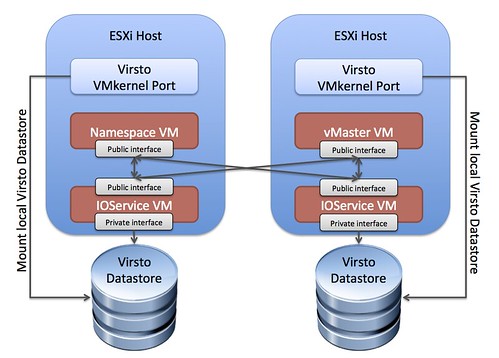
Virsto Network Architecture Diagram

[Read more…] about Install and configure Virsto

Software Defined Storage; just some random thoughts

Duncan Epping · Apr 5, 2013 ·

I have been reading many articles over the last weeks on Software Defined Storage and wrote an article on this topic a couple of weeks ago. While reading up one thing that stood out was that every single storage/flash vendor out there  has jumped on the bandwagon and (ab)uses this term where ever and when ever possible. In most of those cases however the term isn’t backed by SDS enabling technology or even a strategy, but lets not get in to the finger pointing contest as I think my friends who work for storage vendors are more effective at that.

The article which triggered me to write this article was released a week and a half a go by CRN. The article was a good read, so don’t expect me to tear it down. The article just had me thinking about various things, and what better way to clear your head then to write an article about it. Lets start with the following quote:

While startups and smaller software-focused vendors are quick to define software-defined storage as a way to replace legacy storage hardware with commodity servers, disk drives and flash storage, large storage vendors are not giving ground in terms of the value their hardware offers as storage functionality moves toward the software layer.

Let me also pull out this comment by Keith Norbie in the same article, as I think Keith hit the nail on the head:

Norbie said to think of the software-defined data center as a Logitech Harmony remote which, when used with a home theater system, controls everything with the press of a button.

If you take a look at how Keith’s quote relates to Software Defined Storage it would mean that you should be able to define EVERYTHING via software. Just like you can simply program the Logitech Harmony remote to work with all your devices; you should be able to configure your platform in such a way that spinning up new storage objects can be done by the touch of one button! Now getting back to the first quote, whether functionality moves out of a storage system to a management tool or even to the platform is irrelevant if you ask me. If your storage system has an API and it is allows you to do everything programmatically you are half way there.

I understand that many of the startups like to make potential customers believe different, but the opportunity is there for everyone if you ask me. Yes that includes old-timers like EMC / NetApp / IBM (etc) and their “legacy” arrays. (As some of the startups like to label them.) Again, don’t get me wrong… playing in the SDS space will require significant changes to most storage platforms as most were never architected for this usecase. Most are currently not capable of creating thousands of new objects programmatically. Many don’t even have a public API.

However, what is missing today is not just a public API on most storage systems, it is also the platform which doesn’t allow you to efficiently manage these storage systems through those APIs. When I say platform I refer to vSphere, but I guess the same applies to Hyper-V, KVM, Xen etc. Although various sub-components are already there like the vSphere APIs for Array Integration (VAAI) and the vSphere APIs for Storage Awareness (VASA), there are also still a lot capabilities missing. A good example would be defining and setting specific data-services on a virtual disk level granularity, or end to end Quality of Service for virtual disks or virtual machines, or automatic instantiation of storage objects during virtual machine provisioning without manual action required from your storage admin. Of course, all of this from a single management console…

If you look at VMware vSphere and what is being worked on in the future you know those capabilities will come at some point, in this case I am referring to what was previewed at VMworld as “virtual volumes” (sometime also referred to as VVOLs), but this will take time… Yes I know some storage vendors already offer some of this granularity (primarily the startups out there), but can you define/set this from your favorite virtual infrastructure management solution during the provisioning of a new workload? Or do you need to use various tools to get the job done? If you can define QoS on a per VM basis, is this end-to-end? What about availability / disaster recovery, do they offer a full solution for that? If so, is it possible to simply integrate this with other solutions like for instance Site Recovery Manager?

I think exciting times are ahead of us; but lets all be realistic… they are ahead of us. There is no “Logitech Harmony” experience yet, but I am sure we will get there in the (near) future.

Software Defined Datacenter Roadshow – Benelux – Free Event!

Duncan Epping · Feb 6, 2013 ·

Would like to hear more about Software Defined Datacenters from experts like Frank Denneman, Mike Laverick, Cormac Hogan, Kamau Wanguhu and many others? VMware and IBM are organizing an awesome event in the Benelux. Yes this is a full day event, and it is free for everyone, if you just want to sign up… go here. If you need to be convinced keep reading as there are some awesome sessions scheduled.

Agenda
09.00 - 09.30 Registration
09.30 - 09.45 Welcome
09.45 - 10.30 Keynote VMware: Software-Defined Data Center
10.30 - 11.15 Keynote IBM: Converged Systems: beyond NextGen DC’s
11.15 - 11.30 Break and split into parallel sessions
11.30 - 12.15 Parallel track 1 or meet the expert
12.15 - 13.00 Lunch
13.00 - 13.45 Parallel track 2 or meet the expert
14.00 - 14.45 Parallel track 3 or meet the expert
15.00 - 15.45 Parallel track 4 or meet the expert
16.00 - 16.45 Parallel track 5 or meet the expert
16.45 - 17.30 Networking drink

The awesome part is that at this event you will also have the ability to sit down with one of the experts for a 1:1 discussion and get your questions answered. Below is the list of people you can sit down with, make sure to register for that!

VMware
Frank Denneman – Resource Management Expert
Cormac Hogan – Storage Expert
Kamau Wanguhu – Software Defined Networking Expert
Mike Laverick – Cloud Infrastructure Expert
Ton Hermes – End User Computing Expert

IBM
Tikiri Wanduragala – IBM PureSystems Expert
Dennis Lauwers – Converged Systems Expert
Geordy Korte – Software Defined Networking Expert
Andreas Groth – End User Computing Expert

So if you live in The Netherlands, Belgium or Luxemburg… make sure to sign up. As mentioned, it is a free event. And with people like Cormac Hogan, Frank Denneman, Mike Laverick and Kamau Wanguhu you know it is going to get deep technical.

  • 5th March – Amsterdam
  • 7th March – Brussels
  • 8th March – Luxemburg

–> Sign up now <–

  • « Go to Previous Page
  • Page 1
  • Page 2
  • Page 3

Primary Sidebar

About the Author

Duncan Epping is a Chief Technologist and Distinguished Engineering Architect at Broadcom. Besides writing on Yellow-Bricks, Duncan is the co-author of the vSAN Deep Dive and the vSphere Clustering Deep Dive book series. Duncan is also the host of the Unexplored Territory Podcast.

Follow Us

  • X
  • Spotify
  • RSS Feed
  • LinkedIn

Recommended Book(s)

Also visit!

For the Dutch-speaking audience, make sure to visit RunNerd.nl to follow my running adventure, read shoe/gear/race reviews, and more!

Do you like Hardcore-Punk music? Follow my Spotify Playlist!

Do you like 80s music? I got you covered!

Copyright Yellow-Bricks.com © 2026 · Log in