• Skip to primary navigation
  • Skip to main content
  • Skip to primary sidebar

Yellow Bricks

by Duncan Epping

  • Home
  • Unexplored Territory Podcast
  • HA Deepdive
  • ESXTOP
  • Stickers/Shirts
  • Privacy Policy
  • About
  • Show Search
Hide Search

Archives for 2009

Update to several SRM SRA’s

Duncan Epping · Mar 19, 2009 ·

Just noticed that several Storage Replication Adapter’s(SRA) have been updated over the last couple of weeks. For those using one of these specific SRA’s it might be beneficial to update:

  1. EMC RecoverPoint 3.1 Storage Replication Adapter
    Version 1.0.2.1 | Released 03/17/2009
  2. Storage Array Adapter for IBM N-Series
    Version 1.0.1 | Released 03/18/2009
  3. IBM DS4000 / DS5000 Series Storage Replication Adapter
    Version 01.00.35.12 | Released 03/06/2009
  4. NetApp Storage Replication Adapter
    Version 1.0.1 | Released 03/06/2009
  5. HP EVA Storage Replication Adapter
    Version 1.0.1 | Released 02/11/2009
  6. IBM DS8000 Storage Replication Adapter
    Version 1.0.0 | Released 02/13/2009
  7. IBM SVC Storage Replication Adapter
    Version 1.0 | Released 02/13/2009
  8. XP XP Storage Replication Adapter
    Version 1.00.05 | Released 02/02/2009
iSCSI multipathing with esxcli! Exploring the next version of ESX

Duncan Epping · Mar 18, 2009 ·

In the “Multivendor post to iSCSI” article by Chad Sakac and others(Netapp, EMC, Dell, HP, VMware) a new multi-pathing method for iSCSI on the next version of ESX(vSphere) had already been revealed. Read the full article for in depth information on how this works in the current version and how it will work in the next version. I guess the following section sums it:

Now, this behavior will be changing in the next major VMware release. Among other improvements, the iSCSI initiator will be able to use multiple iSCSI sessions (hence multiple TCP connections).

I was wondering how to set this up and it’s actually quite easy. You need to follow the normal guidelines for configuring iSCSI. But instead of binding two nics to one VMkernel you create two(or more) VMkernels with a 1:1 connection to a nic. Make sure that the VMkernels only have 1 active nic. All other nics must be moved down to “Unused Adapters”. Within vCenter it will turn up like this: [Read more…] about iSCSI multipathing with esxcli! Exploring the next version of ESX

SRM and vCenter 2.5 U4

Duncan Epping · Mar 17, 2009 ·

FYI: The Site Recovery Manager compatibility guide has just been updated. As of the 16th of march vCenter 2.5 U4 is supported for SRM 1.0 update 1.

Upgrading ESX 3.5 to the next version with Update Manager

Duncan Epping · Mar 17, 2009 ·

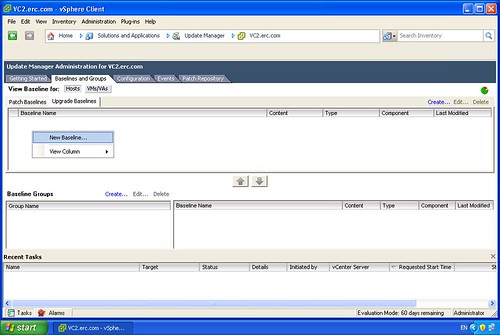
In my Lab I was exploring the upgrade possibilities from ESX 3.5 to the next version.  Usually I do a full reinstall just to be absolutely sure there’s no old packages floating around. For testing purposes I decided to do an upgrade of the ESX host. I opened up Update Manager and with a couple simple clicks I upgraded my host to the next version. (I did an upgrade of vCenter and Update Manager before I even started.) I removed a couple of screenshots that didn’t contain much useful info, in total it were 15 steps to create a baseline and update the host:

Create a new Baseline:

[Read more…] about Upgrading ESX 3.5 to the next version with Update Manager

Whitepaper: Performance Evaluation of AMD RVI Hardware Assist

Duncan Epping · Mar 17, 2009 ·

I recently discussed the effect of RVI/Virtualized MMU on Transparent page Sharing, and just 5 days later VMware published this extensive PDF:”Performance Evaluation of AMD RVI Hardware Assist“.

AMD recently introduced its second generation of hardware support for virtualization, incorporating MMU virtualization called Rapid Virtualization Indexing (RVI). Hardware support for MMU virtualization can improve performance, particularly for MMU-intensive workloads.

VMware ESX 3.5 leverages this RVI support in AMD processors. This paper compares the performance with and without RVI of a number of industry-standard benchmarks and microbenchmarks running in VMware ESX 3.5, Update 2 on AMD Opteron 8384 (“Shanghai”) processors.

Read the PDF for more indepth info, but I think the most important bit is:”The improvement provided by RVI increases with larger numbers of vCPUs; in the four vCPU case RVI performed 42% better than BT.” And that’s just for one of the benchmarks. If you’ve got an AMD processor or Intel Processor that supports virtualized MMU, be sure to do a benchmark and it probably will be beneficial to turn it on.

  • « Go to Previous Page
  • Page 1
  • Interim pages omitted …
  • Page 58
  • Page 59
  • Page 60
  • Page 61
  • Page 62
  • Interim pages omitted …
  • Page 85
  • Go to Next Page »

Primary Sidebar

About the Author

Duncan Epping is a Chief Technologist and Distinguished Engineering Architect at Broadcom. Besides writing on Yellow-Bricks, Duncan is the co-author of the vSAN Deep Dive and the vSphere Clustering Deep Dive book series. Duncan is also the host of the Unexplored Territory Podcast.

Follow Us

  • X
  • Spotify
  • RSS Feed
  • LinkedIn

Recommended Book(s)

Also visit!

For the Dutch-speaking audience, make sure to visit RunNerd.nl to follow my running adventure, read shoe/gear/race reviews, and more!

Do you like Hardcore-Punk music? Follow my Spotify Playlist!

Do you like 80s music? I got you covered!

Copyright Yellow-Bricks.com © 2026 · Log in